


How well do you really understand origin verification—and could misconceptions be putting your business at risk?
Origin verification is a cornerstone of international trade, ensuring regulatory compliance and optimizing costs. However, despite its importance, many misconceptions persist—leading companies to make poor decisions and exposing them to financial and legal risks.
Prodensa has partnered with international trade experts to provide valuable analysis and practical insights into origin verification, helping organizations understand the importance of accurate compliance and proactive strategies—especially relevant for those pursuing nearshoring or exploring shelter services in Mexico.
We would like to thank Adrián González, President of Global Alliance Solutions, for his valuable participation and collaboration. For companies pursuing turnkey operations in Mexico, understanding origin rules is a vital step in planning and executing a compliant cost-efficient setup.
Self-Certification and Supplier Trust: Hidden Risks in Rules of Origin Compliance
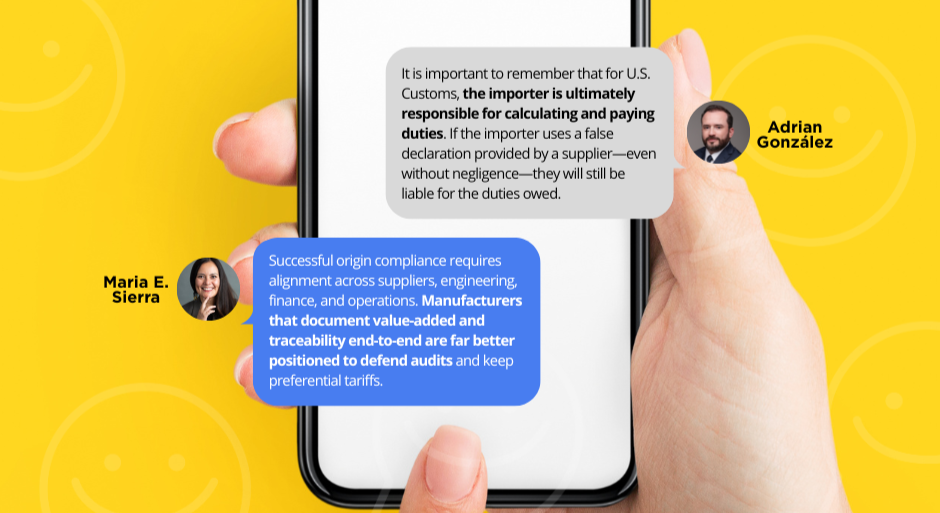
One of the most widespread misconceptions is believing that self-certification of origin or simply trusting supplier declarations is enough to guarantee compliance. While self-certification is a valid tool under many trade agreements, it does not absolve the importing company of its ultimate responsibility for the accuracy of the declared information. This misconception has caused numerous companies to face hefty fines and retroactive duty adjustments.
In reality, self-certification—such as the Certificate of Origin under the United States-Mexico-Canada Agreement (USMCA)—shifts the burden of proof to the importer. In an audit, customs authorities will require documentary evidence to support the origin claim, not just the supplier’s certification. Relying solely on a supplier’s statement without conducting internal due diligence and implementing a robust validation system is a recipe for disaster.
The risks of blind trust in suppliers include:

If the declared origin is found incorrect, the company must pay the duty difference plus interest and possibly surcharges.

In cases of repeated offenses or fraud, customs authorities may revoke permits or deny certain benefits.

A record of non-compliance can harm the company's reputation and hinder future trade operations.

False or incorrect origin declarations can result in substantial fines, either as a percentage of the goods' value or fixed amounts per violation.
It is therefore essential to establish a rigorous supplier origin validation process, including requesting supporting documentation (material declarations, manufacturing processes, etc.), conducting site visits when possible, and maintaining constant communication to ensure they understand and comply with applicable rules of origin.
Why Certificates of Origin Don’t Guarantee Customs Acceptance
The idea that a certificate of origin is a “blank check” guaranteeing automatic acceptance by customs authorities is another dangerous myth. While these documents are essential to request preferential tariff treatment, they are not infallible and are subject to scrutiny.
Authorities such as Mexico’s National Customs Agency (ANAM) or U.S. CBP have the authority to question and verify the validity of any certificate of origin. They do not limit themselves to superficial reviews—they may request additional information, conduct on-site visits, or even audit the company’s accounting and production records.
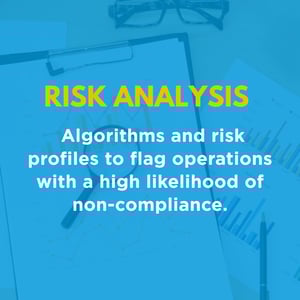
Verification can be triggered by:
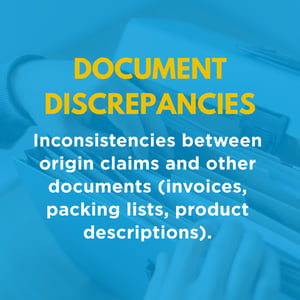


Note: The burden of proof lies with the importer. If origin is questioned, the company must demonstrate compliance with specific rules of origin, which requires robust recordkeeping, detailed production records, and deep knowledge of the applicable rules.
-2.png?width=940&height=436&name=Yellow%20and%20Blue%20Simple%20Message%20%20(1)-2.png)
Preferential Tariffs and Supply Chain Changes: How Small Shifts Impact Compliance
Access to preferential tariffs is a major incentive for accurate origin determination. However, these benefits are directly tied to the supply chain, and any modification can affect eligibility.
A common mistake is assuming that once a product qualifies, it will always qualify. In reality, rules of origin are complex and product-specific. Small changes in sourcing, manufacturing processes, or purchase country can alter origin status.
Examples include:
-
SUPPLIER CHANGE: Switching from a member-country supplier to a non-member supplier may disqualify the product.
-
OUTSOURCING: Contracting production in non-member countries can affect regional value content or required transformation.
-
CURRENCY FLUCTUACTIONS: In RVC-based rules, exchange rate shifts can alter value calculations.
In case of supply chain changes, companies should:
 Reevaluate rules of origin – Determine if changes affect compliance with specific trade agreement rules
Update documentation – Ensure all records and certifications reflect new processes and material origins
Communicate with suppliers – Inform them of the need to maintain traceability and origin of inputs
How Customs Agencies Choose Companies for Origin Verification
Selection is not random; authorities use sophisticated risk-based methods to identify likely non-compliance.
Factors include:
Agencies like Mexico’s ANAM and U.S. CBP invest in technology and training to improve risk targeting, using advanced analytics and predictive models.
To prepare, companies should maintain low-risk profiles through:
 Consistent compliance.
Regular internal audits.
Transparency and cooperation with authorities.
Claiming Origin Without Local Manufacturing: What You Need to Know
Is it possible to claim origin without manufacturing in the country? Yes, but with important nuances. One of the most common misconceptions is that only companies that directly manufacture in a country can claim origin. In reality, rules of origin are far more flexible, adapting to diverse supply chain configurations and varying by agreement, but generally rely on:
- Change in tariff classification (CTC) – Non-originating materials must undergo substantial transformation.
.png?width=940&height=180&name=Yellow%20and%20Blue%20Simple%20Message%20%20(2).png)
- Regional value content (RVC) – A percentage of the product’s value must be added in the member region.
-
Specific production process – Certain key processes must occur in the country.
Therefore, a company can claim origin for a product even if it does not manufacture it directly in the country, as long as:
The materials used are originating from the trade agreement region.
The manufacturing process (even if carried out by a third party) in the agreement country confers origin according to specific rules (CTC or production process).
The required regional value content is met, even if some inputs are non-originating.
This is particularly relevant for companies engaging in contract manufacturing, assembly, or maquila operations. The key is to understand and document how in-country processes or the origin of materials fulfill the specific rules of origin for the applicable trade agreement.
-3.png?width=940&height=198&name=Yellow%20and%20Blue%20Simple%20Message%20%20(1)-3.png)
Leveraging Technology, Training, and Expert Advice for Stronger Origin Compliance
In addition to the above points, there are other fundamental aspects that must be considered in relation to verification of origin:
-
TECHNOLOGY & AUTOMATION: Specialized trade software can automate calculations, track CTC, and store documentation.
-
STAFF TRAINING: Continuous training ensures readiness.
-
LEGAL & CUSTOMS ADVISORY: Expert guidance helps prepare for audits and resolve disputes.
Origin verification is not just procedural—it’s strategic. Dispelling myths is the first step toward building a robust compliance strategy that mitigates risk and maximizes tariff benefits.
By understanding that self-certification is not absolute, certificates are not automatically accepted, supply chain changes impact origin, selection is risk-based, and origin can be claimed without direct manufacturing, companies will be better prepared to navigate complex trade landscapes and secure a predictable, profitable future.
 PRODENSA Key Points:
-
Self-certification requires thorough verification—trusting suppliers alone is risky.
-
Certificates of origin can be challenged; importers bear the burden of proof.
-
Supply chain changes directly impact rules of origin compliance.
-
Customs agencies use advanced risk-based targeting for verifications.
-
Origin can sometimes be claimed without full local manufacturing if specific rules are met.
-
Technology, training, and expert advice are critical for long-term compliance success.
-
Strong origin compliance is a strategic advantage for businesses engaging in nearshoring, manufacturing in Mexico, turnkey operations, and shelter services in Mexico.