


Many companies overpay in tariffs due to misclassification or misinterpretation of rules of origin. Are you one of them?
Many manufacturers pay more duty than they owe, not because the rate is high, but because they never proved their goods qualify for the rate they are entitled to. Under USMCA, a qualifying good can cross the US-Mexico border at 0%. A good that fails the rule, or that nobody documented, pays the standard rate.
USMCA rules of origin are the criteria that decide whether a product counts as North American and qualifies for preferential tariff treatment. This guide explains what they are, the four ways a good can qualify, and the stricter automotive thresholds, so you can tell whether your products make the cut. If you are relocating production from Asia, the step-by-step playbook lives in our companion guide, linked below.
Key Takeaways:
-
Rules of origin decide whether a good is "North American" and qualifies for USMCA preferential (often 0%) tariffs.
- A good qualifies one of four ways; the most common is meeting a product-specific rule through a tariff shift and/or regional value content.
- Passenger vehicles and light trucks must hit 75% regional value content, plus labor value content and a 70% steel and aluminum rule.
- A certificate of origin is a declaration, not proof. Qualification comes first; the certificate records it.

What are USMCA rules of origin?
They determine a product's “economic nationality.” If a good meets the USMCA rule for its category, it qualifies as originating and can enter duty-free or at a reduced rate. There are two families. Preferential origin governs benefits under agreements like USMCA. Non-preferential origin governs anti-dumping measures, quotas, and trade statistics. Assembling or packaging a good in Mexico does not, by itself, make it Mexican. As our trade partner President of Global Alliance Solutions puts it, companies wrongly assume “any added value” confers Mexican origin.
Types of Rules of Origin:
-
Preferential origin: Applies under FTAs (like USMCA, EU-Mexico FTA, or CPTPP), allowing reduced or zero tariffs. Under USMCA, if products meet the agreement’s requirements, they may enter with a 0% tariff.
-
Non-preferential origin: Used for anti-dumping measures, quotas, or trade statistics.
"Many companies mistakenly assume that any added value automatically assigns Mexican origin. Doing so, even in non-preferential contexts, can result in a false country of origin declaration and lead to significant tariff underpayments."
- Adrian González, Global Alliances Solutions
The four ways a good qualifies
USMCA sets out four criteria in Chapter 4:
| Path to qualify | What it means |
| Wholly obtained | Entirely grown, mined, or produced in North America (minerals, crops, live animals) |
| Made of originating materials | Produced exclusively from inputs that already qualify as USMCA-originating |
| Product-specific rule (most common) | Contains non-originating inputs but meets its rule: a tariff-classification shift, a Regional Value Content threshold, and/or a required process |
| Parts / disassembled goods | Specific rules for certain unassembled or disassembled goods and parts |
Two tools do most of the work. A tariff shift requires the finished good to have a different HS classification than its non-originating inputs. Regional Value Content (RVC) requires a minimum share of value to come from the region, calculated by the net cost or transaction value method. A de minimis allowance lets a good still qualify if its non-originating materials that fail the tariff shift are no more than 10% of value.
For a worked tariff-shift example, the RVC formulas, and how to engineer qualification when relocating from China to Mexico, see our companion guide: Qualify for USMCA When Moving Manufacturing to Mexico.
Automotive rules of origin: the 75% test
Vehicles and auto parts face the strictest rules in the agreement, tighter than under NAFTA:
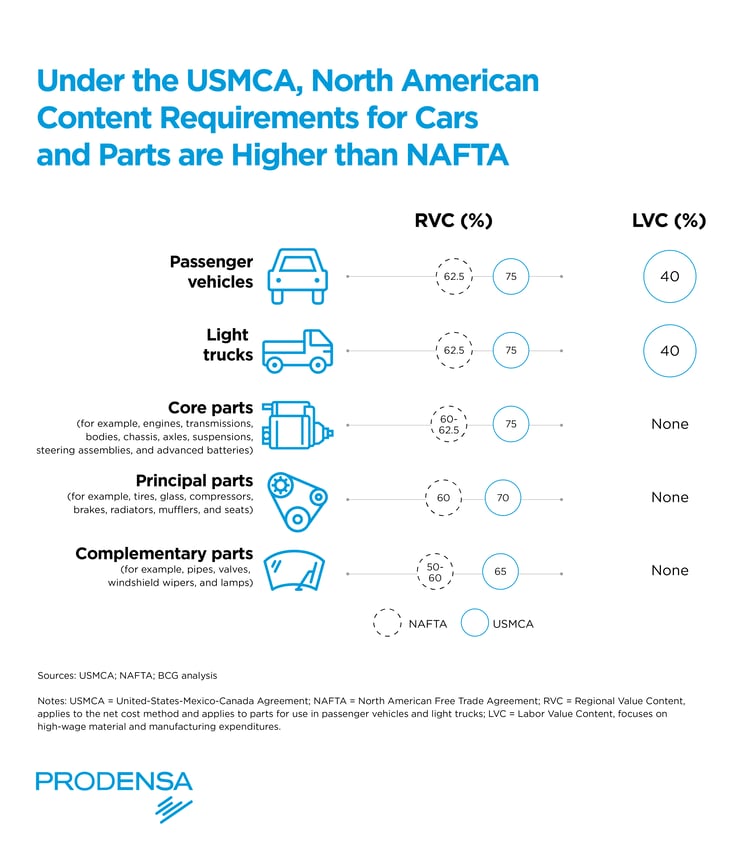
Under USMCA, cars and auto parts must meet higher regional content and labor value thresholds than under NAFTA—making origin compliance essential to avoid unnecessary tariffs.
A certificate of origin is not proof of qualification
This is the most expensive misconception in trade compliance. The certificate is a declaration that a good meets the rule. It is not evidence that it does. If the product fails the technical requirement, a tariff shift or an RVC threshold, customs can reject the claim no matter how clean the paperwork looks. Qualification comes first; the certificate records it.
For the document itself, the nine required data elements, who can certify, and the blanket period, see our USMCA certificate of origin guide.
Common mistakes that make you overpay
- Assuming assembly equals origin. Minimal processing rarely meets the rule: substantial transformation does.
- HS misclassification. Using a commercial or trade name instead of technical specifications produces the wrong code, and the wrong duty.
- Relying on supplier claims. If you did not calculate the RVC, you cannot defend it in an audit.
- Ignoring supply-chain changes. A supplier switching materials can quietly knock a product out of qualification.
How do you confirm your product qualifies?
At a high level, three things settle it:
- Classify the good and its inputs correctly (HS codes based on technical specs, not trade names)
- Find your product-specific rule and test it against the tariff shift and/or RVC threshold
- Document the basis and keep records for at least five years.
Are you restructuring your supply chain?
Get expert support from Prodensa.
Why Verifying Origin Matters Under the USMCA
Verification isn’t just a compliance issue—it’s a strategic element of doing business in Mexico under trade agreements like the USMCA. Proper application can offer major competitive advantages:
- Cost Reduction: products that qualify can enter duty-free or at reduced rates.
- Avoid Penalties: incorrect classification can result in fines and customs delays.
- Competitiveness: companies that leverage FTAs gain a pricing edge over those that don't.
Products from countries like China, Vietnam, Thailand, and India are facing high duties, which incentivizes shipping inputs through Mexico. Companies must correctly apply the substantial transformation criteria under U.S. non-preferential rules to prove that any third-country origin has been removed. U.S. customs will scrutinize this more closely moving forward.
A mistake in determining origin can lead to:
- Overpayment of duties (up to 25% more in some cases).
- Delays at customs due to documentation discrepancies.
- Loss of competitiveness compared to rivals who do leverage FTAs.
.png?width=617&height=498&name=big%20quotes%20(1).png)
Common Misconceptions about Tariff Classifications
Tariff classification assigns a specific code to each product under the Harmonized System. Incorrect classification can result in inappropriate tariffs, penalties, and customs clearance delays.
Common mistakes:
- Lack of product understanding: Misunderstanding product features or composition leads to errors.
- Subjective interpretation: Without clear criteria, the same product may be classified differently by various brokers.
- Commercial names: Using trade names instead of technical specs causes misclassification.
How Incorrect Origin Determination Increases Import Costs
Incorrectly determining a product’s origin can result in the loss of tariff benefits under trade agreements. If a product is ruled non-originating due to misclassification, it will be subject to higher general tariffs.
 Real case: Penalties due to misclassification
A German company imported medical microcontrollers using the wrong tariff code.
Steps to Validate a Product Origin Under Trade Agreements
To ensure your products benefit from preferential tariffs:
Step 1: Know the agreement-specific rules
- Confirm whether your product is covered by a trade agreement (e.g., USMCA for Mexico, the U.S., and Canada).
- Review the Rules of Origin Annex in the agreement.
Step 2: Analyze the product's composition and production process
Assess whether materials and processes meet origin requirements. Origin criteria:
- Tariff shift (Change in Tariff Classification): Final product must have a different HS code than its components.
- Regional Value Content (RVC): Minimum percentage of value must come from the region.
- Specific processing: Some products (e.g., textiles) require specific technical processes.
Step 3: Obtain and verify the certificate of origin
- Ensure it’s correctly signed and matches the commercial invoice.
- Keep detailed records supporting origin claims (invoices, process descriptions, supplier certificates).
- For companies managing turnkey operations, accurate documentation and traceability of inputs is critical to meet origin verification requirements.
Under USMCA, the certificate may be a self-declaration by the exporter.

Step 4: Consult with experts
Seek specialized advice to correctly interpret rules and ensure compliance.
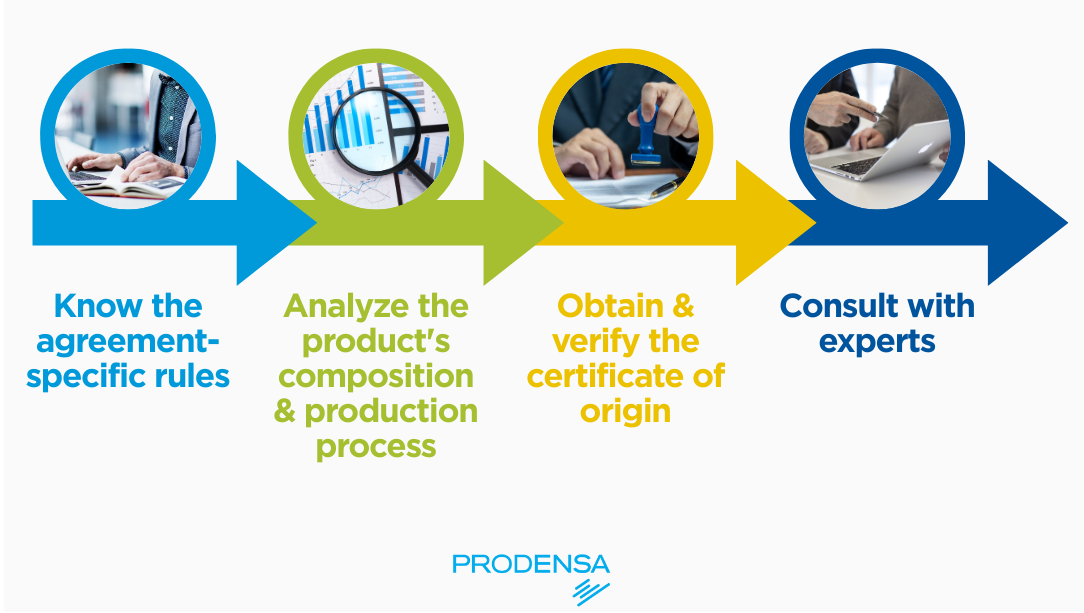
How Expert Review Can Reduce Tariff Liability and Why Staying Informed Matters
Working with international trade professionals can help identify and correct errors in tariff classification and origin determination. These experts can:
Conduct classification audits: Review and correct exi sting product classifications.
 Train staff: Provide training on proper procedures and regulations.
 Represent your company: Assist in resolving disputes or clarifications with customs authorities.
An investment in professional consulting translates into significant savings and reduced risk of penalties and delays. For importers and exporters, being well-informed is not just about compliance—it's a strategic advantage for maintaining competitiveness and controlling costs. Even companies operating under shelter services in Mexico must ensure they meet all documentation and regulatory obligations to maintain trade program eligibility.

 PRODENSA Key Points:
- Many companies overpay tariffs due to misclassification or misinterpretation of rules of origin.
- Origin determination errors can lead to customs delays, fines, and lost competitive advantages.
- There are two types of origin: preferential (under FTAs like USMCA) and non-preferential (for duties, quotas, statistics).
- Common mistakes include using trade names for classification, assuming assembly equals origin, or relying solely on certificates.
- Validating origin requires understanding specific agreement rules, production process analysis, and accurate documentation.
- Expert consultation can significantly reduce tariff liabilities and help companies stay compliant with evolving trade rules.
- Staying up to date on trade regulations is crucial for identifying cost-saving opportunities and reducing risk.
Frequently Asked Questions
What are USMCA rules of origin?
They are the criteria that decide whether a good counts as North American and qualifies for USMCA preferential treatment, often a 0% tariff. They stop goods from outside the region from claiming the benefit through minimal processing.
What are the four USMCA origin criteria?
Wholly obtained in the region; produced exclusively from originating materials; meeting a product-specific rule via a tariff shift and/or regional value content; or specific rules for certain parts and disassembled goods. De minimis allows up to 10% non-originating value.
What is the automotive regional value content threshold?
75% for passenger vehicles and light trucks, up from NAFTA's 62.5%, plus a labor value content requirement (40–45% from plants paying at least US$16/hour) and a 70% North American steel and aluminum mandate.
Is a certificate of origin proof that a good qualifies?
No. The certificate is a declaration. The good must actually meet its rule of origin and you must be able to document it. Qualification comes first; the certificate records it.
What happens if I get origin wrong?
You can lose preferential treatment and pay the standard or penalty rate retroactively, plus interest, fines, and customs delays. Misclassification and unverified supplier claims are the most common causes.
Schedule a Meeting with our Advisors to Discuss your Business Structure and Impact