


How to Qualify for USMCA when Moving Manufacturing from China to Mexico
A product assembled in Tijuana can still be treated as Chinese at the US border. If it does, the core benefit of moving to Mexico, duty-free access under USMCA, disappears, and you can end up paying duty twice. Relocating from Asia is not just a logistics move. It is a trade-compliance project, and origin qualification is where it succeeds or fails.
Qualifying for USMCA means your Mexican-made good meets the rules of origin and enters the US and Canada at a preferential, often 0%, rate. This guide is the execution playbook for getting there when you relocate: how production has to change, how to avoid double duties, and the value-added moves that actually earn origin.
Key Takeaways:
- Relocating to Mexico makes you an importer, producer, and exporter under the USMCA, not just a shipper.
- Final assembly in Mexico does not confer origin. You need substantial transformation: a tariff shift and/or regional value content.
- Get origin wrong and you pay "double duties": once on Chinese inputs, again at the U.S. border.
- IMMEX neutralizes the cost of imported inputs; origin qualification unlocks duty-free export. You need both.
- Value-added moves (vertical integration, advanced manufacturing, yard-forward, regional suppliers) and how you engineer qualification.
We would like to thank Adrián González, President of Global Alliance Solutions, for his valuable participation and collaboration.
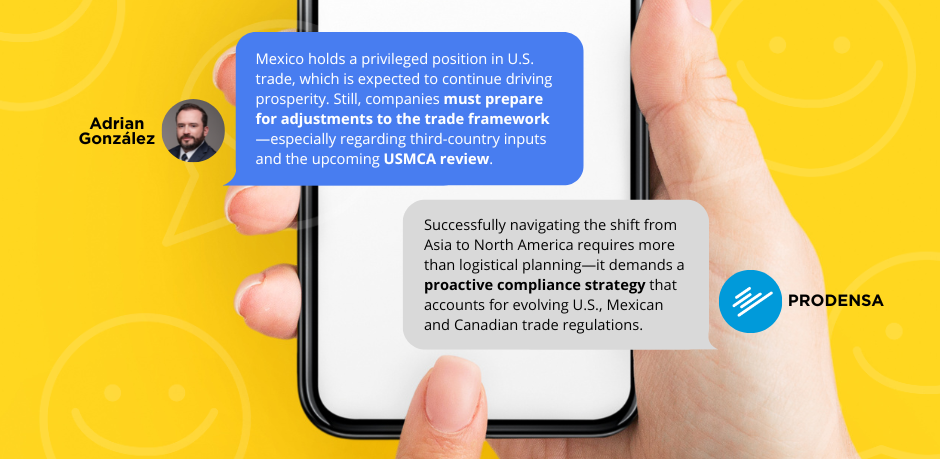
Why moving from China to Mexico changes your tariff equation
Under a “Made in China” model the math was simple: manufacture, export to the US, pay Most Favored Nation duties and, in many cases, Section 301 tariffs. The complexity was logistics. Move to Mexico and you become an importer of components (often still from China), a producer, and an exporter under a sophisticated trade regime at once. The question is no longer “what does it cost to ship from A to B,” but “does my Mexican-made product qualify as originating under USMCA.” The answer decides whether the whole nearshoring case holds.
How do you qualify after locating?
Most manufactured goods qualify through product-specific rules. While the rules vary significantly by product (as classified by HS codes), most rely on one of the following criteria:
Wholly-produced in the USMCA.
Applies to goods that are grown, extracted, or harvested within North America. Examples include minerals mined in Zacatecas or vegetables grown in California. This criterion is uncommon for complex manufactured goods.
Tariff shift.
All non-originating materials must undergo substantial transformation in the region so the finished good lands in a different HS classification than its inputs. Example: import transistors (8541.29) and bare boards (8534.00) from China, perform surface-mount assembly in Mexico to produce a populated board (8542.31). If the rule allows that classification change, the product qualifies.
Regional Value Content (RVC).
A minimum share of value must originate in North America. USMCA allows two methods:
-
Net Cost: (Net Cost − Value of Non-Originating Materials) / Net Cost ≥ the RVC requirement.
- Transaction Value: (Transaction Value − Value of Non-Originating Materials) / Transaction Value ≥ the RVC requirement.
Why "assembled in Mexico" is not enough
This is where nearshoring strategies fail. A common assumption is that final assembly in Mexico automatically grants Mexican origin. USMCA blocks it. If the process is “simple assembly” or “insufficient production,” the good does not qualify even if a tariff shift technically occurs. Customs looks for substantial transformation, real manufacturing, not repackaging.
.png?width=1200&height=782&name=BLOG%20designs%20(1).png)
How to avoid double duties during the transition
The financial trap in relocation is double tariff taxation: you pay Mexican import duty on Chinese components, then pay US duty again on the finished product if it fails to qualify under USMCA.
IMMEX is the first lever. Mexico's IMMEX program lets you temporarily import components while deferring or eliminating VAT, as long as the finished goods are exported on schedule. That neutralizes the import cost of Chinese inputs. Your focus then shifts to the decisive task: making the Mexican production process meet USMCA's origin rules. IMMEX plus origin qualification is the winning combination.
Value-added strategies that earn origin
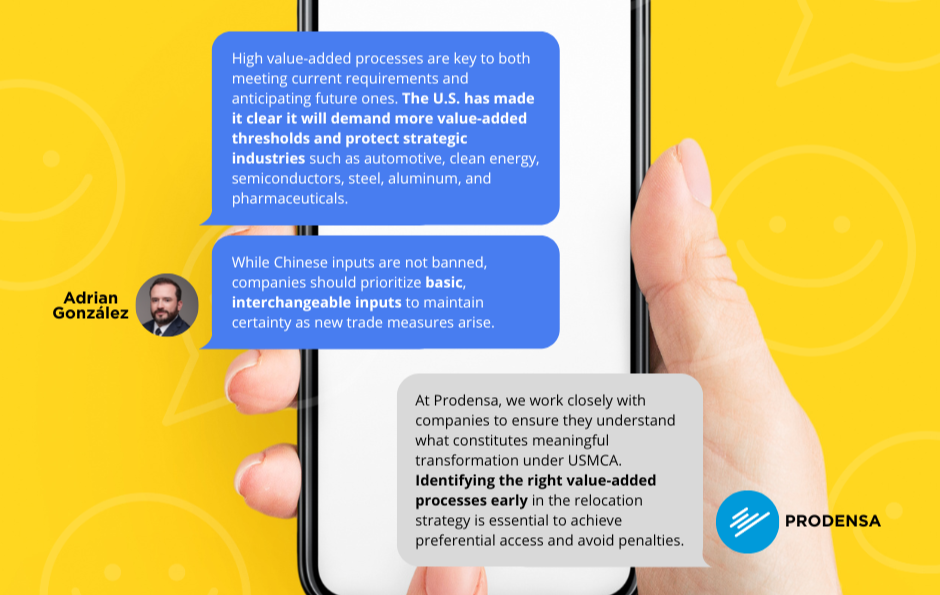
When simple assembly is not enough, the answer is to add substantial transformation and regional value in Mexico. Treat Mexico as an advanced manufacturing hub, not a low-cost assembly zone:
| Strategy | What it looks like |
| Vertical integration | Import discrete components (resistors, capacitors, chips) and perform SMT in Mexico, a qualifying transformation. |
| Advanced manufacturing | For metal products, perform casting, forging, CNC machining, or specialized welding in Mexico. |
| Textiles (yarn-forward) | Bring in roll fabric and do design, cutting, sewing, and finishing locally. USMCA's yarn-forward rule can require even the yarn to be North American. |
| Regional supplier development | Replace Asian inputs with Mexican, US, or Canadian suppliers to lift RVC and shorten the supply chain. |
A 3-step path to prove origin
- Classify accurately. Assign the correct HS code to the finished good and every imported component.
- Analyze the rule of origin tied to your HS code (tariff shift, RVC, or both).
- Certify and document. Issue the certification or origin and keep the bill of materials, process descriptions, and supplier certificates for at least five years.
What the 2026 USMCA review means for relocation decisions
USMCA negotiations remain ongoing, and key outcomes are still unresolved. For companies evaluating relocation decisions, the best approach is to prepare for potential changes by strengthening compliance, origin analysis, supplier traceability, and regional value content strategies now rather than waiting for a definitive outcome.
How Prodensa makes the relocation qualify
The China-to-Mexico shift is not just logistical—it’s a strategic reinvention. Success isn’t measured by the opening of a new plant, but by the uninterrupted flow of tariff-free goods crossing the U.S. border every day.
To achieve this, your operation must be designed with compliance at its core. Optimizing your supply chain under USMCA requires:
 A full audit of your Bill of Materials to trace the origin of each component.
Accurate HS classification and detailed rule of origin analysis.
Strategic use of IMMEX to manage import costs.
Investment in value-added processes that deliver substantial transformation in Mexico.
Long-term commitment to developing a North American supplier base.
By mastering these variables, your company won’t just mitigate transpacific supply chain risks—it will unlock the full potential of North America’s most powerful manufacturing platform. The opportunity is real, but only for those willing to do the work.
Planning a move from China to Mexico? Let our nearshoring and trade team design the operation so your goods qualify from the first shipment.

Frequently Asked Questions
Does assembling a product in Mexico make it qualify for USMCA?
Not by itself. Simple assembly or insufficient production does not confer origin. The product must undergo substantial transformation, meeting a tariff shift and/or regional value content threshold, to qualify.
What is “double duty” when moving from China to Mexico?
Paying import duty in Mexico on Chinese components, then paying duty again when the finished product enters the US because it failed to qualify under USMCA. IMMEX plus proper origin qualification avoids both.
How does IMMEX help with USMCA qualification?
IMMEX defers or eliminates VAT on temporarily imported components, provided the finished goods are exported. It neutralizes input costs, but the Mexican production process still has to meet USMCA rules of origin for duty-free access.
What value-added processes help a product qualify?
Vertical integration (importing discrete components and doing SMT in Mexico), advanced manufacturing (casting, forging, CNC machining), yarn-forward textiles, and replacing Asian inputs with North American suppliers.
 PRODENSA Key Points:
-
Understanding and applying USMCA rules of origin is essential for companies shifting from China to Mexico.
-
Simply relocating assembly is not enough—products must undergo qualifying transformation to earn tariff-free status.
-
IMMEX can significantly reduce import costs but must be paired with compliance to origin rules.
-
Value-added processes like SMT, machining, or yarn-forward textile strategies can help meet USMCA thresholds.
-
Non-compliance can lead to double tariffs, customs issues, and loss of nearshoring advantages.
-
Strategic planning must include HS code classification, origin analysis, and documentation from the beginning.
-
Nearshoring and turnkey operations in Mexico succeed when trade compliance is integrated into the relocation model.
-
Doing business in Mexico involves more than logistics—it requires expert handling of shelter services and trade programs.
-
Companies that get origin compliance right will unlock North America’s full manufacturing potential.


