


What if one of the most overlooked documents in your export process could expose your company to high penalties—or unlock huge tariff savings?
Free Trade Agreements (FTAs) drive competitiveness by allowing goods to cross borders with preferential tariffs. At the heart of these benefits lies the certificate of origin—a seemingly simple document that carries immense technical complexity and legal responsibility. The question is not if customs authorities will verify your product’s origin, but when. An origin audit (or “origin verification process” in technical terms) can be disruptive and costly if you're not prepared. It's not just a bureaucratic requirement; it's an in-depth investigation that tests the integrity of your entire supply chain and compliance processes.
Prodensa has partnered with international trade experts to provide valuable analysis and practical insights into the origin audit process, helping organizations understand the importance of documentation, supplier management, and compliance strategy—especially relevant for those pursuing nearshoring or exploring shelter services in Mexico.
We would like to thank Adrián González, President of Global Alliance Solutions, for his valuable participation and collaboration. For companies pursuing turnkey operations in Mexico, understanding origin rules is a vital step in planning and executing a compliant cost-efficient setup.
Why and When Do Origin Audits Happen?
Contrary to popular belief, origin audits are not always random. While random selection exists, most verifications are driven by specific risk factors constantly monitored by customs authorities—such as Mexico’s National Customs Agency (ANAM) or the U.S. Customs and Border Protection (CBP)—through sophisticated algorithms and data analysis.
The main triggers include:
Understanding these triggers is the first step to shifting from a reactive stance to a proactive compliance strategy.
How to Manage an Origin Investigation During a Customs Audit
Once you receive an official notification—whether it's a detailed questionnaire, a request for information, or notice of an on-site verification—time is of the essence. Success depends not on what you do after receiving the letter, but on the compliance structure you've built beforehand.
Robust preparation is based on the following pillars:
1️⃣ Create an Origin Dossier per product: Don’t wait to be asked. For every part number exported under an FTA, maintain a physical or digital folder with all evidence supporting origin qualification. Include:
- Detailed rule of origin analysis (tariff shift, regional value content, etc.)
- Bill of Materials (BOM) showing originating and non-originating materials
- HS classifications for raw materials and finished products
- RVC spreadsheets and methodology, if applicable
- Supporting documentation from suppliers
2️⃣ Appoint a response team: Identify a project leader (usually the Customs or Compliance Manager) and form a cross-functional team including logistics, purchasing, engineering, finance, and legal if needed.
3️⃣ Conduct periodic self-assessments: Annually simulate an internal audit for high-volume or high-risk products to identify weaknesses before the authorities do.
4️⃣ Know timelines and procedures: Each FTA (e.g., USMCA, EU-Mexico) has different timelines for origin verifications. Typically, you'll have 30–45 days to respond. Understand your rights and request extensions if needed.
5️⃣ Maintain records: Most agreements, including USMCA, require you to keep all origin-related records for at least five years. Poor document management is an automatic audit failure.
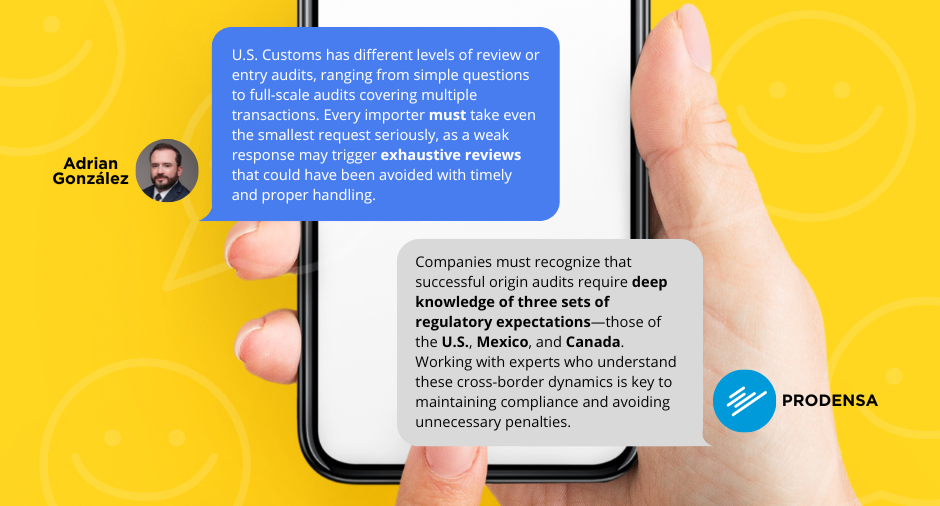
Why Supplier Documentation Matters in Origin Compliance
Your certificate of origin is only as strong as the weakest link in your supply chain. As the producer or exporter, you are ultimately responsible for the accuracy of the information declared—even if it comes from your suppliers. “My supplier told me it was originating” is not a valid defense.
To protect yourself, implement a rigorous supplier management program:
⭐
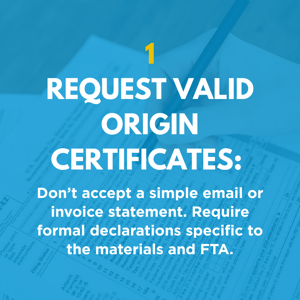
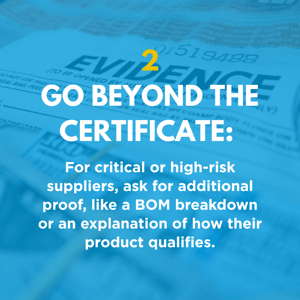
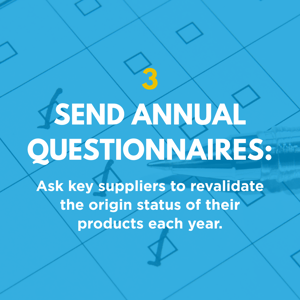

During an audit, customs authorities may verify your suppliers directly. If your supplier can’t substantiate origin, your own certificate becomes invalid.
What are the Common Mistakes That Lead to Non-Compliance Penalties?
Most origin-related penalties stem not from fraud but from avoidable technical errors:
 Incorrect HS classification: Misclassification of raw materials or final goods invalidates origin analysis—especially for tariff shift criteria.
Errors in RVC calculation: Using the wrong formula (e.g., net cost vs. transaction value), including non-eligible costs, or inconsistent accounting data can void the calculation.
Misuse of the “De Minimis” rule: This rule allows a small percentage of non-originating materials, but is often misapplied—especially to ineligible goods like agricultural or textile products.
Blank or unsupported certificates: Signing a certificate without reviewing the dossier exposes the company and the signatory to legal risk.
Lack of traceability: Failure to show that the originating material purchased was actually used in the final product. Traceability between purchasing, inventory, and production is key.
Consequences range from retroactive duty payments with penalties to severe fines or even suspension from import/export registries—effectively shutting down operations.
How to Strategically Defend Your Certificate of Origin During a Customs Audit
Once your dossier is complete and your team aligned, your audit response must be strategic:
 Prepare a clear, structured response: Avoid sending unorganized documents. Include a cover letter that concisely explains how the product meets the origin rule and reference supporting evidence.
Be transparent and collaborative: Hiding information increases suspicion. If your internal review uncovered minor issues, be proactive and explain them.
Don’t hesitate to seek clarification: If the authority’s request is vague, you can ask for clarification.
Prepare for on-site verification: Authorities may inspect your facilities and processes. Ensure your team is trained and records are accessible.
Involve experts: Customs brokers or trade consultants can be instrumental in preparing responses, communicating with authorities, or providing legal defense if needed.
 PRODENSA Key Points:
- Origin audits are targeted, triggered by risk factors like documentation inconsistencies or sector sensitivity.
- FTA compliance opens doors, but only when origin rules are properly demonstrated.
- Audit readiness starts early, with clear documentation and a trained internal team.
- Your supply chain matters—weak supplier documentation can invalidate your certificate.
- Common missteps include HS misclassification, RVC miscalculations, and unsupported claims.
- Responding strategically can reduce audit impact and avoid penalties.
- Proactive compliance pays off, building trust, resilience, and operational efficiency.