


Search for shelter services time to market and every provider will give you the same promise: production in Mexico in 90 days. The number is real. It is also the wrong first question for 2026, and the companies that learn that after signing are the ones we get called in to rescue.
Here is the short answer for anyone evaluating shelter services in Mexico on speed:
Under a shelter, a foreign manufacturer can typically be in production in 30 to 90 days. Building your own Mexican subsidiary takes about 10 months to reach first IMMEX operations, and 13 to 16 months before full VAT certification benefits arrive.
The gap is not effort or budget. It is sequencing. A shelter lets you start production inside a legal, customs, and employer infrastructure that already exists, instead of building each piece one at a time while your launch date waits.
Get the Updated Launch Timeline
A Prodensa Advisor will walk you through the times we are seeing in 2026.
But before you build the business case on speed alone, keep reading.
In 2026, the Mexico launches that fail are rarely the slow ones. They are the fast ones built on a weak location decision or a thin trade compliance posture. This updated guide gives you the real timelines our project teams run, week by week, the speed differences between shelter models, and the risks that come with moving faster than your decision quality. The numbers come from more than 1,000 client projects and 40 years operating in Mexico, not from a benchmark report.

Speed, location and trade compliance are what decide success in Mexico
Most companies arrive at the shelter conversation operating under the false sense that speed will solve their problems: the customer deadline, the tariff exposure, the board pressure to show a Mexico footprint. That maybe after launch some adjustments could be made.
 PRODENSA Experience: Speed compresses a timeline. It does not correct a decision. And it's not easy to make structural changes later.
Two variables decide whether a Mexico operation makes money in 2026, and neither is speed:
-
The first is location: labor availability and turnover, industrial cluster fit, utility capacity, and proximity to your customers and your border crossing. These are decisions that directly affect the culture of your operations in Mexico.
-
The second is trade compliance: your USMCA origin position, your tariff math under Section 232 and 301, and your standing with the SAT (Mexico's tax authority), which has tightened scrutiny on IMMEX operations year over year.
This is why our own pre-operative sequence starts with the feasibility analysis, USMCA compliance and origin analysis, and city evaluation, all before a single real estate or incorporation step. The order is deliberate. Speed built on top of those answers is an advantage. Speed instead of those answers is a liability.
So how fast, really? Slower than a few years ago, and not equally fast for everyone
 Our honest answer: Mexico launches are slower today than they were a few years ago. Government review of IMMEX programs, Annex 24 inventory control, transfer pricing, and sub-maquila structures has intensified, and authorities are paying closer attention to who is operating under whose permits and why. The 30-to-90-day shelter window still holds, but it holds because the shelter's permits and registrations pre-date your project, not because the scrutiny disappeared. The scrutiny moved upstream, into the quality of the decision and the diligence behind it. Understanding what the government is paying attention to is now part of being fast.
Types of Shelter Models
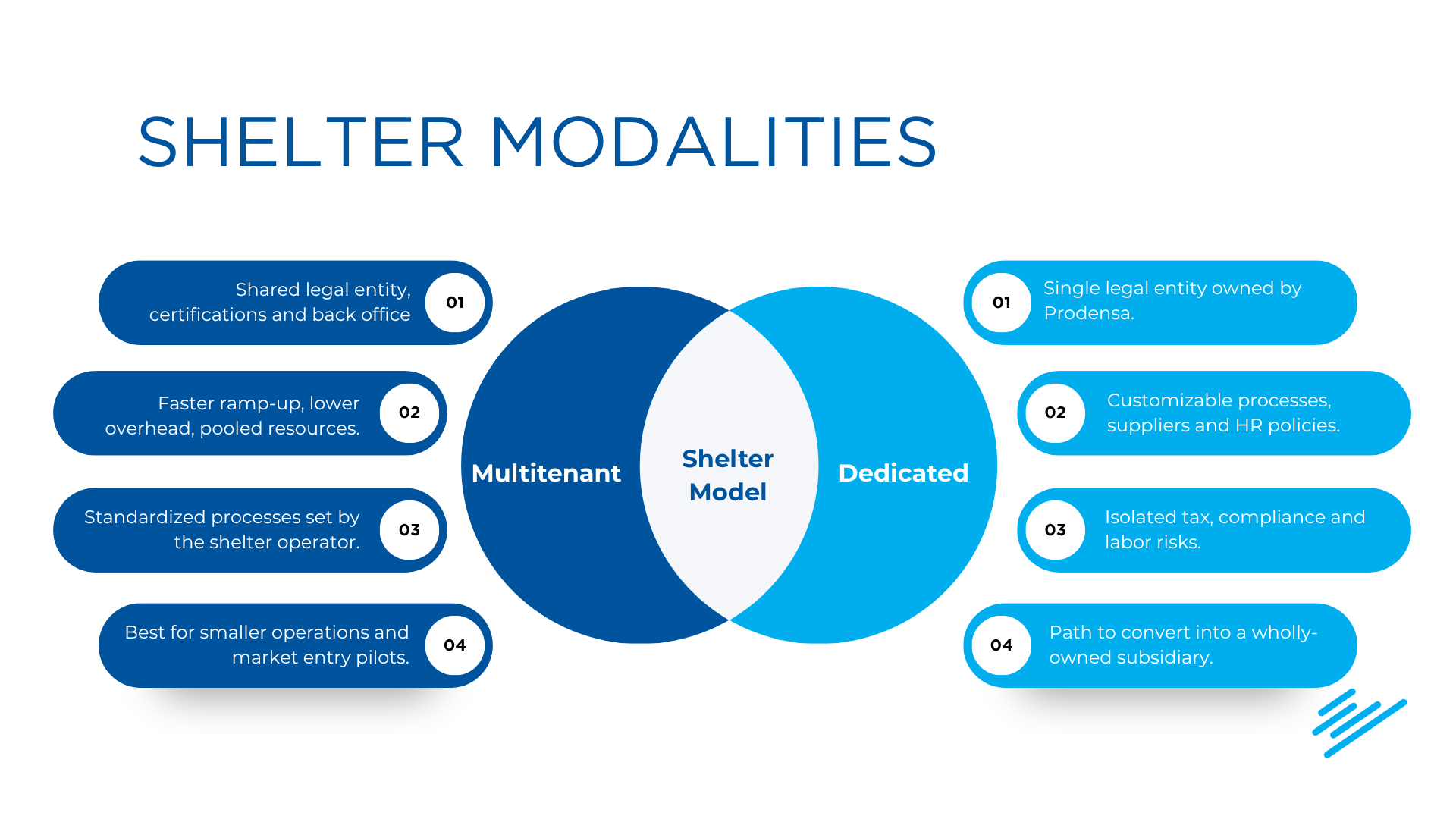
Speed also depends on which shelter model you choose. The models are not interchangeable, and the fastest one is not automatically the right one:
-
Multitenant shelter is the fastest path, because the entity, IMMEX authorization, and VAT certification are shared and already operating. Production in weeks is realistic. The trade-off: you share an entity, so another tenant's tax, customs, or labor issue can touch your operation, and customization is limited.
- A dedicated shelter starts slower, because the provider builds an exclusive entity around your operation. You give up some launch speed and gain isolation from third-party risk, a custom labor strategy, and a clean graduation path to independence later.
How Shelter Services Accelerate Time-to-Market
When establishing manufacturing operations, speed is often critical to achieving business goals. Delays in navigating permits, regulatory compliance, and labor issues can slow down production and erode the competitive advantage. Shelter service providers in Mexico offer a turnkey solution that allows companies to focus on production while the shelter provider handles the legal, HR, and administrative aspects of doing business in Mexico.
1. Simplifying Regulatory Compliance
Setting up a new manufacturing facility in Mexico requires navigating a complex web of regulatory requirements, including labor laws, environmental regulations, tax compliance, and import/export rules. Shelter companies are well-versed in Mexican regulations and handle all aspects of legal compliance. By outsourcing these responsibilities to experts, businesses can sidestep the potential delays and costly mistakes that often come with trying to manage these tasks independently.
2. Faster Facility Setup
Some shelter companies have access to ready-to-use industrial spaces or can assist in the site selection and facility setup. This means that companies can streamline the process of finding the right site for the operation, secure permits, and if needed, construct or improve the building. Some shelter companies operate within specific industrial parts, offering immediate access to facilities. Others take a more objective approach by offering national coverage and network, adapting to the specific business strategy of the company.
3. Streamlined Hiring and Workforce Management
Recruiting and managing a local workforce is one of the most challenging aspects of opening a new facility in a foreign country. Shelter companies often have robust recruitment networks and can help businesses quickly find and hire skilled workers. They also handle labor contracts, payroll, employee benefits, and other HR responsibilities, ensuring compliance with Mexico’s labor laws. By tapping into their local expertise, businesses can hit the ground running without spending months building an HR department from scratch.
4. Reduced Risk and Lower Overhead
One of the key benefits of using shelter services is risk mitigation. Since the shelter company acts as the employer of record and assumes legal responsibility for compliance issues, the risk to the foreign manufacturer is significantly reduced. Additionally, by avoiding the need to manage a legal entity with administrative functions, companies can significantly reduce their overhead costs and corporate knowledge requirements by building a partnership with a shelter company.
5. Focus on Core Competencies
With the logistical, legal, and administrative aspects handled by the shelter service provider, manufacturers can focus their resources and expertise on core business activities like production and product development. This shift allows companies to rapidly scale their operations without being bogged down by operational bottlenecks, enabling them to meet market demands faster.

Where the time actually goes: the standalone timeline, phase by phase
These are not estimates pulled from a search result. What follows summarizes the actual pre-operative and IMMEX launch timelines our project teams run when a client builds a standalone operation in Mexico. The work breaks into two phases, and the second cannot start until the first delivers a building you legally occupy.
Phase 1: from decision to beneficial occupancy (about 6-8 months)
The first six weeks belong to the feasibility analysis, the business case, USMCA compliance and origin analysis, and city evaluation, with a finalist location selected around week 6.
Real estate strategy, search, and constructibility analysis run roughly 2 months, from when the building is first selected to lease negotiation, and execution.
Incorporation and tax ID registration start near the beginning of the timeline but are taking several months to complete. Official address registration and bank accounts finish up around 6 months in the process.
Tenant improvements, operating permits, ERP implementation and first machinery imports are happening around this time as well. Beneficial occupancy, for a dedicated manufacturing entity, is commonly achieved by 6-8 months from beginning a feasibility analysis and fully validating the business plan and risk profile.
Phase 2: from occupancy to a fully certified IMMEX operation (about 8-12 months)
Occupying the building does not mean producing for export. The employer ID and work rules register in the first few weeks after occupancy. Then employees are hired, usually starting with the executive team. Depending on the machinery import and training schedule, this usually begins about a month after occupancy and continues upwards of 4 months for large-scale facilities.
The EHS studies and safety NOM's compliance must be completed as soon as possible, and then the IMMEX program registration usually starts about a month after beneficial occupancy and runs about 3-4 months for the approval. Sectorial programs, AEO, and the VAT/IEPS certification follow, with VAT certification landing a good 12 months after beneficial occupancy.
Shelter IMMEX Launch Timeline - 2026
|
Launch milestone |
Standalone subsidiary |
A multi-tenant shelter |
|
Site selection through signed lease |
Finalist location selected about 6 weeks and lease executed about 2-3 months |
Runs in parallel with contract signing; ready-to-occupy options compress it further |
|
Legal entity (incorporation, tax ID, address, bank accounts) |
In total, this process takes about 6 months to complete |
Day one — you operate under the shelter's entity |
|
Beneficial occupancy of the facility |
Commonly achieved after about 6-8 months |
Within weeks of signing |
|
Employer registration and workforce hired |
Hiring can begin about a month after beneficial occupancy |
Hiring can begin about a month after beneficial occupancy |
|
IMMEX program authorization |
Application starts a month after occupancy; IMMEX operations begin about 3-4 months later |
An extension to the new facility can be achieved in about 3-4 months |
|
VAT/IEPS certification, sectorial programs, AEO |
A good 8 months after beneficial occupancy; until then, temporary imports carry 16% VAT. Sectorial programs about 90 business days after IMMEX authorization |
VAT relief from your first import, after extension of VAT certification and IMMEX program. Sectorial programs about 90 business days after IMMEX authorization |
|
Total: decision to first production with VAT Certification |
About 10 months to IMMEX operations; 20-24 months to full VAT certification benefits |
About 3-6 months after beneficial occupancy |
Get the current version of this timeline for your projectThese benchmarks shift with regulatory changes, state-level processing times, and your industry's permit layer. In a 30-minute session, our project team will walk you through the updated pre-operative and IMMEX launch timeline mapped to your product, headcount, and target state, and show you exactly which weeks a shelter removes for your case.
|
||
The shelter IMMEX modality, in one minute
Shelter is a formal modality of the IMMEX program, not an informal arrangement. Under the shelter modality, the provider holds the IMMEX registration and acts as the legal operator in Mexico, while the foreign manufacturer owns the production process, the equipment, and the inventory.
Shelter Provider Responsibilities:
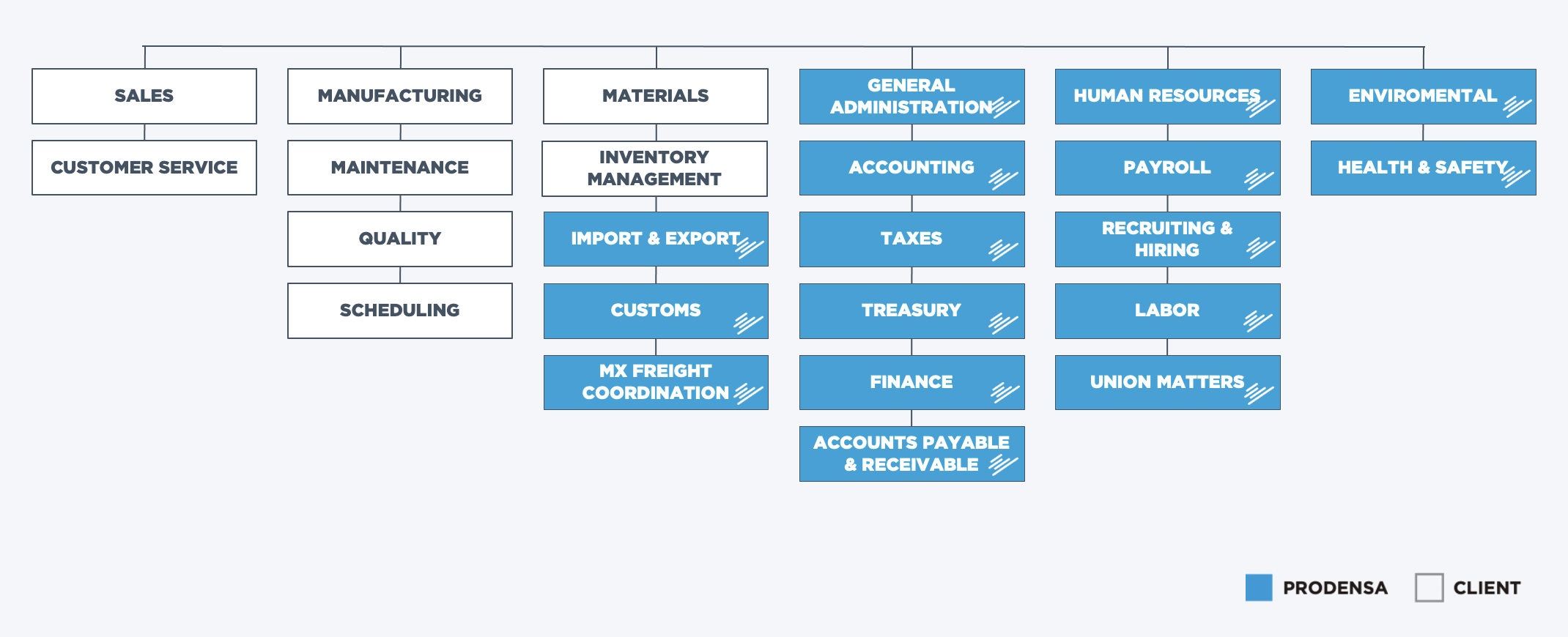
The other modalities (industrial, services, and holding) all require the foreign company to hold its own program, which is precisely the lead time the multitenant shelter modality removes. For a dedicated subsidiary, the shelter services time to market can be accelerated by applying some efficiencies.
When the shelter is not the fastest path
 PRODENSA Experience: sometimes shelter services do not add value to an operation. Prodensa gives clients flexible options to understand the best path according to each business plan, and provides a la carte services for support outside of shelter services in Mexico.
- You already have infrastructure. If you already operate a Mexican entity with IMMEX and VAT certification, adding a line or a site through your existing structure may be faster than contracting a shelter, provided your compliance posture is current.
- You need a customized operational structure. More advanced operations that require a wholly-owned subsidiary like commercial operations, the toller or contract manufacturing model, among others. In those cases, Prodensa acts as an integral 3rd party support to provide the level of support needed.
Don't get fooled by speed: the risks of a rushed decision, and how to mitigate them
- Do not skip the first six weeks; shrink them. Even on a compressed schedule, run the feasibility, USMCA origin analysis, and city evaluation first, in abbreviated form if necessary. They are the cheapest weeks of the entire project and the only ones that prevent unrecoverable mistakes.
- Choose the structure that gives you the most peace-of-mind. If the location or volume decision still carries uncertainty, a multitenant shelter is the lowest-commitment way to be fast: you can start production, learn the market, and transition to a dedicated structure or your own entity once the decision is validated. It's possible, but remember: at the advantage of speed, you will spend more.
- Work backwards from your committed production date. Fix the date your customer needs product, then subtract validation, equipment installation, and hiring. The result is the date your structure must be operational. Then check whether the location and origin analysis can be done soundly inside that window; if not, that gap is your real problem, not the timeline.
- Compress the reversible decisions, never the irreversible ones. Hiring plans, lease length, and equipment phasing can flex. The state you choose and your origin posture under USMCA cannot, not cheaply. Put your scarce diligence time against the irreversible decisions.
The pattern we see across rescue projects is consistent: the damage rarely comes from moving fast. It comes from moving fast on a decision that was never made soundly in the first place.
What to do this quarter
If a Mexico launch is on your 2026 or 2027 roadmap, three actions protect your timeline:
- Work backwards from your committed production date. Fix the date your customer needs product, then subtract validation, equipment installation, and hiring. The result is the date your structure must be operational. Then check whether the location and origin analysis can be done soundly inside that window; if not, that gap is your real problem, not the timeline.
- Pressure-test the structure decision early. Multitenant, dedicated, sub-shelter, or inshoring is a 30-minute structured conversation, not a quarter-long study. Getting it wrong is expensive; our team has unwound enough mis-fit structures to know.
- Update Gantt chart with current market timelines. Any provider can say 90 days. Ask for the milestone plan behind it (facility, first hire, first import, first production, with names attached) and ask what they will check before they let you go fast.
We have spent 40 years compressing this exact timeline for more than 1,000 client projects. The fastest way to protect yours is to see the current numbers before you commit to a structure.
Shedule a meeting to get the updated launch timeline

Case Studies: Success in Action
Several multinational companies have leveraged shelter services for market entry into Mexico. For example, the automotive and aerospace industries have seen significant growth thanks to shelter services that help streamline the setup process. Manufacturers have reported saving months in the setup phase, allowing them to meet aggressive production timelines and capture market opportunities sooner than expected.
Shelter Services via a Pre-Established Entity in Mexico
PRODENSA's inshoring model provides a binational solution with the most streamlined time-to-market solution in Mexico.
A Transfer of Shelter Service Provider in Mexico
A takeover strategy for a client seeking a shelter service provider change in Mexico, successfully navigating IMMEX Program complexities and beating the clock.
A Trustworthy Partner in Mexico: Continued Growth
How PRODENSA has supported a key client on multiple expansion projects over the years, empowering strategic decisions in their business plan.
Conclusion: The Competitive Advantage of Shelter Services
When foreign companies evaluate shelter services, time to market is usually the first thing they ask about, and shelter services deliver: by handing non-core functions such as regulatory compliance, HR, and facility setup to an experienced partner, businesses reach production months sooner than a standalone build, at lower cost and lower risk. But that speed only becomes a competitive advantage when it sits on top of sound location and trade compliance decisions, not in place of them.
By partnering with the right shelter company, businesses can unlock Mexico's potential as a strategic manufacturing hub and accelerate their expansion, without trading away the diligence that makes the launch durable.
Frequently asked questions:
How long does it take to start manufacturing in Mexico with shelter services?
Under a shelter, most foreign manufacturers reach first production in 90-120 days, depending on the shelter model, facility readiness, headcount, and industry-specific permits. The shelter's legal entity, IMMEX authorization, VAT/IEPS certification, and employer registrations already exist and need to be extended. The window assumes the location and trade compliance decisions behind the launch are sound; speed does not substitute for them.
Is launching in Mexico faster or slower than it was a few years ago?
Slower. Incorporation timelines have drastically increased, and we see more scrutiny of who is incorporating. Government review of IMMEX programs, Annex 24 inventory control, and operating structures has intensified, and authorities look more closely at who operates under whose permits. Shelters preserve the 90-to-120-day window because their permits pre-date your project, but sound diligence on location and trade compliance is now part of being fast, not an alternative to it.
How long does a standalone Mexico entity take before production?
Based on Prodensa's project delivery timelines, plan on about 6-8 months from decision to beneficial occupancy (feasibility, site selection, lease, incorporation, and tax ID), then roughly 3-4 months to begin IMMEX operations, with VAT/IEPS certification landing closer to 12 months after beneficial occupancy.
Why are shelter services faster than setting up a subsidiary in Mexico?
Because the long-lead items are inherited rather than built in a multi-tenant shelter operation. The shelter provider already holds the legal entity, the IMMEX program, the VAT certification, and the employer infrastructure. Your project starts at the production step instead of the paperwork step. For a dedicated entity, the shelter provider can provide efficiencies and speed up the process with their corporate history.
Does operating under a shelter mean giving up control of production?
No. You retain full control of production, quality, scheduling, and intellectual property. The shelter provider handles the legal, customs, HR, and administrative layer as the employer of record in Mexico.
What does shelter services time to market depend on?
Four variables: the shelter model you choose (multitenant is fastest; a dedicated entity takes longer), whether your facility is ready-to-occupy or requires build-out, your industry's regulatory layer (medical and aerospace add certifications), and how many people you need to hire before launch.
Can we start under a shelter and move to our own entity later?
Yes. Graduation to your own subsidiary is a normal path, and the right shelter contract plans for it from day one. Many clients run their standalone IMMEX application in parallel while producing under the shelter, so the transition costs no production time.