
The decision between shelter services and a wholly owned subsidiary in Mexico is the single biggest structural choice a foreign manufacturer makes when entering Mexico.
Different ways to manufacture in Mexico
Entering the Mexican manufacturing sector is an exciting yet challenging endeavor. With its growing economy, strategic location, and competitive labor costs, Mexico offers immense opportunities for global manufacturers.
Mexico has positioned itself as a manufacturing hub, drawing companies from a wide range of industries. There are two primary entry routes:
-
Partnering with a shelter services provider
-
Incorporating a wholly-owned subsidiary
Each model offers a unique approach to entering the market, and operational models exist for nearly every business case. Other companies may choose a joint venture or acquisition strategy for specific business plans.
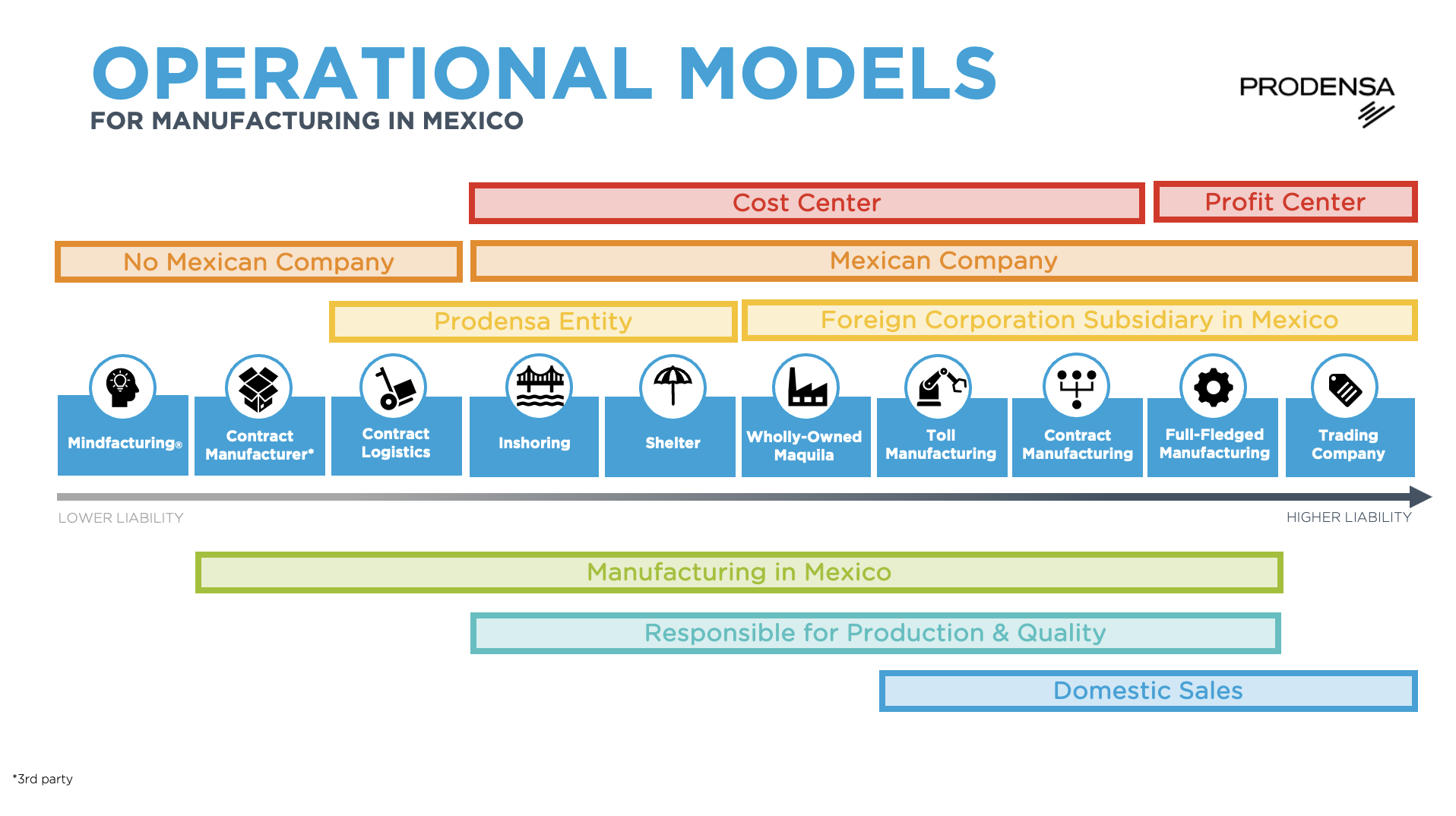
This guide gives you the framework we use with Prodensa clients to make this decision: the four questions that determine which model fits, a side-by-side comparison across the criteria that actually matter, the cost math at year one and year five, and the third path (transition strategy) most articles skip entirely.
What each operating model actually is
1. Shelter services in Mexico
A shelter is a Mexican legal entity that holds the IMMEX permit, the VAT certification, and the administrative infrastructure in partnership with a foreign manufacturing company. The shelter provider runs every function that requires a Mexican corporate presence, including: HR, payroll, customs, trade compliance, accounting, EHS, labor relations, and government affairs. You fund the operation, run production, and own the manufacturing decisions. The shelter rents you the regulatory package that lets you operate in Mexico without setting up your own entity.
Materials enter Mexico temporarily under IMMEX without VAT on importation (once certified), provided finished goods are exported. Most shelter clients begin production within 60–90 days under a multitenant model or 9–12 months under a dedicated entity.
PROs of Shelter Services in Mexico
- Reduced Risk and Liability: shelter providers manage compliance, minimizing legal exposure.
- Quick Start: an operations partner can streamline the startup process and timeline.
- Focus on Core Activities: outsource the administrative overhead.
- Economies of Scale: shared services reduce costs in the early years.
CONs of Shelter Services in Mexico
- Limited Control: a shared shelter model may restrict operational autonomy. An independent shelter setup offers more control.
- Limited Flexibility in Operational Model: the IMMEX Program restricts domestic sales; a separate entity is required for internal market access.
- Potential Unexpected Costs and Taxes: shared costs or tax exposure for capital-intensive companies can arise under some shelter models.
By partnering with a provider of shelter services in Mexico, companies can benefit from various administrative and legal services that simplify the setup process.
2. Wholly-owned subsidiary in Mexico
A wholly owned subsidiary is your own Mexican legal entity. You incorporate the company (typically as an S.A. de C.V. or S. de R.L. de C.V.), register for tax purposes with the SAT, hire your own workforce, build out your HR and accounting functions, and apply for your own IMMEX permit and VAT certification.
Full setup typically takes 12–18 months from entity incorporation to first production, with material capital deployment across legal, HR, customs, and real estate. Once operational, you have full control — and full responsibility for every regulatory, labor, and tax obligation.
PROs of Wholly-Owned Subsidiary
- Full Control: operate with your own policies, staff and infrastructure.
- Flexibility in Operations Model: greater tax and operational flexibility.
- Long-Term Investment: position your company as a lasting stakeholder in Mexico.
CONs of Wholly-Owned Subsidiary
- Initial Planning & Investment: requires significant capital and planning.
- Complex Regulatory Environment: deep local knowledge is essential.
- Full Team Structure: higher initial HR and admin costs.
For larger corporations with a dedicated team experienced in international operations, a wholly-owned subsidiary can give the flexibility needed to meet varying business goals and needs.

Shelter services vs wholly owned subsidiary: side-by-side
How the two models compare across the criteria that drive most decisions:
| Consideration | Shelter Services | Wholly-Owned Subsidiary |
| Time to first production | Faster (3-6 mo. advantage) | Slower (full setup needed) 12-18 months |
| Setup Cost (relative) | Low to Medium | High |
| Operational Control | Shared or dedicated shelter model | Full control |
| Compliance Burden | Shelter handles compliance | Internal team required |
| Flexibility | Limited Models | Customized Structure |
| Exit / Closing Cost | Low (Contractual) | High (Legal) |
When to choose shelter services
Choose shelter services when one or more of these is true:
- You are entering Mexico for the first time and want to validate the operating model before committing to a standalone entity.
- You need production running in under 6 months. A wholly-owned subsidiary cannot meet this timeline.
- Your production is export-only and you do not plan to sell into the Mexican domestic market.
- Your industry is heavily regulated (i.e. medical, aerospace, automotive, food & beverage).
- You are managing tariff or supply-chain volatility and want the flexibility to scale up or down without restructuring an entity.
When to choose wholly owned subsidiary
Choose a wholly owned subsidiary when one or more of these is true:
- Your horizon is 5+ years and your commitment to Mexico is confirmed at the leadership level.
- Your plan to sell into the Mexican domestic market (the IMMEX program restricts domestic sales).
- You require full customization of HR, benefits and labor relations strategy that a shelter cannot accomodate.
- You have internal Mexico operations leadership who can efficiently run customs, trade compliance, and labor relations without outside support.
- Your industry is low-regulation and the time-to-compliance advantage of a shelter is small.
The third path: a transition strategy
The choice does not have to be permanent. Most foreign manufacturers we work with at Prodensa enter Mexico under a shelter and graduate to a wholly owned subsidiary 24–48 months later, once volume, regulatory comfort, and team maturity justify the cost of running their own entity.
This is often the right answer when neither model is a clear fit at year one. A dedicated shelter structured with a clean exit clause lets you start fast, learn the regulatory environment with a partner, and transition the entity to your ownership when you are ready. Done well, you keep your building, your workforce, your IMMEX permit, your VAT certification, and your customs history. Done poorly, you pay twice for the same operation.

Why this decision matters more in 2026
Three things have changed since most foreign manufacturers last evaluated the question of shelter services vs. wholly-owned subsidiary in Mexico:
- The 2026 USMCA review in July 2026 brings stricter scrutiny on rules of origin, labor value content, and Tier-N supplier traceability. The compliance overhead of either model is higher than it was in 2024.
- Section 232 (steel and aluminum) and Section 301 (China) tariff dynamics have changed landed-cost math materially. Companies that chose a structure a few years ago may be looking at drastic business changes since then.
- SAT has increased audit frequency and tightened transfer-pricing scrutiny under the Safe Harbor regime. The administrative cost of running either model has gone up; the gap between them has narrowed slightly.
Not sure which path fits your operation?
Book a 30-minute model assessment with a Prodensa Advisor.
"The companies that get this decision right are the ones that match the model to their actual horizon and risk profile, not the ones that pick the cheapest option in year one. We have seen too many operators choose a wholly owned subsidiary to save the shelter fee, then spend years two and three building the infrastructure they could have rented for half the total cost. The right structure compounds with you as you scale. The wrong one drains capital before you ever see return on Mexico."
-Marco Kuljacha, President Start up & Consulting
Why Prodensa?
Prodensa is Mexico's leading shelter services provider and operational partner for wholly-owned subsidiaries in Mexico. With over 40 years of experience, we guide companies through every stage of The Mexico Journey®.
- Market Entry Support: from market analysis to full-scale feasibility model.
- Regulatory Expertise: IMMEX, labor law, trade compliance.
- Start-up Program: supported over 1,000 manufacturers.
- Flexible Models: shared or dedicated IMMEX solutions tailored to your goals.
Choosing between shelter services vs wholly-owned subsidiary in Mexico depends on your operational goals, risk tolerance, and timeline.
Prodensa helps you assess these factors and implement the most efficient, compliant, and scalable model. Whether you need a fast track to market or a long-term local footprint, Prodensa is your strategic partner in Mexico.
Ready to take the next step?
Contact us today to learn more about how Prodensa can help you achieve your business goals and thrive in the Mexican market.