

There are multiple types of shelter services in Mexico; choosing the wrong one is not a small mistake. If you're evaluating shelter services for the first time (or reassessing your current model) this guide walks you through the shelter operating models foreign manufacturers actually use in 2026, how they differ, and how to choose between them.
What shelter services are (and what they are not)
Shelter services are a recognized modality of Mexico's IMMEX program (Industria Manufacturera, Maquila y de Servicios de Exportación). Under the model, a Mexican shelter company holds the IMMEX permit, the VAT certification, and the legal entity. The foreign manufacturer funds the operation and runs production. The shelter handles every administrative function that requires a Mexican corporate presence.
Materials enter Mexico temporarily under IMMEX without VAT on importation, provided finished goods are exported. The structure functions like a free trade zone, but without the geographic restrictions of one. Your operation can be located in Nuevo León, Coahuila, the Bajío, Baja California, or anywhere else that fits your supply chain.
What shelter services are not: they are not outsourcing your manufacturing. You retain full operational control over production, quality, scheduling, and customer relationships. The shelter provides the regulatory and administrative wrapper that lets you operate in Mexico without setting up your own legal entity.
Who does what under a shelter agreement
A typical shelter arrangement splits responsibilities like this:
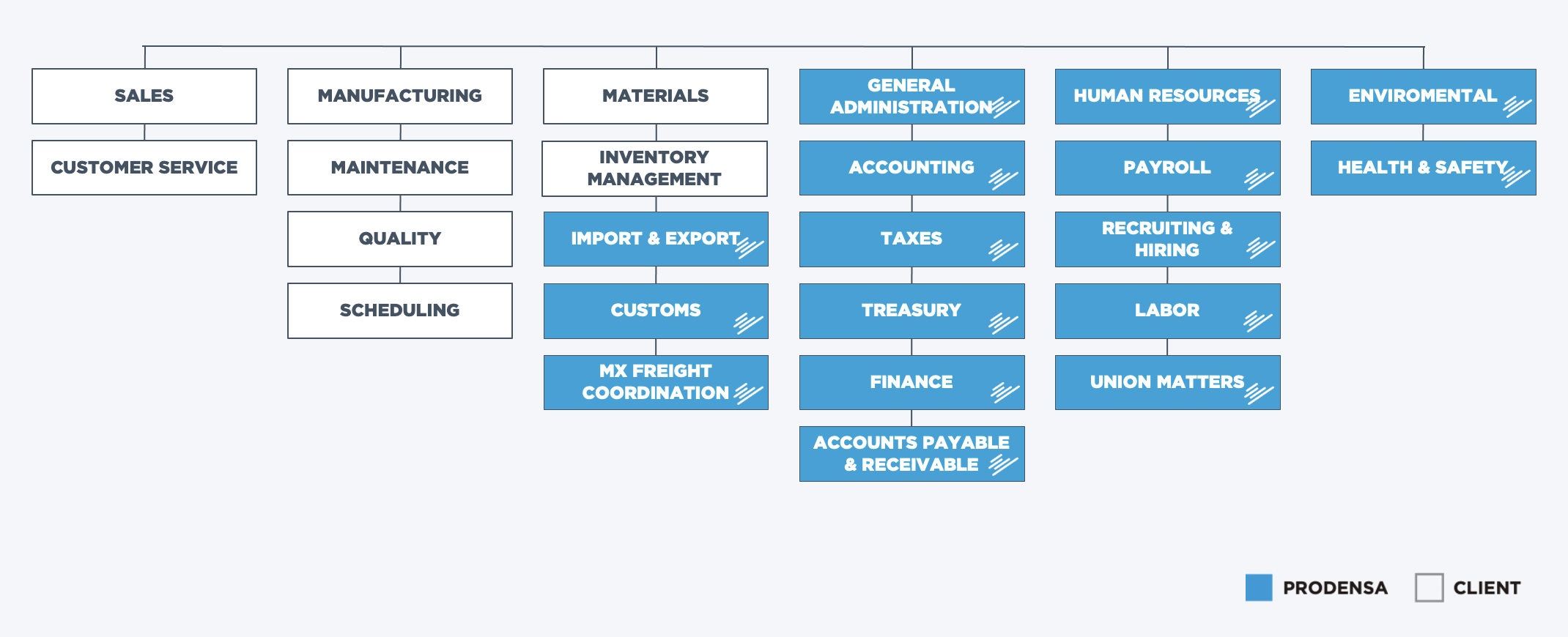
The focus of the company that provides shelter services in Mexico will be to reduce the learning curvy by administering the legal entity and running day-to-day administrative functions in a compliant way.
The two shelter operating models foreign manufacturers actually use
Most providers describe shelter services as a binary choice: multitenant or dedicated entity. In practice, foreign manufacturers operate under two distinct types of shelter services in Mexico in 2026. Each has different cost, speed, flexibility, and exit implications.
In both types of shelter models mentioned below, the foreign client has the benefit of avoiding a Permanent Establishment by partnering with the shelter provider in Mexico.
1. The Multitenant Shelter Model
A multitenant shelter is a pre-established Mexican legal entity that houses multiple foreign manufacturers under one IMMEX permit and one VAT certification. The shelter provider owns the entity. You operate as a tenant within it.
What it gets you:
- The fastest path to manufacturing. Because the legal entity, IMMEX permit, and VAT certification already exist, a multitenant client can be producing in Mexico in as little as 60–90 days, versus 9–12+ months for a dedicated structure.
- Immediate VAT certification benefits. New raw materials and capital equipment imports avoid VAT from day one of operation, with material cash-flow implications during ramp-up.
- Economies of scale on administrative functions. HR, accounting, and EHS overhead is spread across multiple operations, lowering per-unit administrative cost.
- Low-commitment entry. A multitenant model is the right structure for companies running a Mexico pilot, evaluating long-term commitment.
What do watch out for:
- Shared entity, shared risk. A tax, customs, or labor issue at another tenant under the same entity can affect your operation.
- Limited customization. Compensation structures, labor relations strategy, and benefit programs are usually set at the entity level, not per tenant.
- Building flexibility constraints. If the shelter provider owns the facility, your ability to expand, modify, or relocate is governed by the lease and the shared infrastructure.
- Exit friction. Transitioning out of a multitenant entity typically requires creating a new legal entity and migrating permits, workforce, and customs records.
2. Dedicated (independent) shelter
A dedicated shelter is an exclusive Mexican legal entity created for one foreign manufacturer. The shelter provider still holds the entity and administrative responsibility, but the IMMEX permit, VAT certification, and workforce are exclusive.
What it gets you:
- Full operational and financial visibility. Because no other company shares your entity, financial statements, customs records, and labor data reflect your operation only.
- Isolation from third-party risk. Tax investigations, customs audits, or labor disputes affecting other companies do not touch your operation.
- Customization. Compensation strategy, union relationships, benefit structure, and EHS protocols are designed for your business.
- Clean transition to independence. When you're ready to graduate to your own subsidiary, the entity can transfer to your ownership without disrupting production, workforce, or permits. You keep your building, your people, and your customs history.
What to watch out for:
- Longer setup. A dedicated entity typically takes 9–12+ months to fully establish, including IMMEX registration, VAT certification, and labor onboarding.
- Higher administrative cost. The dedicated model carries the full overhead of a standalone Mexican entity, even though the shelter provider runs it on your behalf.
- Provider lock-in if poorly structured. Some shelter contracts make it difficult or expensive to transition the entity from the provider's ownership to yours. Always negotiate the exit terms before signing.
Side-by-side comparison
| Decision Criteria | Multitenant | Dedicated |
|
Time to first production |
60-90 days | 9-12+ months |
| Setup cost (relative) | Low | High |
| Operational customization | Low | High |
| Isolation from third-party risk | Limited | Full |
| Cash flow / VAT day 1 | Yes | Once certified |
| Building flexibility | Limited | Full |
| Path to standalone subsidiary | Requires new entity | Clean transfer |
| Best fit | Pilot programs, fast launches | Long-term operations, regulated industries |
How to choose between them
The decision usually comes down to four questions. Answer them honestly before you start interviewing shelter providers, not after. We have seen too many companies pick a model based on a provider's pitch and then discover the structure doesn't match their business in year two.
How long do you intend to operate in Mexico?
If your horizon is 3+ years and you're already confident about commitment, the dedicated model usually wins on total cost of operation by year three. If you're piloting, evaluating, or running a short-term production window (tariff arbitrage, capacity overflow, a specific contract), multitenant is probably the lower-risk entry.
How regulated is your industry?
Medical devices (FDA + COFEPRIS), aerospace (AS9100, ITAR), automotive Tier 1, and food & beverage (sanitary regulations) demand higher isolation from third-party compliance risk. Dedicated almost always makes more sense for these sectors. Consumer goods, furniture, and lower-regulation electronics can usually operate effectively in multitenant.
What is your exit / graduation plan?
If your long-term intent is to take ownership of your Mexican operation, the dedicated model offer a clean handoff. Multitenant exit is possible but takes 6–12+ months and requires careful planning of workforce continuity, customs history, and permit migration.
What is your tolerance for shared-entity risk?
In a multitenant entity, a customs audit triggered by another tenant's classification error can pause your shipments. A labor dispute at another tenant can attract Rapid Response Labor Mechanism (RRM) scrutiny that touches the whole entity. These risks are manageable but real. Price them into your decision before signing.
"The right shelter model is not the cheapest or the fastest. It is the one that matches your horizon, your industry, and your tolerance for shared-entity risk. We have seen companies save 15% in the first year by choosing a fast-track model, and then spend that savings three times over in year three migrating out. The structure you choose at the start determines what your exit looks like at the end." -Marco Kuljacha, President
Now sure which shelter type to choose?

Why this matters more in 2026
Three things have changed since most foreign manufacturers last evaluated their shelter structure:
- The 2026 USMCA review brings stricter scrutiny on rules of origin, Labor Value Content, and Tier-N supplier traceability. The compliance overhead under any shelter model is higher than it was in 2024.
- Section 232 (steel and aluminum) and Section 301 (China) tariff dynamics have changed landed-cost math materially. Companies are re-evaluation whether multitenant flexibility justifies the year-three mitigation cost, or whether locking in a dedicated structure makes sense given the new tariff floor.
- SAT has increased audit frequency and tightened transfer-pricing scrutiny under the Safe Harbor regime (minimum taxable profit of 6.5% over costs and expenses for IMMEX operations). Multi-entity shelter structures face more documentation requirements than they did 24 months ago.
Conclusion: let's discuss what's right for you
Utilizing shelter services in Mexico offers a practical solution for global manufacturers to skip the learning curve and work with an administrative operations partner in Mexico. By understanding the different types of shelter services in Mexico available and carefully selecting the right partner, companies can mitigate the complexities of establishing and running a manufacturing operation in a foreign jurisdiction. Shelter services not only streamline the process but also provide the peace of mind that comes with knowing your operations are in compliance with local laws and regulations.
The same startup support can be provided to companies that choose to create their own subsidiary in Mexico, or that need just one area of support in their journey.
Contact us for a free consultation on how to best navigate shelter services in Mexico, and take the first step towards unlocking the full potential of manufacturing in this vibrant country.