


How the IMMEX program works, step by step
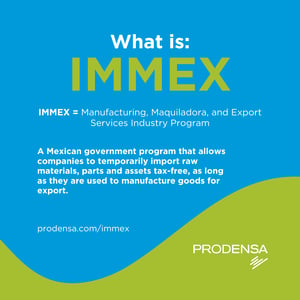
IMMEX stands for Industria Manufacturera, Maquiladora y de Servicios de Exportación. It is the framework more than 5,800 manufacturers use to produce goods and deliver services from Mexico without paying VAT on the inputs they import temporarily.
IMMEX works as a closed loop. You bring foreign inputs in without paying VAT, you transform or use them in Mexico, and you export the result within an authorized window, accounting for every item along the way.
Five stages define the framework:
-
Authorization. You apply to the Secretaría de Economía for an IMMEX permit under one of the five program types. Approval requires registered Mexican locations and a commitment to export at least US$500,000 a year, or 10% of total sales.
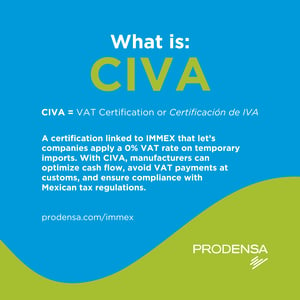
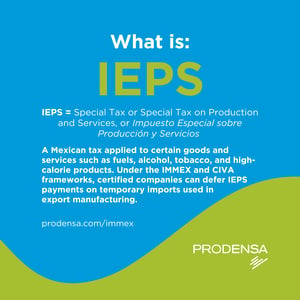
- Temporary import. You import raw materials, components, machinery, and equipment under the program. With VAT/IEPS certification (commonly called CIVA), you receive an immediate VAT credit at customs, so the import is cashless for VAT. IEPS is Mexico's excise tax on certain products.
- Transformation. You manufacture, assemble, repair, or, under the services modality, deliver export services such as design or engineering. The maquiladora model, factory transformation of imported inputs, is one way to operate here, not a separate program.
- Export. You export the finished goods or services within the timeframes the program sets for temporary imports. Goods that overstay their window become subject to duties and VAT.
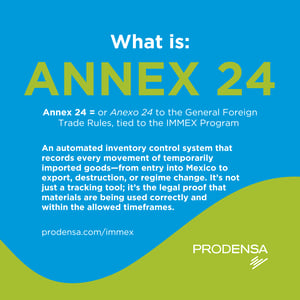
- Inventory control. Throughout, Annex 24 requires a real-time electronic system that records every entry, exit, production use, return, and export. This is the record SAT audits.
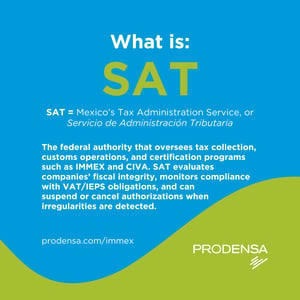
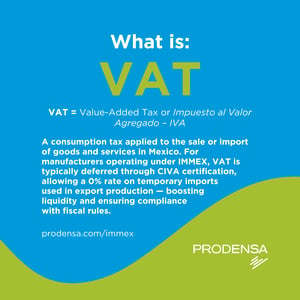
IMMEX Terminology
Definitions of frequent terminology with the program.
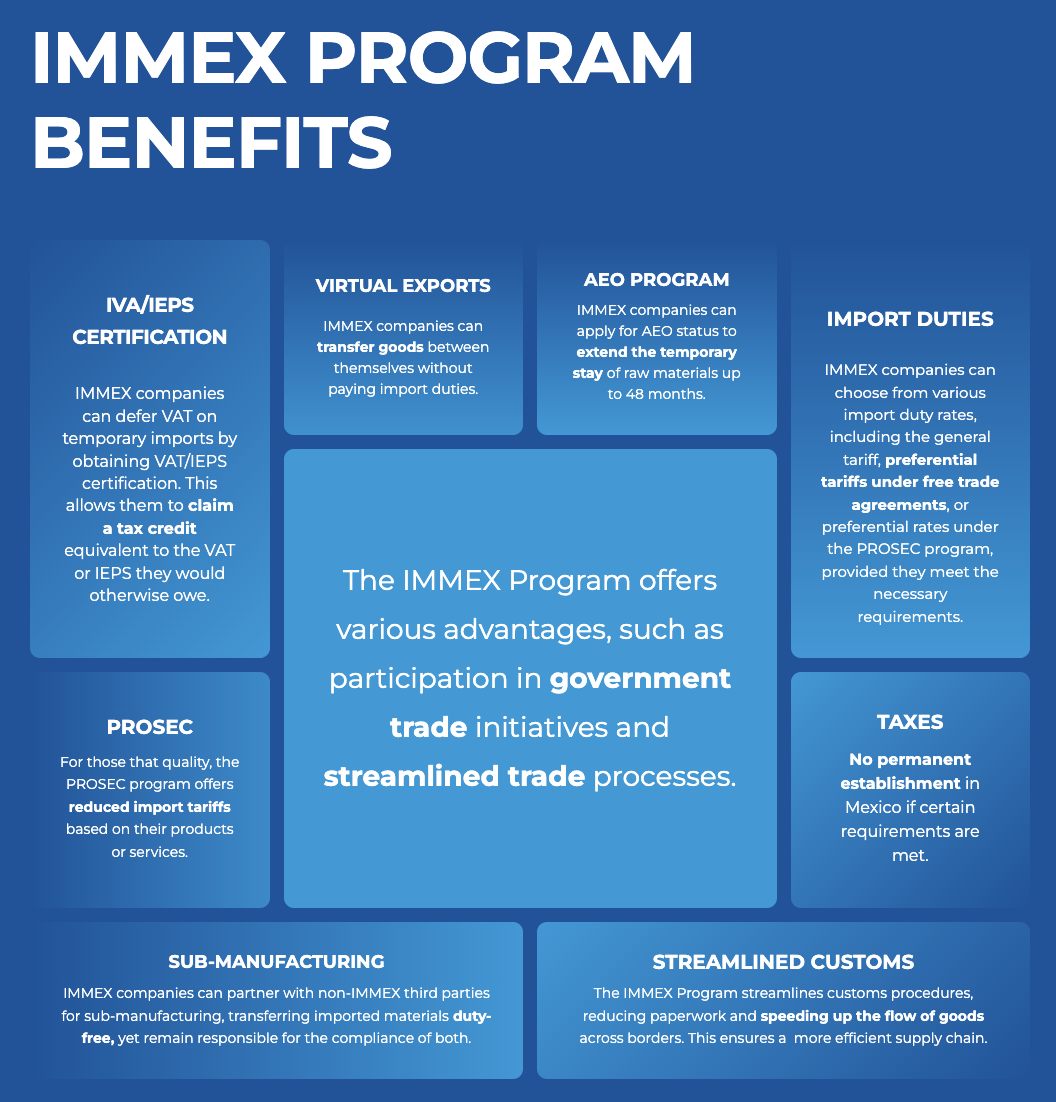
Key advantages of the IMMEX program include:
- Import tax deferral on raw materials and production inputs
- VAT exemptions or credits through IMMEX certification tiers (A, AA, AAA)
- Streamlined export processes aligned with USMCA and other trade agreements
By leveraging IMMEX, foreign investors can reduce operational costs, optimize cash flow, and accelerate time-to-market—making Mexico a strategic hub for global manufacturing.
The five types of IMMEX, and how to choose
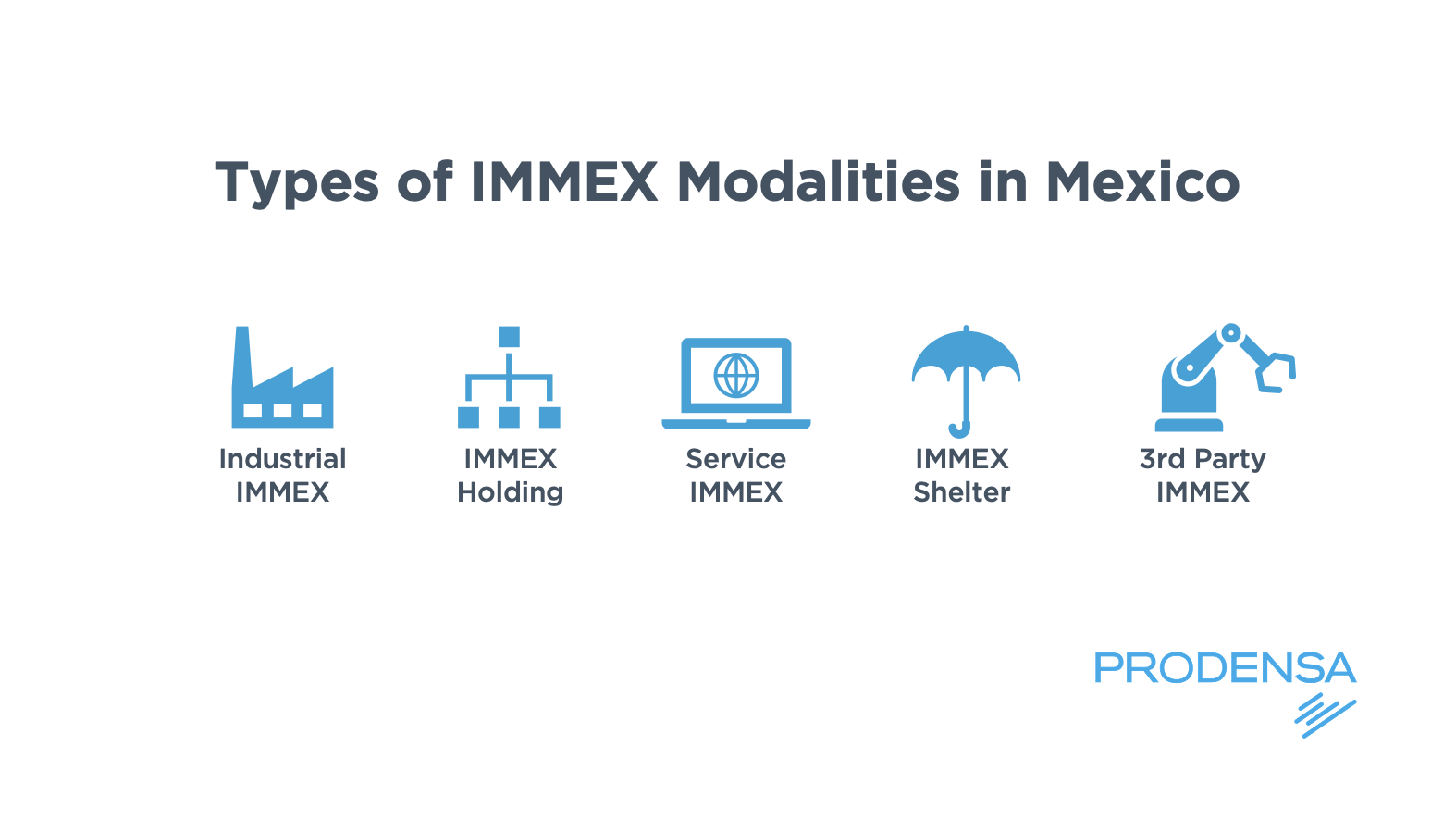
IMMEX is not one-size-fits-all. There are five program types, and the right one depends on how you intend to operate:
-
Industrial: the most common type, for a company running its own manufacturing operation in Mexico.
- Holding (Controladora): for an organization managing several IMMEX operations under one certificate.
- Services (Servicios): for companies delivering export services such as customer support, purchasing, and design engineering, rather than transforming physical goods. We cover this angle in IMMEX for export services.
- Shelter (Albergue): manufacturing under an operating partner that holds the IMMEX permit for you, so you can produce in Mexico without forming a Mexican legal entity. See our Shelter program resources hub.
- Third party (Terciarización): for companies that provide manufacturing services to other IMMEX holders.
The right modality depends on how you intend to operate and how much of the Mexican entity you want to own. We help you match the two through our IMMEX advisory practice.

The obligations built into the framework
The benefits are automatic only if the compliance is. Three obligations sit at the core of how IMMEX works:
-
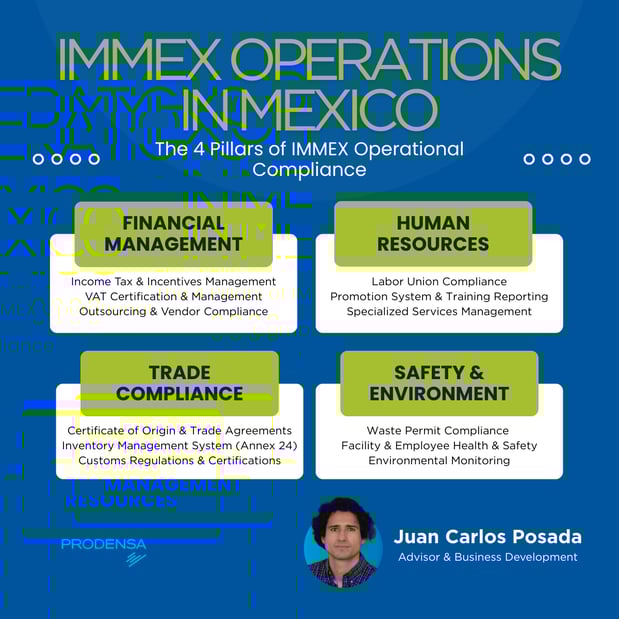
Annex 24 inventory control. Real-time tracking of every temporarily imported good. This is where most IMMEX problems start, and where SAT audits focus. We break it down in our Annex 24 guide and in IMMEX operative compliance.
- VAT/IEPS (CIVA) certification under Annex 30. Certification comes in three tiers, A, AA, and AAA, lasting one, two, and three years. Your tier determines your VAT credit, audit frequency, and bond requirements. See our VAT/IEPS (CIVA) certification guide.
- Timeframes and reporting. You must export within authorized windows, file periodic reports, and meet labeling and traceability rules. Miss them and the SAT can reclassify imports as definitive, which triggers duties and penalties.
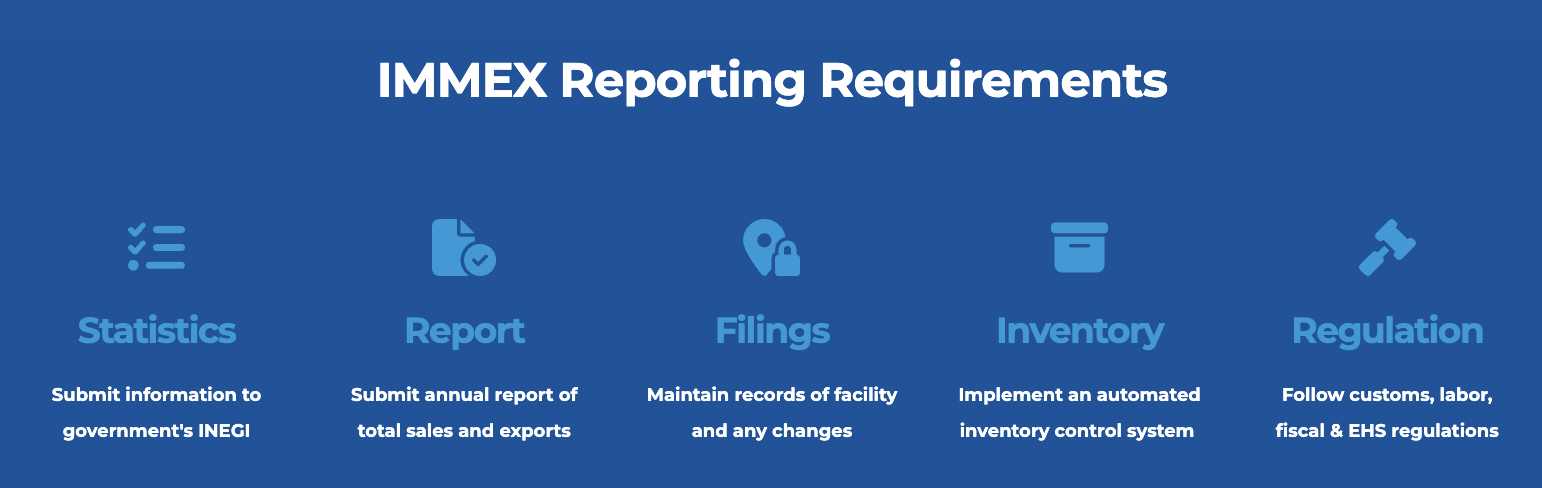
Under the Federal Fiscal Code (Article 103), misusing inventory systems or misreporting exports can be classified as contraband, with criminal liability for corporate officers. The framework rewards discipline and punishes drift.
What IMMEX means for your tax exposure
The are substantial tax advantages in the IMMEX program, but they come with legal obligations that decide whether those advantages hold. Three bodies of Mexican law govern the tax side of an IMMEX operation, and getting any of them wrong turns a benefit into a liability.
- Value-added tax and the VAT Law. Under the VAT Law (Articles 25 to 28-A), goods imported under IMMEX are subject to the general 16% VAT. By obtaining VAT certification you can defer that payment or take an immediate credit at customs, so the import is cashless for VAT. The certification level, A, AA, or AAA, sets the scope of your benefits, your compliance audit frequency, and your duration and renewal terms. For the mechanics, see our manufacturer's guide to VAT reimbursement.
- Income tax and permanent establishment risk. Articles 181 to 183 of Mexico's Income Tax Law define when a foreign company is treated as having a permanent establishment in Mexico, which can subject it to local income tax. The risk can apply even without your own physical presence. How you structure the operation, and which IMMEX modality you choose, determines the exposure.
- The Federal Fiscal Code. Article 103 of the Federal Fiscal Code classifies certain non-compliant IMMEX practices, such as misusing inventory systems or misreporting exports, as contraband. The consequences are not only financial. They can include high-value fines, suspension or cancellation of IMMEX benefits, and criminal liability for corporate officers. This is why inventory control and accurate reporting are tax decisions, not just paperwork.
How IMMEX works alongside the USMCA
IMMEX is the platform every trade strategy sits on, but it does not by itself make your product originate under the United States-Mexico-Canada Agreement (USMCA). That takes a separate rules-of-origin analysis.
USMCA Article 2.5 also limits duty-deferral programs like IMMEX from being used to avoid duties on non-originating inputs re-exported within the region. If your operation uses components from outside North America, for example from Asia, those inputs can still carry duties even when the finished product qualifies for duty-free export. Track country of origin for every input and reconcile deferred duties where they apply.
This is the binational reality. A sourcing decision made at headquarters in the United States shows up as a margin number at the plant in Mexico.
Two 2026 developments raise the stakes:
-
the USMCA joint review in 2026, bringing tighter scrutiny on rules of origin
-
after the US Supreme Court struck down the IEEPA tariffs in February 2026, USMCA qualification became more valuable.
A well-run IMMEX program is the foundation for both.
How Prodensa helps you run IMMEX
IMMEX is an advisory problem as much as it is a paperwork problem. The rules shift, the audits are frequent, and the penalties for getting inventory control, tax structuring, or origin wrong are real. We administer IMMEX operations end to end: registration, VAT/IEPS certification, Annex 24 and Annex 30 compliance, Authorized Economic Operator (AEO) certification, and origin determination. Our IMMEX practice is led by María Elena Sierra, former Head of Certification and Affairs at the SAT and a World Customs Organization certified AEO Expert, who currently administers more than 70 IMMEX operations for clients in Mexico.
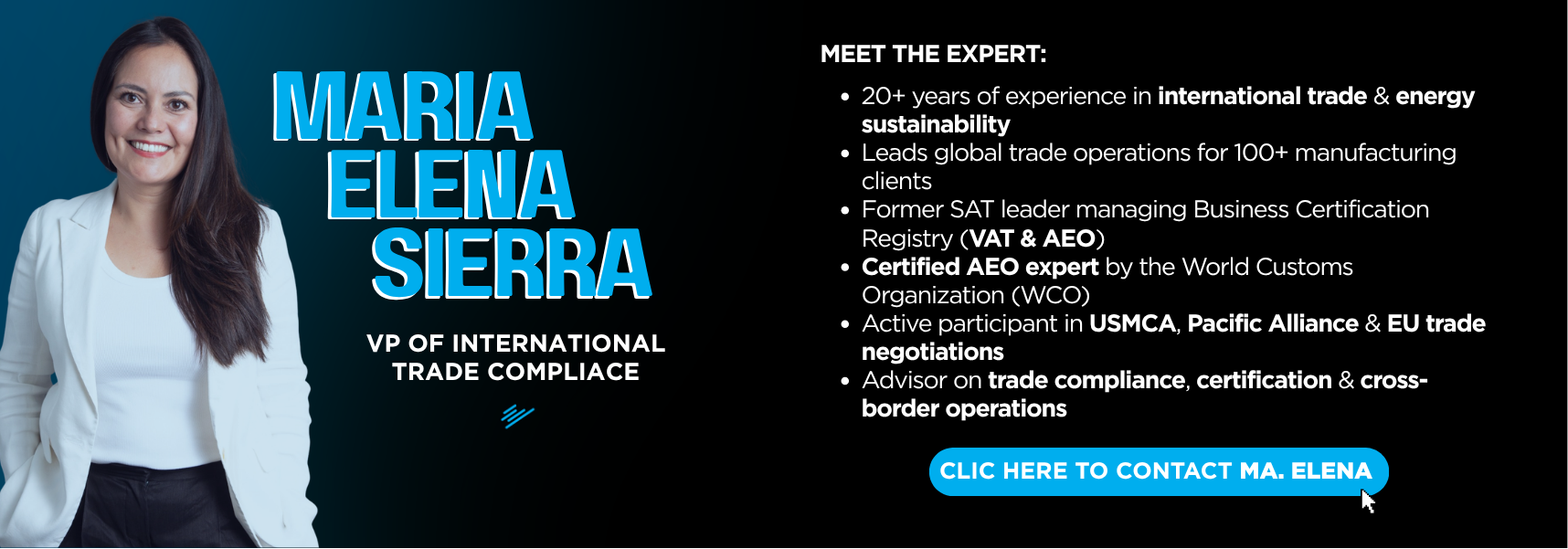
If you are choosing a program type, or pressure-testing whether your current program can withstand a 2026 audit, talk to our IMMEX advisory team.

Need Help with IMMEX Compliance?
Mexico's IMMEX Program offers exceptional benefits—but only when properly managed. At Prodensa, we help foreign investors and manufacturers navigate every stage of the IMMEX journey, from program enrollment to VAT certification and USMCA compliance.
If your company needs support with:
-
Setting up or maintaining Annex 24 inventory control systems
-
Applying for Annex 30 VAT certification
-
Auditing IMMEX compliance practices
-
Avoiding common legal and tax pitfalls
👉 Request a proposal or speak with one of our IMMEX compliance specialists today.
Frequently Asked Questions
How does the IMMEX program work?
IMMEX works as a closed loop. A company gets an IMMEX permit from the Secretaría de Economía, temporarily imports raw materials, components, and equipment into Mexico without paying the 16% VAT (cashless at customs with VAT/IEPS, or CIVA, certification), transforms or uses them, and exports the finished goods or services within authorized timeframes. Throughout, an Annex 24 electronic system tracks every item in real time, and the SAT audits that record.
What are the five types of IMMEX?
There are five: Industrial (own manufacturing), Holding or Controladora (several operations under one certificate), Services (export services rather than physical goods), Shelter or Albergue (operating under a partner that holds the permit, with no Mexican legal entity required), and Third party or Terciarización (manufacturing services for other IMMEX holders).
What taxes apply to an IMMEX operation?
Three apply. Imports carry the 16% VAT, deferred or credited with VAT/IEPS (CIVA) certification. Income tax can apply if the structure creates a permanent establishment under Articles 181 to 183 of the Income Tax Law. And non-compliance, such as misusing inventory systems, can be treated as contraband under Article 103 of the Federal Fiscal Code, with fines and criminal liability.
Does IMMEX remove VAT in Mexico?
Not automatically. Temporary imports are subject to the 16% VAT, but with VAT/IEPS (CIVA) certification an IMMEX company receives an immediate VAT credit at customs, so the import is effectively cashless for VAT. Certification comes in A, AA, and AAA tiers lasting one, two, and three years.
What is the difference between IMMEX and a maquiladora?
A maquiladora is a factory that imports materials, transforms them, and exports the finished goods. It is one way to operate under IMMEX, not a separate program. IMMEX is the broader legal framework, and it covers services as well as physical manufacturing.
Does IMMEX guarantee USMCA duty-free treatment?
No. IMMEX defers VAT and duties on temporary imports, but it does not make a product originate under the USMCA. Origin requires a separate rules-of-origin analysis, and non-originating inputs can still carry duties under USMCA Article 2.5 even when the finished product qualifies for duty-free export.
Article sources: