


What if the real competitive advantage in manufacturing today isn’t lower costs, but deeper integration? The United States–Mexico–Canada Agreement (USMCA) is often seen as just another trade deal, but in reality, it underpins one of the most powerful production ecosystems in the world.
As North America moves through the ongoing process of the 2026 USMCA review, the stakes are already high. The region represents nearly 30% of global GDP and operates as a tightly connected manufacturing platform where components move seamlessly across borders before becoming finished products. Companies that recognize this interconnected reality (and plan accordingly) will be better positioned to stay competitive, resilient, and ready for whatever changes come next.
Why USMCA Is Not Just a Trade Deal: The Hidden Power of North America’s Trilateral Manufacturing Engine
Policymakers often make the mistake of seeing the 2026 USMCA review as a series of separate two-country disputes. For investors and business planners, this view misses how closely connected manufacturing, logistics, and regulations are across North America.
One of the clearest indicators of this dynamic is the treaty utilization rate over the past year. The imposition of U.S. tariffs on goods originating outside the region created a powerful incentive for corporations to further align their operations with USMCA rules.
Throughout 2025, Mexican exports qualifying under USMCA provisions increased substantially, rising from representing less than half of total trade value to more than 80%. Similarly, utilization by Canadian companies reached its highest level in two decades, climbing to 53% of exports destined for the U.S. market, compared to 37% reported in 2024. (Federal Reserve Bank of Dallas (using U.S. Census Bureau and U.S. International Trade Commission DataWeb data; Global Affairs Canada.)
These figures confirm that the North American production system views the shared regulatory framework as essential infrastructure for maintaining operational viability. Weakening or challenging this common framework in favor of asymmetric bilateral agreements (a strategy promoted by certain sectors in Washington through tariff-based pressure) would represent a clear case of economic self-sabotage.
According to analyses from research institutions such as the Center for Strategic and International Studies (CSIS), losing trilateral integration would not only dismantle the value chains built over more than three decades, but would also reduce North America's systemic competitiveness against the commercial and technological momentum of East Asian economies.
For manufacturers operating under IMMEX programs in Mexico, this reality carries direct operational implications. Proper inventory management, VAT/IEPS Certification, and the traceability requirements established under Annexes 24 and 31 are the tools that enable companies to certify origin and maintain preferential access to the U.S. and Canadian markets.
Why USMCA Stability Matters for Global Manufacturers
At the corporate level, North America's largest automakers have already been forced to absorb billions of dollars in additional costs resulting from unilateral tariff measures imposed outside the USMCA framework.
General Motors reported an adverse impact of $1.1 billion in additional costs during the second quarter of 2025 alone. During the same period, Ford Motor Company estimated an annualized extraordinary expense of approximately $2 billion resulting from these tariff measures, including $800 million incurred in a single quarter.
These figures clearly demonstrate that barriers intended to selectively penalize one trading partner ultimately increase production costs for U.S.-based manufacturers themselves, weakening their global competitive position.
For companies planning to establish or expand operations in Mexico under this volatile environment, partnering with an experienced operational advisor that understands customs compliance and rules-of-origin certification has become a critical success factor.
Prodensa offers you comprehensive solutions ranging from strategic consulting and site selection to Shelter Services, enabling foreign manufacturers and investors to establish operations in Mexico quickly while minimizing the regulatory and operational risks associated with the ongoing USMCA review process.

-
USMCA Automotive Rules: What’s Changing and Why It Matters
The automotive industry represents North America's most sophisticated example of trilateral production integration, operating through a cross-border manufacturing network that moves approximately $400 billion in trade annually.
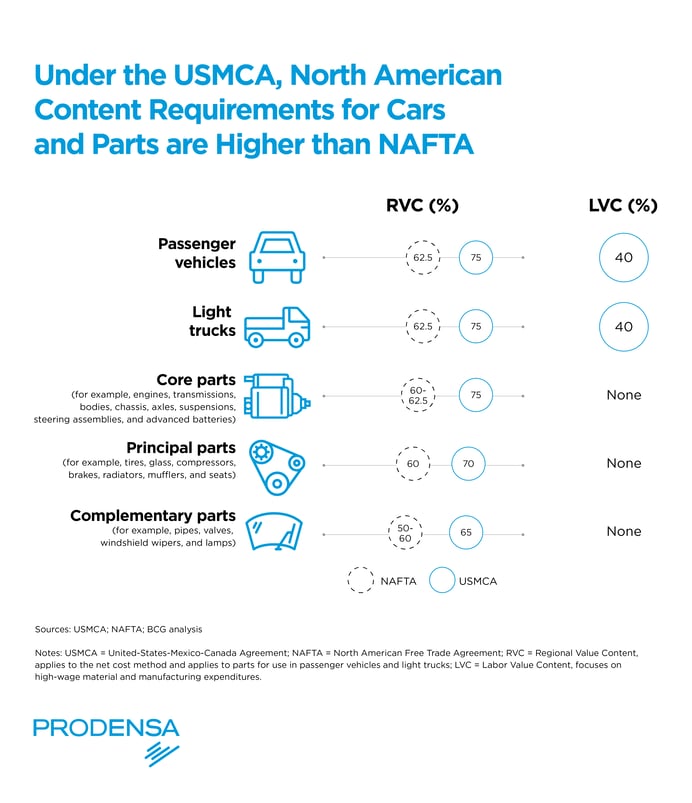
Under the USMCA framework that entered into force in 2020, significantly stricter origin requirements replaced those established under NAFTA, including:
- 75% Regional Value Content (RVC) for passenger vehicles.
- 40% to 45% Labor Value Content (LVC) generated in high-wage production facilities.
- A minimum of 70% regional steel and aluminum sourcing.
-
Why North American Content Requirements Are Getting Tougher?
Although approximately 90% of the vehicles imported by the United States from Mexico and Canada formally comply with the current Rules of Origin, the actual U.S.-origin content contained within those vehicles averages only 42%.
This gap explains why the U.S. delegation is expected to push for increasing the overall Regional Value Content threshold to levels approaching 80%, while also introducing specific requirements for a mandatory quota of direct U.S. content.
Manufacturers across all three countries oppose this proposal, arguing that drastic changes to the Rules of Origin would significantly increase administrative complexity and create unsustainable compliance costs.
In fact, analyses conducted by the U.S. International Trade Commission (USITC) reveal that, as regional certification costs have increased, several manufacturers have chosen to stop claiming USMCA preferential treatment altogether and instead pay the standard Most Favored Nation (MFN) tariff of 2.5% on passenger vehicles. This trend ultimately undermines the treaty's primary objective of strengthening regional integration.
-
Controlling Inputs of Asian Origin
The primary point of friction lies in the U.S. demand for stronger safeguards to prevent Chinese companies from using Mexico or Canada as assembly platforms for entering the North American market.
The United States is expected to propose restrictive caps limiting indirect Asian content to approximately 20% to 25% of a vehicle's total value. These restrictions would extend beyond components imported directly from China, potentially including parts manufactured within North America by facilities owned or controlled by Chinese capital.
Agri-Food Trade Under USMCA: Growth, Integration, and Emerging Risks
North America's agricultural and food sector represents a highly efficient and complementary continental system, where climate, geography and production specialization create an integrated market serving the needs of more than 500 million consumers.
Since the implementation of NAFTA (and later its modernization through the USMCA) agricultural and livestock trade among the three countries has experienced sustained growth, making Canada's and Mexico's markets the United States' most important agricultural trading partners.
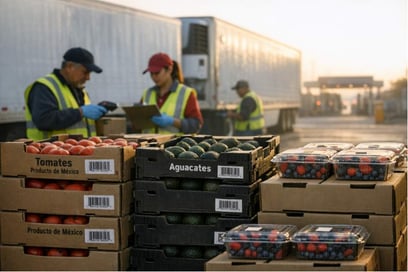 Agricultural exports and imports between the United States and Canada have increased fourfold and tenfold, respectively, since the original agreement entered into force.
Likewise, agricultural trade between Mexico and the United States has expanded dramatically. Mexican agricultural exports have grown nearly fifteenfold, while imports from the United States have increased fivefold.
Today, bilateral agricultural trade between both countries exceeds $45 billion annually, with Mexico maintaining an agricultural trade surplus of approximately $11 billion, supported by $28 billion in exports compared to $17 billion in imports.
*Sources: U.S. Department of Agriculture (USDA), Foreign Agricultural Service (FAS).
Agricultural and Livestock Integration Patterns in North America
| Regional Integration Pattern | Synergies and Operating Mechanism | Impact and Vulnerability During Trade Frictions |
|---|---|---|
| North-to-South Grain and Oilseed Flows | The United States exports land-intensive crops—including corn, soybeans, and wheat—which represent 73.3% of its agricultural exports to Mexico. | Livestock feed shortages in Mexico and income losses for farmers across the U.S. Midwest. |
| South-to-North Fruit and Vegetable Flows | Mexico leverages its climate and labor advantages to export fresh fruits and vegetables, representing 73.1% of its agricultural exports to the United States. | Immediate increases in fresh food prices for U.S. consumers. |
| U.S.-Canada Cross-Specialization | Two-way trade in similar but differentiated agricultural products, such as U.S. soybeans and soybean products versus Canadian canola. | Greater vulnerability to retaliatory tariffs and reciprocal technical trade barriers affecting competitive product categories. |
| Cross-Border Pork Supply Chain | Canada exports piglets and live hogs to the United States for feeding and processing, while the United States exports processed pork to Mexico, accounting for 37% of total U.S. pork exports. | Disruption of the regional meat supply chain, resulting in shortages and higher prices for an essential protein source in the Mexican market. |
Sources: U.S. Chamber of Commerce, CSIS, Brookings Institution
This system functions under a model of two-way seasonal and industrial complementarity. However, the ecosystem remains highly vulnerable to retaliatory measures stemming from trade disputes in unrelated sectors, as well as to the introduction of non-tariff sanitary, phytosanitary, and biotechnology barriers.
How Mexico and Canada Are Reinforcing North American Supply Chains
The U.S. administration's efforts to push its partners toward separate bilateral negotiations have strengthened diplomatic coordination between Canada and Mexico. Both countries recognize that the United States holds substantially greater leverage in one-on-one negotiations, reducing their ability to defend shared regulatory interests.
In February 2026, Canada reinforced this partnership by deploying its Team Canada Trade Mission to Mexico, led by Dominic LeBlanc. Bringing together more than 370 delegates and 240 business organizations, it represented Canada's largest bilateral commercial mission to Mexico in more than two decades.

On September 18, 2025, Mexican President Claudia Sheinbaum and Canadian Prime Minister Mark Carney met to launch the Canada–Mexico Action Plan 2025–2028 and reaffirm their commitment to strengthening the USMCA and North American competitiveness.
The mission resulted in the signing of the Canada–Mexico Action Plan 2025–2028, elevating the bilateral relationship to a Comprehensive Strategic Partnership focused on prosperity, labor mobility, shared security, and sustainable industrial development.
Working alongside Mexico's Secretary of Economy, Marcelo Ebrard, both governments established a common front aimed at protecting three fundamental pillars of the USMCA.
You Must Be One Step Ahead
The USMCA is not renegotiated every day. What happens over the coming months will define the competitive landscape for North American manufacturing throughout the next decade.
The companies investing today in knowledge, compliance, and operational readiness will be the ones best positioned to capitalize on North America's deep integration once today's regulatory uncertainty begins to subside.
That is why we developed the executive report: "USMCA 2026: What Executives Need to Know (Before Everyone Else)." Designed specifically for manufacturing, logistics, customs, and supply chain leaders, this report provides strategic insights into the regulatory, operational, and geopolitical developments already reshaping the rules of doing business in North America.


Regional Value Content (RVC): The percentage of a product's value that must originate within North America to qualify for preferential treatment under the USMCA. Passenger vehicles currently require 75% RVC.
Labor Value Content (LVC): A USMCA requirement mandating that a portion of a vehicle's value be produced in facilities that meet specific wage thresholds, encouraging higher-value manufacturing within the region.
Rapid Response Labor Mechanism (RRM): A facility-specific dispute resolution mechanism unique to the USMCA that allows labor complaints to be investigated quickly and may result in restrictions on imports from non-compliant facilities.
Chapter 31: The USMCA's formal dispute settlement mechanism, providing binding panel decisions to resolve disagreements between member countries.
Rules of Origin: The criteria used to determine whether a product qualifies as originating within North America and is therefore eligible for preferential tariff treatment under the USMCA.

Will the 2026 USMCA review eliminate the agreement?
No. The review is designed to evaluate and potentially update the agreement—not terminate it. Most discussions focus on modernizing specific provisions rather than replacing the treaty itself.
Which industries are most likely to be affected?
Automotive, electronics, advanced manufacturing, agriculture, medical devices, aerospace, and any industry with highly integrated North American supply chains are expected to experience the greatest impact.
Should companies postpone investment decisions until the review is complete?
In most cases, no. Many companies are instead strengthening their compliance, origin certification, and supply chain resilience so they are prepared regardless of the review's outcome.
Why are Rules of Origin becoming increasingly important?
As governments seek to encourage regional production while limiting dependence on non-regional suppliers, origin compliance is becoming one of the primary determinants of tariff eligibility and long-term competitiveness.
How can manufacturers prepare today?
Companies should evaluate their supply chains, review origin qualification, strengthen customs compliance, verify Annex 24 and Annex 31 processes where applicable, and develop contingency scenarios for potential regulatory changes.

- The USMCA is more than a trade agreement. It's the operational framework supporting North America's integrated manufacturing ecosystem.
- Regional integration continues to deepen. Recent increases in USMCA utilization rates demonstrate that manufacturers are relying more heavily on the agreement to remain competitive.
- Rules of Origin will become increasingly strategic. Companies should expect greater scrutiny of Regional Value Content (RVC), Labor Value Content (LVC), and the origin of critical components, particularly in the automotive sector.
- Compliance is now a competitive advantage. Strong customs processes, origin certification, Annex 24 and Annex 31 management, and VAT/IEPS compliance help companies preserve preferential market access while reducing operational risk.
- Supply chain resilience depends on preparation, not prediction. Manufacturers that evaluate sourcing strategies, strengthen traceability, and model multiple regulatory scenarios will be better positioned regardless of the outcome of the 2026 review.
- Mexico remains a strategic manufacturing platform. Its integration with the United States and Canada, combined with specialized manufacturing capabilities and a mature supplier ecosystem, continues to make it one of the world's most competitive production locations.
- Early planning creates long-term value. Companies evaluating expansion into Mexico should assess customs strategy, site selection, operational structure, and regulatory compliance from the outset to avoid costly adjustments later.