

Mexico's automotive sector continues to prove why it's one of the most strategically important manufacturing platforms in North America. As global supply chains shift, trade policies evolve, and electromobility accelerates, the country remains a cornerstone for vehicle production, autoparts manufacturing, and cross-border integration with the United States.
Our newly released Mexico's Automotive Industry 2026 eBook provides a comprehensive, data-driven look at the industry's current state: from production volumes and workforce development to regional clusters, foreign direct investment, and the growing EV ecosystem.
Below, we break down the key takeaways.

Mexico by the Numbers: a global automotive powerhouse
Mexico's position in the global automotive landscape is hard to overstate.
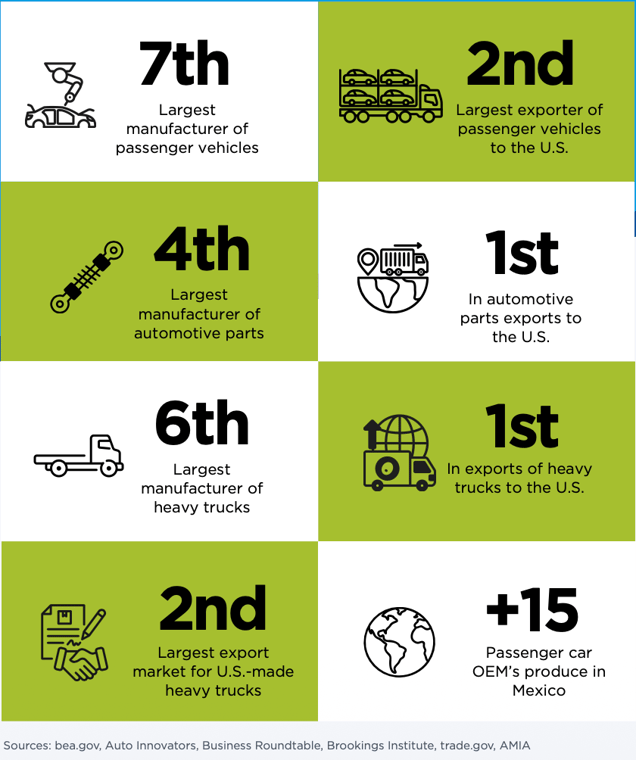
The automotive industry contributes 3.8% of Mexico's national GDP and 20% of its manufacturing GDP. With more than 1,000 exporting automotive suppliers operating across the country and the U.S. supplying nearly 38% of the foreign content embedded in Mexican automotive exports to the U.S.*, the integration between both economies runs deep.
The industry exports 87% of its total production, and 79% of those exports are destined for the United States. Mexico also hosts more than 26 automotive-focused R&D centers staffed by over 15,000 engineers — a clear sign that the country is moving well beyond assembly into design and innovation.
Source: INA with data from INEGI, ANUIES, AMIA
*There is a range between 20–38% that reflects two accepted methods for measuring U.S. content in Mexican vehicle exports. The lower figure (~20%) uses the standard value-added approach (OECD Trade in Value Added), which measures the share of a vehicle's total value created in the United States. The higher figure (~38%) uses a refined input-tracing method (De Gortari) that follows where components actually originate — reflecting that the U.S. supplies roughly 74% of the foreign inputs embedded in these vehicles. Source: Peterson Institute for International Economics (PIIE), 2024, based on OECD TiVA and De Gortari (2019); 2020 data.
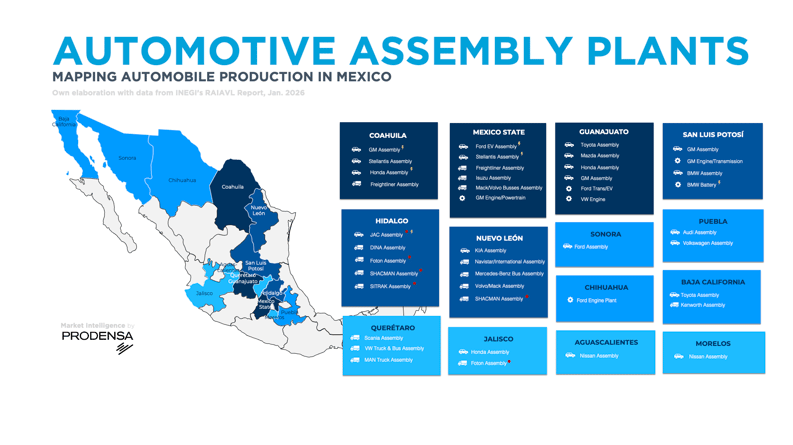
Mexico's automotive ecosystem is concentrated by clusters that supply both passenger and heavy vehicles.
Production & Sales: steady output in a shifting market
In 2025, total passenger vehicle production in Mexico reached 3.95 million units, a slight 0.9% decrease compared to 2024. Exports totaled 3.39 million units.
|
(billion units) |
2020 |
2021 |
2022 |
2023 |
2024 |
2025 |
|
Total Production |
3.04 |
2.979 |
3.308 |
3.526 |
3.989 |
3.953 |
|
Total Exports |
2.681 |
2.706 |
2.865 |
3.071 |
3.479 |
3.385 |
|
Total Imports |
0.765 |
0.991 |
1.176 |
1.36 |
1 |
0.98 |
Sources: INEGI, AMIA
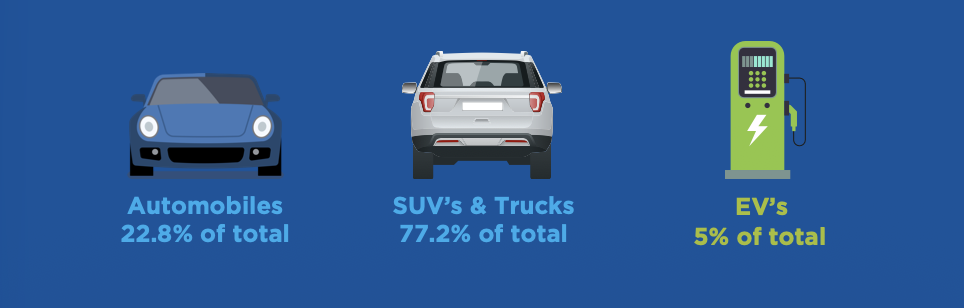
SUVs and trucks now account for 77.2% of total production.
On the sales side, Mexico's domestic light vehicle market saw a modest uptick, with 1.52 million units sold in 2025, a 1.35% increase over the prior year.
Nissan, General Motors, and Toyota remain top-selling brands.
While KIA and other newer entrants continued to gain ground.
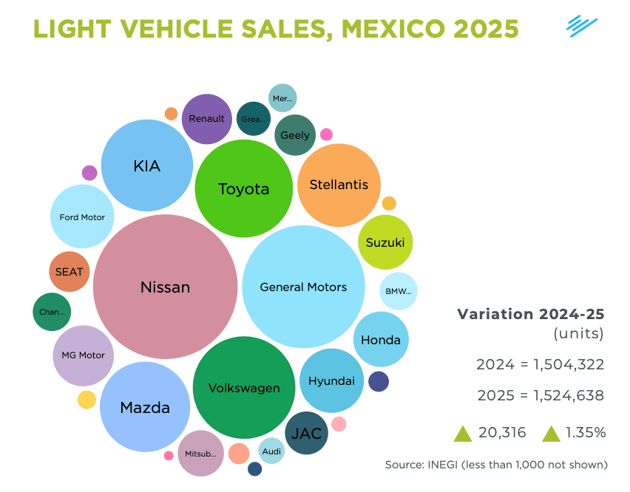 Note - graphic includes both imported and domestically produced autos.
Total vehicle imports reached nearly 989,000 units, down 1.5% year-over-year. A closer look at where those imports originate reveals a more nuanced story.
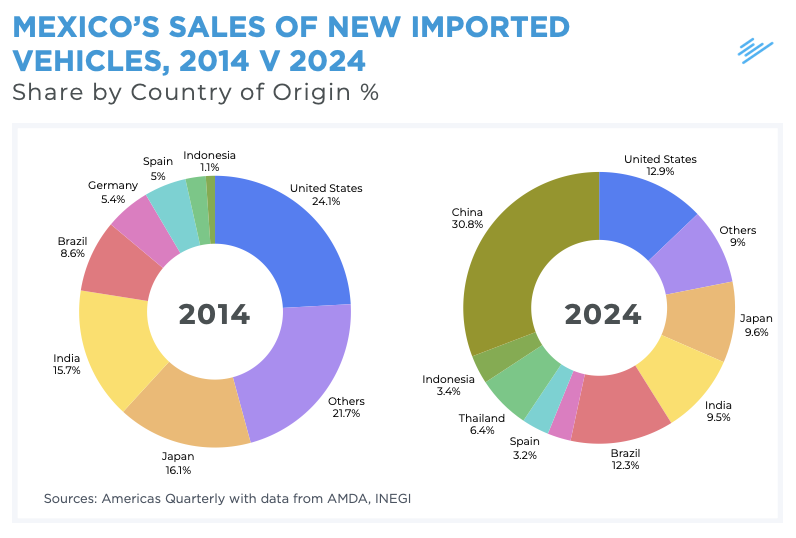
Nearly 40% of light vehicle imports by country came from China in 2025, though many were actually produced by Western OEMs.
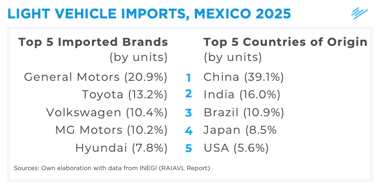
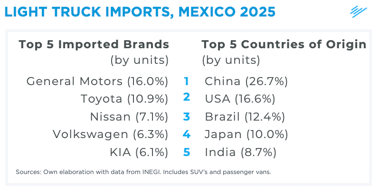
This distinction between manufacturing location and brand origin is becoming increasingly important as trade policy shifts toward greater scrutiny of supply chain origin.
Read more about Mexico and China's trade relationship.
The data above represents just the top level view. The full eBook digs into the rapidly evolving role of Chinese automakers in Mexico.
Download the 2026 Mexico Auto Industry Report for the full OEM-by-OEM breakdown.
Data included in the full eBook:
- Production & Export by OEM, Passenger & Heavy Vehicles
- Chinese OEM Production and Sales, Passenger & Heavy Vehicles
- Electric Vehicle Models Produced in Mexico
👉 Download the full 2026 automotive industry report.
The Autoparts Sector: $119 Billion and Growing
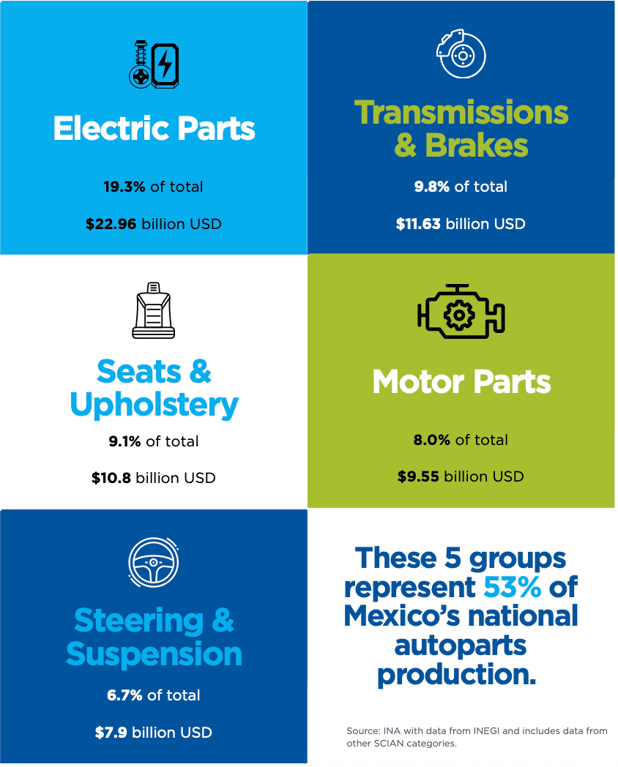
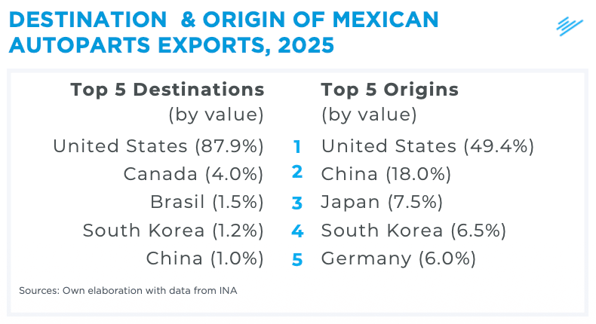
Mexico's autoparts industry generated $119 billion in total production in 2025, with $103.5 billion in exports, with the vast majority heading to the United States (87.9% by value). The sector contributed approximately 6.3% to the country's national manufacturing GDP.
The top five autoparts categories produced in Mexico together account for 53% of total national production.
Electric parts alone account for 19.3% of the total, valued at nearly $23 billion.
Mexico supplies the United States with approximately 42% of its imported autoparts, and in 2025 the country posted a $35.4 billion surplus in autoparts trade globally (Cluster Industrial).
But the real opportunity lies in localizing what's still missing from the supply chain. A significant portion of inputs used in Mexican automotive production, particularly:
-
advanced materials,
-
precision components,
-
and specialized processes
are still imported. For manufacturers and suppliers considering expansion, this gap represents a meaningful entry point.
Electric Vehicles: a distributed ecosystem takes shape
EV production in Mexico reached 198,678 units in 2025, led by established global OEMs.
Ford's Mustang Mach-E topped the list with nearly 60,000 units, followed by GM's Equinox EV & Honda's Prologue.
Notably, Stellantis entered the market with the Wagoneer S, producing over 12,000 units (a 152% increase from its initial ramp-up).
|
OEM |
Model |
Units Produced |
% Change from 2024 |
|
FORD |
Mustang Mach-E |
59,769 |
10.90% |
|
Honda |
Prologue |
33,338 |
-28.30% |
|
General Motors |
Equinox EV |
75,912 |
24.40% |
|
General Motors |
Blazer EV |
16,826 |
-50.20% |
|
Stellantis |
Wagoneer S |
12,010 |
152.20% |
|
JAC |
E10X |
508 |
-38.30% |
|
JAC |
EJ7 |
0 |
-100.00% |
|
JAC |
ESei4 Pro |
40 |
42.90% |
|
JAC |
EX450 |
275 |
2,650.00% |
|
Total |
|
198,678 |
-1.10% |
Source: INEGI RAIAVL Report January 2026
Rather than building a single EV mega-hub, Mexico is developing a distributed ecosystem of EV suppliers that supports vehicle production across North America. In 2025, 45 electromobility-related projects were announced, totaling $1.57 billion in investment (Cluster Industrial Automotive Investment Report Q4 2025) focused on battery components, power electronics, lightweight materials, and EV drivetrain systems.
Mexico's role in the EV transition is not to replace existing production hubs, but to complement and integrate with North America's evolving automotive ecosystem.
Workforce: deep talent, institutional support
Mexico's automotive workforce is one of its most compelling competitive advantages. The sector employs over 1 million workers, including nearly 1,000 who assemble vehicles directly at OEM plants and the ecosystem of autoparts and service suppliers.
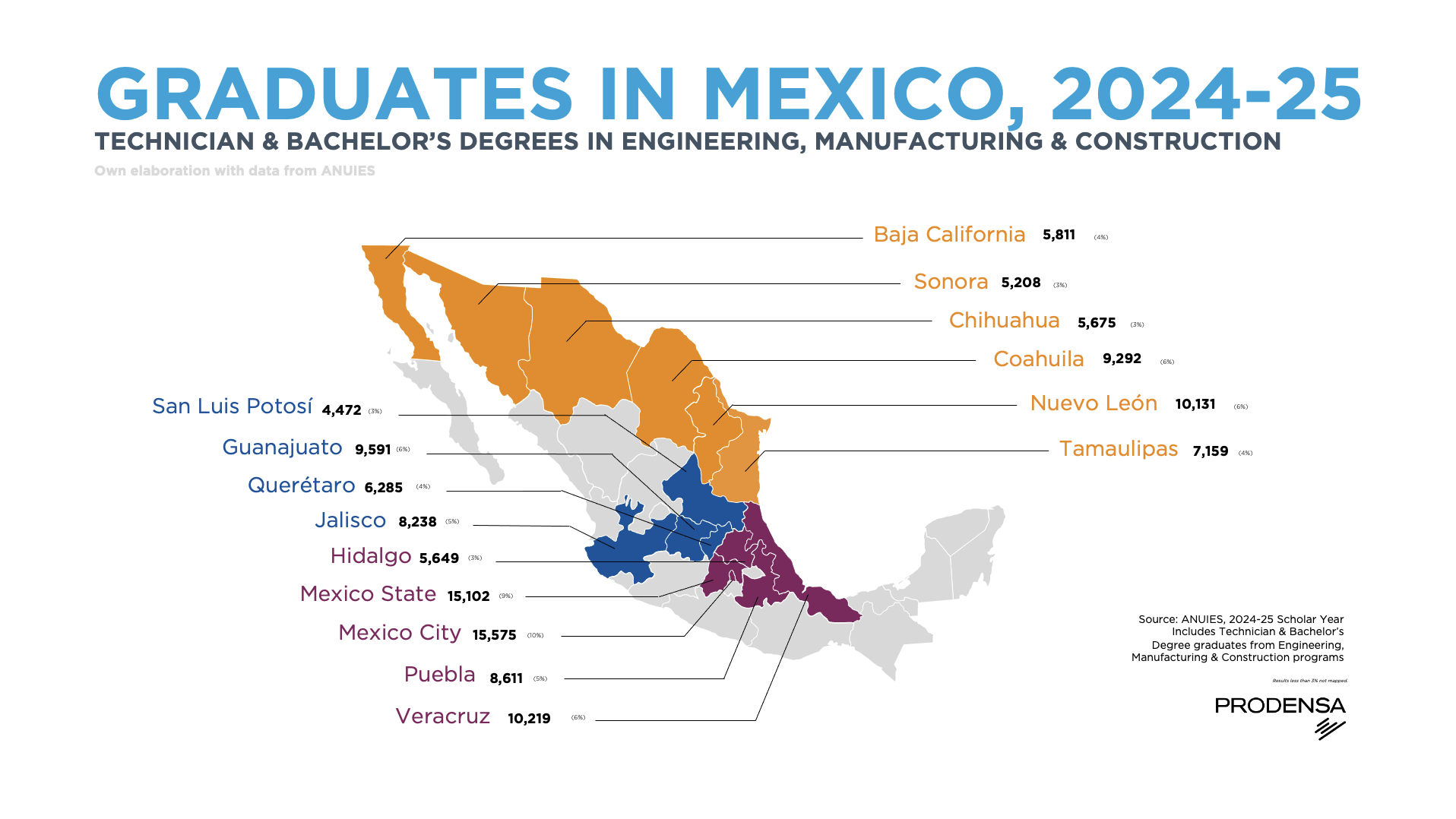
More than 145,000 technicians and engineers graduate annually from relevant programs.
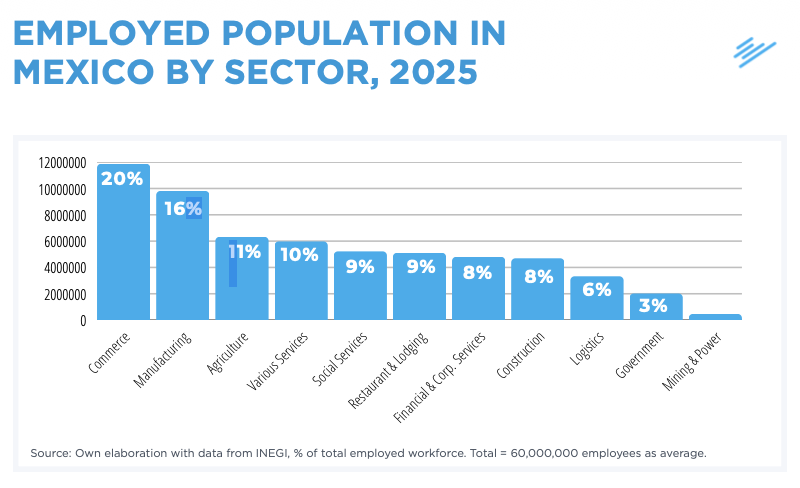
Manufacturing is Mexico's largest employment sector, engaging nearly 10 million people, about 16% of the total employed workforce.
The country boasts one of the largest technical and vocational training systems in the OECD, with 23 bachelor's-degree programs in automotive engineering and a growing network of dual-education partnerships between universities and companies.
Beyond production, Mexico's automotive industry increasingly designs, engineers, and innovates. With 26 R&D centers and three OEM-run feeder programs alongside assembly operations, the country is building a layered talent pipeline that serves both basic manufacturing and advanced engineering needs.
Automotive Clusters: the strategic corridors
Mexico's automotive manufacturing footprint spans 15 states and is concentrated in three strategic corridors, each deeply integrated with U.S. supply chains.
The Bajío Region including Guanajuato, San Luis Potosí, Aguascalientes, and Querétaro is considered the 3rd most important automotive cluster in North America, representing nearly 50% of Mexico's vehicle production capacity. Guanajuato alone hosts General Motors, Mazda, Toyota, and Honda, supported by over 440 Tier 1, 2, and 3 suppliers and more than 2,400 automotive-related companies.
The Northern Border States account for over half of all autoparts production. Nuevo León has emerged as Mexico's leading electromobility and advanced automotive manufacturing hub, while Coahuila is home to Stellantis, Daimler Freightliner, and General Motors, with automotive exports representing 65% of the state's total.
The Central Mexican Valley, anchored by Mexico State and Puebla, serves as a logistics and e-commerce hub with deep manufacturing roots. Puebla alone — home to Volkswagen and Audi — sees over 40% of its GDP tied to the automotive industry.
Investment: $9.2 billion in automotive investment
Even as global investment slowed in 2025, Mexico attracted $9.26 billion in total automotive FDI across 204 announced projects from 20 different countries. These projects are expected to create over 55,920 jobs and span more than 2,274 hectares of new industrial development.
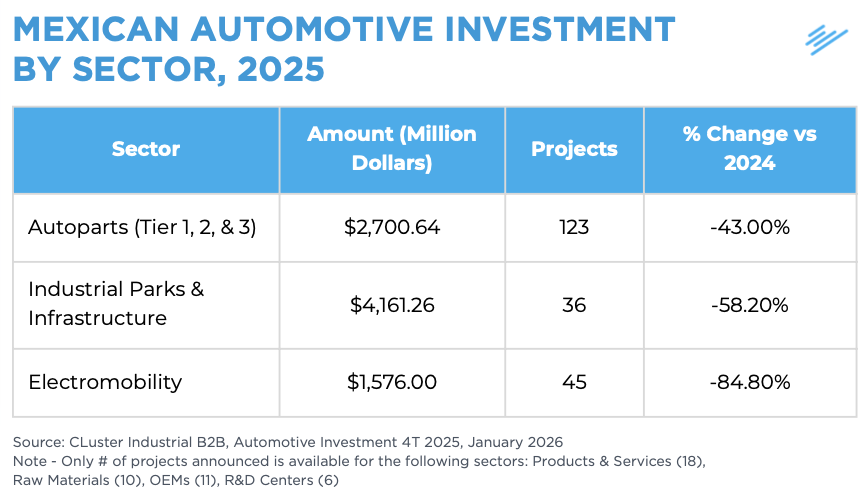
Investment continues to concentrate in the North and Bajío regions, where mature supplier ecosystems already exist and integration with U.S. markets is tightest.
The top states for automotive FDI include Nuevo León ($1.45 billion), San Luis Potosí ($762 million), and Guanajuato ($447 million).
Mexico's domestic reinvestment accounted for 53.4% of total automotive FDI, signaling strong confidence from companies already operating in the country. China followed at 11.3%, the USA at 10.5%, and South Korea at 7.3%.
Download the 2026 Mexico Auto Industry Report for the full OEM-by-OEM breakdown.
Data included in the full eBook:
- State-by-state FDI tables with project details, including EV projects
- Investment-by-sector breakdown
👉 Download the full 2026 automotive industry report.
The U.S.-Mexico Connection: deeply intertwined
The automotive relationship between the U.S. and Mexico is not just about trade volumes; it is a shared production system.
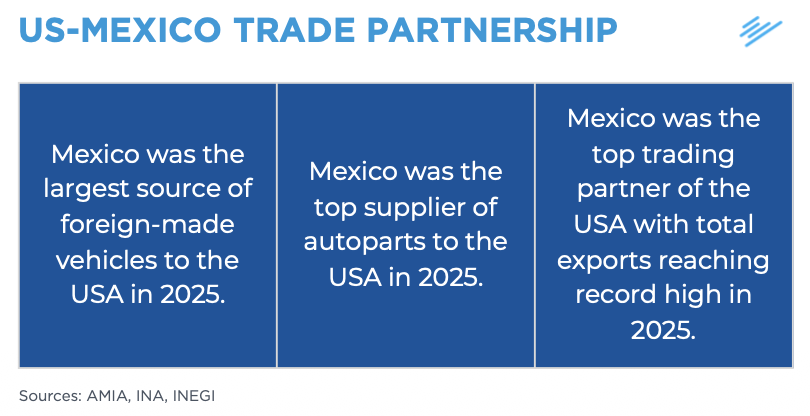
In fact, 74% of the direct and indirect inputs incorporated into vehicles manufactured in Mexico come from the United States.
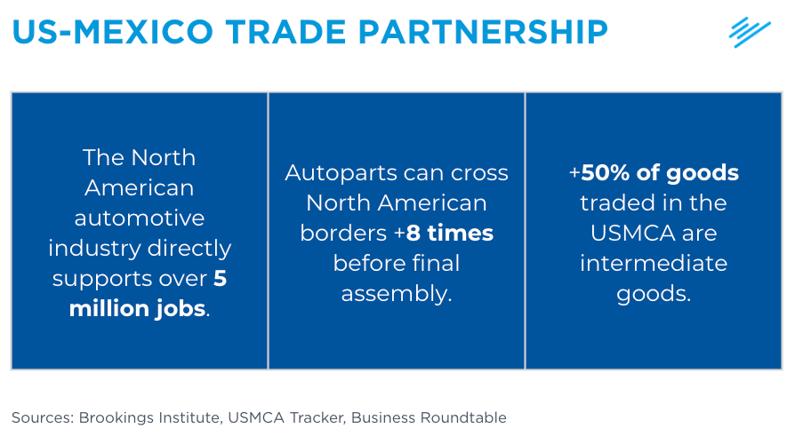
For manufacturers evaluating their North American strategy, Mexico is not just a low-cost alternative. It is a deeply integrated, trade-advantaged production platform with the workforce, infrastructure, and supplier base to support complex, high-value manufacturing.
Get the Complete Picture
This blog post covers the highlights, but the full Mexico's Automotive Industry 2026 eBook goes much deeper — with OEM-level production tables, regional cluster maps, Chinese OEM market data, detailed FDI breakdowns by state and sector, workforce statistics, and more.
Whether you're an automotive manufacturer exploring Mexico for the first time or an established supplier looking to expand, this eBook is your essential reference.
-1.png?width=1200&height=400&name=Ebook%20Banners%20(7)-1.png)
Prodensa has been serving foreign investors in the manufacturing industry since 1985, supporting over 1,000 industrial projects across Mexico. To discuss your automotive manufacturing or supply chain strategy, schedule an advisory session(https://www.prodensa.com/insights) or call +1 (888) 202-2745.

Interested in Manufacturing in Mexico?
