The 2026 USMCA Joint Review
is not just a policy milestone.
It's a strategic inflection point for manufacturers in Mexico.
This page is your live operational intelligence hub:
- real-time updates
- enforcement trends
- on-the-ground insights from the front line
The 2026 USMCA Joint Review is not just a policy milestone. It's a strategic inflection point for manufacturers in Mexico.
This page is your live operational intelligence hub:
-
real-time updates
-
enforcement trends
-
on-the-ground insights from the front line
A North American Platform Worth Protecting
North America today operates less like three separate economies and more like a single production platform. The depth of integration between the United States and Mexico is visible not only in the $800 billion in annual trade, but in the daily movement of materials, energy, components, and talent that make modern manufacturing possible across the region. Mexico is now the United States’ largest trading partner and one of its most important co-production allies, supplying critical manufacturing capacity while simultaneously serving as a major market for U.S. agriculture, energy, and industrial goods.
This integration did not happen overnight. It is the result of three decades of industrial collaboration built first under NAFTA and now under the United States–Mexico–Canada Agreement. Supply chains have matured, companies have invested billions into regional production, and manufacturers have built highly sophisticated cross-border ecosystems that depend on regulatory stability and operational trust.
The upcoming USMCA review represents an important moment for that system. For policymakers, it is an opportunity to evaluate how the agreement has performed in a changing geopolitical and economic environment. For companies operating across North America, however, it is something more practical: a reminder that trade frameworks are not abstract policy discussions but the rules that shape real production networks, capital investment, and employment across the region.
At Prodensa, we operate alongside more than one hundred manufacturing facilities in Mexico and support many more through consulting and operational services. From this vantage point, one thing is clear: the North American manufacturing platform has become one of the most competitive production ecosystems in the world. Much of that success comes from proximity, shared industrial culture, and a deeply integrated supplier base that allows companies to respond faster to markets and manage increasingly complex supply chains.
At the same time, the environment surrounding global trade is evolving rapidly. Geopolitical shifts, technological change, sustainability requirements, and new expectations around supply chain transparency are all reshaping how companies organize production. These forces are accelerating regionalization and reinforcing the strategic importance of North America as a manufacturing base.
This page is intended to provide a continuous window into that evolving landscape. Each week we will share insights, data, and perspectives on the policies, operational trends, and strategic considerations shaping the future of USMCA and North American manufacturing.
Our goal is simple: to help leaders understand not just the headlines around trade policy, but the deeper structural forces shaping one of the most important industrial regions in the world.
Because in the end, USMCA is not just a trade agreement.
It is the framework that sustains one of the most integrated production platforms on the planet.

What is the USMCA Joint Review?
Chain Leaders
For manufacturing operations inside Mexico, the 2026 USMCA Joint Review is not an abstract policy discussion. It functions as a real-time stress test of your compliance architecture, supplier documentation, and internal governance.
The review process creates: increased political signaling, heightened enforcement positioning, pressure around Rules of Origin, and greater scrutiny of labor, energy, and compliance frameworks.
The companies most exposed are not the ones watching headlines — but the ones operating without audit-ready systems.
- Political noise happens in Washington.
- Enforcement happens inside your plant.
For manufacturing operations inside Mexico, the 2026 USMCA Joint Review is not theoretical.
It functions as a real-time stress test of your compliance architecture, supplier documentation, and internal governance.
The companies most exposed are not the ones watching headlines — but the ones operating without audit-ready systems.
Across sectors, we are observing:
• Increased IMMEX audit frequency
• Greater Annex 24 & Annex 30 scrutiny
• Origin verification activity in automotive and electronics
• Heightened labor documentation review
• Expanded coordination requirements between Mexican and U.S. customs brokers
For supply chain and procurement leaders, the 2026 USMCA Joint Review will directly influence sourcing decisions across North America.
Rules of Origin requirements and regional value content thresholds are pushing companies to re-evaluate supplier footprints and manufacturing inputs.
Across North American supply chains, we are seeing:
• Supplier localization within the USMCA region
• Greater pressure to meet regional value content (RVC) thresholds
• Sourcing shifts away from Asia toward North America
• Increased scrutiny of supplier origin documentation
• Higher risk of origin verification audits
For trade compliance and legal teams, the 2026 USMCA review represents a significant escalation in regulatory scrutiny.
While policy discussions occur at the government level, enforcement is implemented through origin verification, customs audits, and compliance investigations.
• Origin certification accuracy
• Annex 24 and Annex 30 inventory control systems
• Customs and SAT audit exposure
• Rapid Response Mechanism labor cases
• Tariff exposure tied to incorrect origin claims
The 2026 Review Impact on Mexico Operations
If interpretation tightens or enforcement accelerates:
- Supplier structures may need adjustment
- BOM validation becomes critical
- Certification exposure increases
- North American sourcing pressure intensifies
Companies certifying origin without documented validation face elevated risk.
Read More
Enforcement trends suggest:
- Higher probability of Annex 24/30 audits
- Inventory reconciliation scrutiny
- Greater SAT documentation requests
- Increased coordination requirements between Mexican and U.S. customs brokers
Manual compliance systems are becoming insufficient.
Read More
The Rapid Response Labor Mechanism remains active and politically visible.
For Mexico operations, this means:
- Collective bargaining scrutiny
- Contract legitimacy validation
- Documentation transparency expectations
- Wage structure analysis
Labor exposure is now trade exposure.
Read More
Shifts in tariff structures or regional sourcing pressure may increase reliance on:
- PROSEC program optimization
- Rule 8 strategies
- Alternative supplier identification
Tariff engineering must align with origin compliance.
Read MoreUSMCA Review Radar: Mexico Operational Risk Matrix

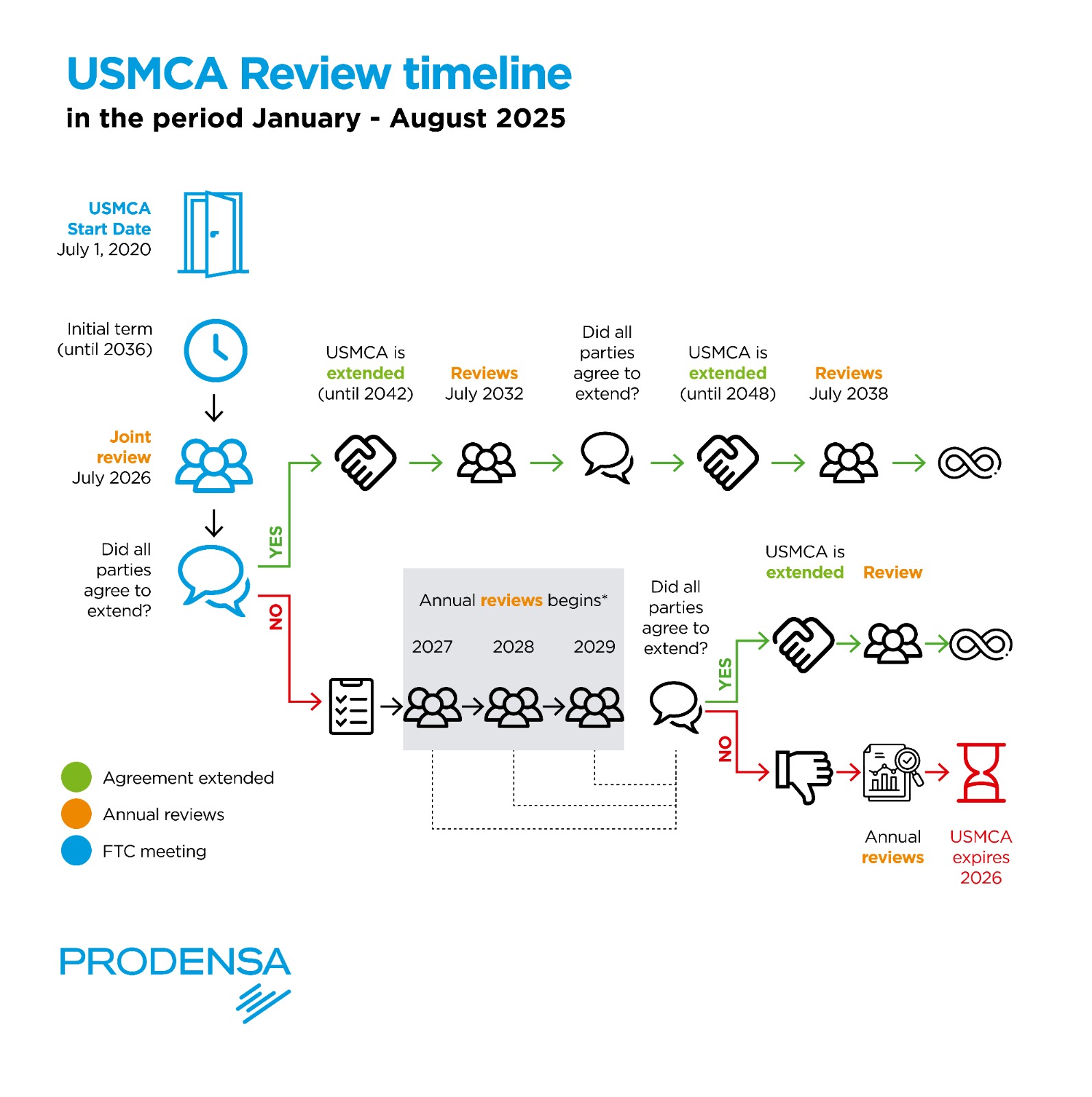
Policy Timeline: What Happens Next?
Preparation should begin before formal review activity peaks.
2024–2025
Public consultations & institutional positioning
Early 2026
Formal Joint Review discussions
Mid- 2026
Political signaling & negotiation framing
Post - Review
Clarifications, enforcement trends, possible adjustments
MYTH vs. REALITY: USMCA Joint Review
Read common misconceptions about the USMCA review.
Reality: Increased enforcement often signals institutional maturity.
What Mexico Is Signaling
Through consultations and regulatory enforcement patterns, Mexico is signaling:
- Commitment to maintaining trade integration
- Stronger compliance expectations
- Institutional coordination with U.S. enforcement priorities
- Increased documentation discipline
The trend is not deregulation — it is structured enforcement.
How Prepared is your Mexican Operation?
The 2026 USMCA review acts as a stress test. Manufacturers operating in Mexico should be evaluating:
TBD
How Prodensa Supports Manufacturers During the 2026 Review
We don’t just launch factories — we operationalize compliance inside Mexico.
- Product-level qualification
- RVC calculation validation
- BOM structuring
- Certification risk assessment
- Annex 24/30 diagnostics
- SAT audit simulations
- Inventory reconciliation systems
- Digital compliance platform integration
- Compliant supplier identification
- Tariff engineering alignment
- Regional value optimization
- Workforce compliance diagnostics
- Collective bargaining exposure review
- Wage benchmarking analysis
- Compliance software for Mexican manufacturing
- Multi-site and complex operations
- Automatized reporting for audits
- Executive-level updates
- Consultation insights
- Scenario modeling for Mexico operations
Stay Ahead of the 2026 Review
Sign up for our USMCA Mexico Updates and receive:
- Live enforcement tracking
- Policy milestone alerts
- Operational risk analysis
- Executive brief summaries
Read our Expert Perspectives Related to the USMCA
Click to read the blog post.
Revisiting the USMCA in 2026: analyzing Trump & Harris trade policies
How Tariffs are Shaping Automotive Manufacturers in Mexico [2025]
The US-Mexico Border Boom
Industrial Reforms in Mexico