


When it comes to manufacturing and supply chains, tariff costs and the tax structure applied to imports play a critical role in the competitiveness of both Mexican and foreign companies operating in Mexico.
👉 Updated for 2026: The Manufacturer's Guide to Doing Business in Mexico
Among the trade policy instruments offered by the Mexican government to mitigate these costs is the Sectoral Promotion Program, commonly known as PROSEC. This program is a regulated trade instrument that allows manufacturers to access preferential tariff treatment on authorized inputs under defined sector and compliance conditions.
As regulatory scrutiny increases across North America, particularly around the use of trade facilitation programs, companies must ensure that any PROSEC strategy is fully aligned with customs, origin, and tax compliance requirements in both Mexico and the United States.
Although PROSEC is often mentioned alongside the IMMEX program, its nature and benefits are distinct. When properly implemented, PROSEC can improve cost efficiency when applied within a properly structured and compliant trade framework.
The Origin and Purpose of PROSEC
PROSEC was created to strengthen the competitiveness of Mexico’s manufacturing sectors, particularly in the context of global trade integration and agreements such as the USMCA (T-MEC). Its design responded to trade restrictions that limited the use of tariff benefits only to exported goods under previous frameworks.
Unlike export-focused incentive programs such as IMMEX, PROSEC does not require final goods to be exported. Its primary function is to allow companies to import inputs and intermediate goods at preferential tariff rates for manufacturing purposes—whether the finished products are sold domestically or internationally.
This makes PROSEC a critical tool for reducing manufacturing costs, protecting margins, and building resilient supply chains, especially in industries with complex global supply chains that must be aligned with regional trade requirements.
How PROSEC Really Works
To understand PROSEC’s value, it is useful to contrast it with IMMEX:
 Destination of goods
- IMMEX: Allows temporary, tax-free imports (subject to VAT certification) provided the finished goods are exported.
- PROSEC: Allows imports at reduced tariff rates independent of the final market destination, within the framework of applicable trade regulations.
The dual benefit
For companies that sell both in the U.S. and in Mexico, PROSEC is essential. If a component imported from non-FTA countries carries a 15% tariff:
- Without PROSEC: You pay the full 15% IGI on goods sold in Mexico.
- With PROSEC: You may pay only 0% or 5%, directly improving margins on domestic sales.
PROSEC Structure and Authorized Sectors
PROSEC operates under a Presidential Decree published in Mexico’s Official Gazette and currently covers 24 manufacturing sectors considered strategic for Mexico’s industrial development.
While the program includes a broad range of industries, several sectors are particularly relevant to foreign manufacturers operating in Mexico, including:






Each sector includes a defined list of authorized tariff classifications for both finished goods and eligible inputs. Importantly, PROSEC benefits are not granted at the company level, but rather tied to the specific products and tariff codes authorized under the applicable sector.
This means companies must carefully align their manufactured products, tariff classifications, and sourcing structure with the corresponding PROSEC sector in order to access preferential tariffs.
Technical Classification Requirements
To benefit from PROSEC, companies must:
- Manufacture goods classified under the authorized tariff codes of the sector.
- Import only those inputs listed in the corresponding PROSEC Decree articles.
- Be a legal entity established in Mexico and demonstrate that imported goods are used exclusively in the production process.
This structure requires precise tariff classification, robust inventory controls, traceability systems, and deep knowledge of the Mexican tariff schedule (TIGIE).
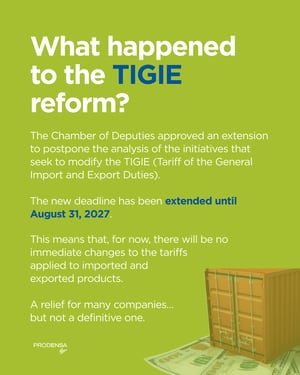
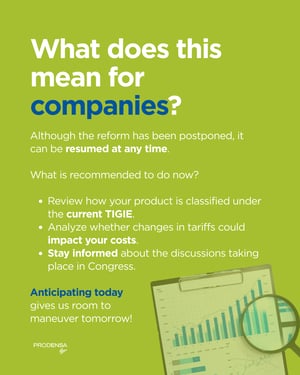
Mexican Tariff Schedule (TIGIE) Reform
Paused at the moment, the reform could be resumed at any moment.
Dive Into Preferential Tariffs and the Role of Rule 8
Preferential Tariffs Under PROSEC
The core benefit of PROSEC is the reduction or elimination of Import Duty (IGI) on specific inputs and capital goods. Preferential rates may be 0% or significantly lower than the standard Most-Favored-Nation (MFN) rates—particularly relevant for inputs sourced from countries without free trade agreements.
The Rule 8 Complement (TIGIE 98.02)
A key technical element in the PROSEC framework is its interaction with Rule 8 of the TIGIE (Tarifa de la Ley de los Impuestos Generales de Importación y Exportación).
Rule 8 allows certain goods not explicitly listed in the PROSEC Decree to be imported at preferential tariff rates when they are incorporated into authorized manufacturing processes. However, it is important to clarify that Rule 8 benefits are not automatic.
Companies must obtain prior authorization from Mexico’s Ministry of Economy, typically through a specific import permit linked to the production of authorized goods under the PROSEC program. This authorization is:
- granted on a case-by-case basis
- subject to technical justification of productive use
- tied to the manufacturing of goods authorized under the PROSEC sector
When approved and properly managed, Rule 8 can significantly expand the operational scope of PROSEC by enabling preferential tariff treatment for critical inputs not originally listed in the decree.
Commercial and
Logistics Benefits
For companies operating in Mexico under USMCA supply chains, understanding how PROSEC interacts with tariff structures, sourcing strategies, and compliance obligations is essential for protecting margins and maintaining trade compliance.
Cost Reduction and Competitiveness
By reducing Import Duty (IGI), PROSEC can significantly lower production costs. The magnitude of savings depends on the tariff structure of imported inputs and the geographic sourcing of those components.
In sectors such as automotive, electronics, and machinery manufacturing—where inputs are often sourced from countries without free trade agreements—PROSEC can generate substantial tariff reductions compared to standard Most-Favored-Nation (MFN) rates.
An example
If a component sourced from non-FTA countries carries a 15% MFN tariff, PROSEC may reduce that duty to 0% or a significantly lower preferential rate, depending on the authorized tariff classification and sector.
The actual savings therefore depends on:
- the tariff classification of imported inputs
- the country of origin of those inputs
- the specific PROSEC sector authorization
Market Flexibility
Unlike export-only programs, PROSEC does not restrict where finished goods are sold. Products manufactured under PROSEC can be sold both domestically and internationally, increasing commercial flexibility.
Synergies With Other Trade Programs
PROSEC can coexist with IMMEX, allowing companies to combine benefits:
- IMMEX: Temporary deferral of import taxes.
- PROSEC / Rule 8: Reduction or elimination of those taxes when goods are definitively incorporated into production.
This dual strategy requires integrated compliance systems to accurately control customs status changes and tax payments.
Trade Compliance Software Built for Integration: Prodensa DMS
With more complex regulatory requirements, we have opened up our software that allows us to manage trade compliance on behalf of +80 global manufacturers in Mexico.
.png?width=517&height=517&name=DMS%20Graphics%20(5).png)
PROSEC and USMCA (Article 2.5)
A common misconception is that USMCA automatically eliminates tariffs. This is only partially true.
An example
If a finished product exported to the U.S. or Canada does not qualify as originating, USMCA Article 2.5 (formerly NAFTA Article 303) prohibits duty drawback or exemption on non-originating inputs.
In this context, PROSEC provides a structured mechanism to apply preferential tariff rates within the limits permitted by Mexican regulation.
- Without PROSEC: 15% IGI on non-FTA country inputs.
- With PROSEC: 0%–2.5% IGI (within permitted limits).
 The interaction between Rule 8, PROSEC and Article 2.5 requires an accurate "Lesser of Two Duties" analysis to avoid penalties for tax omission.
Limitations and Compliance Risks
Sector and Tariff Limitations
Benefits apply only to authorized sectors and tariff codes. Imports outside these lists are subject to full MFN duties, potentially erasing expected savings.
Strict Compliance Requirements
- Annual Operations Report (RAOCE): Mandatory filing with Mexico’s Ministry of Economy.
- Deadline: Last business day of April
Note: If you have IMMEX, the date often falls towards the end of May, but it is vital not to rely on this and to check the official annual calendars.
- Inventory controls: Accurate reflection of customs status in Annex 24/30 when combined with IMMEX.
Non-compliance can result in retroactive cancellation of benefits, tax reassessments, and penalties.
Administrative Burden
Implementing PROSEC effectively requires specialized resources in customs and foreign trade, management systems, and coordination between logistics, customs, and finance departments. A lack of internal preparedness is a recurring risk that leads to errors in customs declarations, tariff classification, and annual reports.
Common Implementation Mistakes
In practice, we frequently see:
Executive Recommendations
To fully leverage PROSEC as a strategic tool—not just a compliance mechanism—manufacturers should focus on execution discipline and cross-functional alignment:
- Implement advanced tariff classification systems and provide ongoing training on the TIGIE and applicable PROSEC decrees.
- Integrate inventory controls and productive-use reporting with customs entries and tax obligations to enable preventive, audit-ready compliance.
- Coordinate foreign trade, engineering, and finance teams so sourcing and cost decisions fully consider PROSEC tariff implications.
- Plan program applications and sector expansions well in advance, taking into account review timelines at the Ministry of Economy and technical filing requirements.
When these elements are aligned, PROSEC shifts from a reactive benefit to a repeatable source of cost control and risk reduction.

 PROSEC (Sectoral Promotion Program):
A Mexican trade program that allows manufacturers to import authorized inputs at preferential tariff rates, independent of the final market destination, within the framework of applicable trade regulations.
Rule 8 (TIGIE 98.02):
A licensing mechanism that extends preferential tariffs to certain goods not explicitly listed in the PROSEC Decree when used in authorized manufacturing processes.
Lesser of Two Duties:
A technical calculation used to determine the lowest applicable import duty when PROSEC, Rule 8, and USMCA Article 2.5 interact.
RAOCE (Annual Operations Report):
A mandatory annual filing required to maintain PROSEC authorization and benefits.
-Jan-05-2026-08-00-38-0004-PM.png?width=1200&height=180&name=Ebook%20Banners%20(1)-Jan-05-2026-08-00-38-0004-PM.png)
Is PROSEC only useful for exporters?
No. PROSEC applies regardless of whether finished goods are sold domestically or internationally.
Can PROSEC be combined with IMMEX?
Yes, but it requires precise control of customs status and inventory records.
Does USMCA replace the need for PROSEC?
No. PROSEC remains critical when products do not qualify as originating.
-4.png?width=1200&height=179&name=Ebook%20Banners%20(2)-4.png)
- PROSEC is not a paperwork exercise; it is a compliance-driven cost optimization strategy that requires disciplined execution.
- When combined correctly with IMMEX and Rule 8, PROSEC can deliver substantial savings.
- Misclassification and weak controls are the primary sources of risk.
- Expert design and execution turn PROSEC into a competitive advantage—not a liability.
Have a complex compliance question ?
We help manufacturers everyday. Let's see how we can help.
