


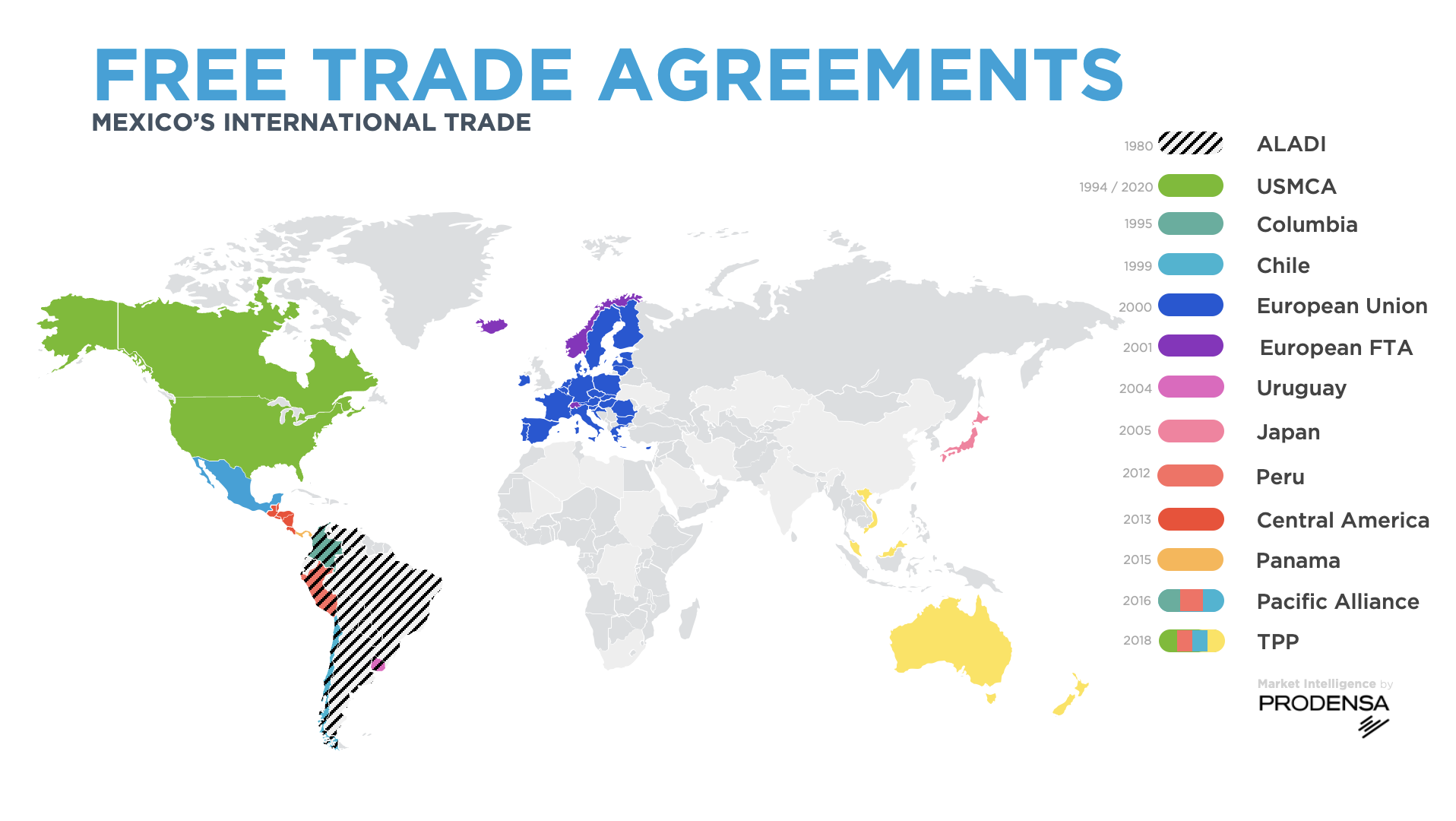
Mexico has 14 free trade agreements (FTAs) covering roughly 50 countries, according to Mexico's Secretaría de Economía. That network gives goods made in Mexico preferential, often duty-free, access to markets that represent most of the world's GDP, and it is one of the biggest reasons global companies choose Mexico for manufacturing and export. Here is the full picture: how many agreements Mexico has, what they cover, and how they benefit your business.
Key Takeaways:
-
Mexico has 14 free trade agreements covering ~50 countries, plus 30+ reciprocal investment protection agreements (APPRIs).
-
The USMCA is the anchor: duty-free access to a North American market of more than US$30 trillion in combined GDP.
-
Beyond North America, Mexico has FTAs with the EU (modernized in 2025), EFTA, Central America, the Pacific Alliance, and the CPTPP (which the UK joined in December 2024).
-
For business, this means lower tariffs, investor protections, streamlined customs, and access to major global markets.
-
Qualifying for these benefits depends on meeting each agreement's rules of origin.
How many free trade agreements does Mexico have?
Per the Secretaría de Economía, Mexico maintains 14 free trade agreements reaching about 50 countries. It also holds more than 30 Agreements for the Promotion and Reciprocal Protection of Investments (APPRIs), which give foreign investors a legal framework and a mechanism to resolve disputes. Together, these have driven economic growth, attracted foreign investment, and diversified Mexico's exports.
Mexico's free trade agreements at a glance
The most important agreements for global businesses operating in Mexico:
| Agreement | In force | Coverage |
| USMCA | 2020 | Duty-free access to North American market of $30T+ combined GDP. Includes Canada, United States and Mexico. |
| Mexico-European Union | 2000 (modernized 2025) | The EU's 27 member states including Austria, Belgium, Bulgaria, Croatia, Cyprus, Czechia, Denmark, Estonia, Finland, France, Germany, Greece, Hungary, Ireland, Italy, Latvia, Lithuania, Luxembourg, Malta, Netherlands, Poland, Portugal, Romania, Slovakia, Slovenia, Spain, and Sweden. |
| Mexico-EFTA | 2001 | Iceland, Liechtenstein, Norway, Switzerland |
| Mexico-Central America | 2013 | Costa Rica, El Salvador, Guatemala, Honduras, Nicaragua. The signing led to a pact with improved terms and a balance between commercial commitments, the expansion of global trade, and international cooperation. |
| Pacific Alliance | 2011 / 2016 | Includes Chile, Colombia, Pero, Mexico and has 32 observing countries around the world. The four signing countries represent 38% of the LatAm & Caribbean GDP. |
| CPTPP | 2018 | eleven Pacific Rim nations: Australia, Brunei, Canada, Chile, Japan, Malaysia, Mexico, New Zealand, Peru, Singapore, and Vietnam. This group collectively accounts for about 15% of global trade and 13% of global GDP. The UK joined in December 2024. |
| Mexico-Japan (EPA) | 2005 | Preferential access to the Japanese market |
Mexico is also a member of the Latin American Integration Association (ALADI, since 1980), an inter-governmental organization that aims to promote the economic integration in the common marketplace. It continues the process initiated by the Latin American Free Trade Association in 1960. The signing nations include: Peru, Argentina, Bolivia, Brazil, Chile, Colombia, Cuba, Ecuador, Mexico, Paraguay, Uruguay and Venezuela.
What is the USMCA, and why does it matter most?
The North American Free Trade Agreement (NAFTA), superseded by the United States-Mexico-Canada Agreement (USMCA) in 2020, is Mexico's most important trade agreement. It covers goods, services, investment, intellectual property, labor, and the environment. Its key provisions:
-
Reduced tariffs: duty-free treatment for a vast range of goods traded among the three countries.
- Rules of origin: goods must meet specific requirements to qualify for preferential treatment; getting this right is where the savings live.
- Streamlined customs: provisions that cut border wait times and improve supply-chain efficiency.
- Digital trade: protections for cross-border data flows and intellectual property.
- Labor and environmental standards: stronger rules that shape the modern operating environment.
Why do Mexico's free trade agreements matter for business?
For companies operating in or exporting from Mexico, the FTA network delivers concrete advantages:
-
Lower or zero tariffs, reducing landed cost for businesses and consumers
- Investor protections and a stable, predictable legal framework
- Access to wider markets and a more diverse supplier and customer base
- Stronger IP, e-commerce, and labor regulation
- Greater competitiveness and long-term investor stability, which supports export-sector jobs
Opportunities for Doing Business in Mexico
Leveraging the free trade agreements of Mexico, especially the USMCA, can open up a world of opportunities for businesses operating in or considering doing business in Mexico.
- Supply Chain Optimization: Mexico's strategic location and robust manufacturing base make it an ideal location for supply chain optimization. By establishing operations in Mexico, businesses can benefit from reduced transportation costs, access to a skilled workforce, and proximity to the US market.
- Market Access: The USMCA provides unparalleled access to the North American market, which represents a combined GDP of over $30 trillion. Businesses can capitalize on this vast consumer base by exporting goods and services.
- Investment Opportunities: Mexico offers attractive investment opportunities across various sectors, including manufacturing, automotive, aerospace, and energy. The USMCA provides a stable and predictable investment environment.
- Free Trade Zones: Mexico has zones that offer tax incentives and streamlined customs procedures. These zones can be ideal for manufacturing and assembly operations.
- E-commerce Growth: The growing e-commerce market in Mexico presents significant opportunities for businesses to sell products and services online. The USMCA facilitates cross-border e-commerce by addressing customs procedures and digital trade.
- IMMEX & maquila programs: Mexico's IMMEX regime offer tax deferral and streamlined customs for export manufacturing.
Strategies for Success
To maximize the benefits of the free trade agreements in Mexico, companies should consider the following strategies:
- Conduct Thorough Market Research: Understand the Mexican market, consumer preferences, and competitive landscape.
- Build Strong Partnerships: Collaborate with local partners to navigate the business environment and leverage their expertise.
- Comply with Regulations: Stay up-to-date with FTA and local regulations and ensure compliance to avoid penalties and disruptions.
- Leverage Technology: Utilize technology to streamline operations, improve supply chain visibility, and enhance customer experience.
- Consider Free Trade Zones: Evaluate the potential benefits of operating within a free trade zone to optimize costs and logistics.
- Risk Management: Develop a comprehensive risk management plan to address potential challenges, such as supply chain disruptions or economic fluctuations.
How Prodensa helps
PRODENSA is a Mexican consulting and project management firm, supporting foreign clients to achieve successful operations in Mexico. We offer clients an initial USMCA review to understand if their business plan supports an operation in Mexico.
Book a Free Consultation
With our Business Advisor team.
Some of our experience:
Frequently Asked Questions
How many free trade agreements does Mexico have?
14 FTAs covering ~50 countries (Secretaría de Economía), plus 30+ reciprocal investment protection agreements (APPRIs).
What is Mexico's most important free trade agreement?
The USMCA, which replaced NAFTA in 2020 and gives duty-free access to a North American market of more than US$30 trillion in combined GDP.
Does Mexico have an FTA with the European Union?
Yes, in force since 2000 and modernized in 2025, covering the EU's 27 member states. Mexico also has an FTA with the EFTA countries.
Is Mexico part of the CPTPP?
Yes, since 2018. The United Kingdom joined in December 2024, bringing membership to 12 economies.
How do these agreements benefit my business?
Lower tariffs, investor protection, streamlined customs, and access to major markets, provided your goods meet each agreement's rules of origin.