


The nearshoring wave is not slowing down. U.S. companies are shifting manufacturing, engineering, customer operations, and back-office work to Mexico at the fastest pace in two decades — and most of them hit the same wall in week one: we want to hire someone in Mexico, but we do not have a Mexican entity. Now what?
The good news is that you have options. The better news is that the right one usually takes less than two weeks. The catch is that the option that looks cheapest — hiring a freelance contractor — is the one that quietly creates the most legal and financial exposure on both sides of the border.
This guide answers the questions U.S. HR and operations leaders actually ask when they start hiring in Mexico, and it shows you the fastest compliant path from "we should do this" to "she starts Monday."
Can a U.S. company hire employees in Mexico without a legal entity?
Yes. Foreign companies can legally hire Mexican employees without forming a Mexican entity by using an Employer of Record (EOR). The EOR becomes the legal employer in Mexico, handling payroll, taxes, benefits, and labor law compliance, while the U.S. company directs day-to-day work and reports.
This is the model most U.S. and other foreign companies use to test the Mexican market, build a small team, or staff a project before committing to a full corporate setup.
What are the options for hiring in Mexico from the U.S.?
There are three legitimate paths, and the right one depends on your headcount, function, and timeline.
-
Independent contractors are fast to set up and require no infrastructure. The trade-off is severe legal exposure. Under Mexico's Federal Labor Law (LFT), workers who perform ongoing, directed work are presumed to be employees no matter what the contract says — and misclassification penalties are heavy.
-
Setting up your own Mexican entity (typically an S. de R.L. de C.V. or S.A. de C.V.) gives you full control and is the right end state for any company that plans to operate in Mexico long term. The trade-off is time and overhead: 4–6 months to incorporate, ongoing accounting and tax obligations, and direct exposure to Mexican labor liability.
-
An Employer of Record (EOR) lets you hire in 1–2 weeks with no entity required. The EOR holds the legal employment contract, runs payroll and benefits, and absorbs the compliance burden. You pay a fee per employee per month. For most U.S. companies entering Mexico — and especially those building a team before they commit to incorporation — this is the right starting point.
Prodensa's binational EOR, Mindfacturing®, was built specifically for this scenario: U.S. companies that need to hire in Mexico now, with full legal protection on both sides of the border, without spending six months on entity setup first.
What are the risks of hiring a freelance contractor in Mexico as a foreign company?
Hiring a freelance contractor in Mexico from the USA carries significant legal and financial risk for both parties. Under Mexico's Federal Labor Law, workers performing ongoing, directed work are presumed employees regardless of contract wording. Misclassification can trigger retroactive labor liability, IMSS back-payments, tax penalties, and even permanent establishment exposure for the U.S. company.
Risks to the Foreign Company:
Mexican labor courts apply what is called the "primacy of reality" doctrine: the actual nature of the relationship matters, not what the contract says. If the worker keeps set hours, uses your tools, follows your instructions, or depends on you economically, they are legally an employee — full stop. If that determination is made, the reclassified worker can claim a lot of back-payments for benefits and severance.
In 2021, the outsourcing reform added another layer. Any arrangement that looks like personnel outsourcing without REPSE registration is illegal. Fines apply for unregistered service providers.
There is also a tax dimension. A contractor who acts on the U.S. company's behalf in Mexico can create a permanent establishment under Mexican tax law and the U.S.-Mexico tax treaty. Permanent establishment risk in Mexico often arises unintentionally through employees, contract authority, warehousing, construction projects, or recurring executive presence.
Risks to the Worker in Mexico:
The contractor model is not just risky for the company. It strips the Mexican worker of nearly every constitutional labor protection.
A contractor has no IMSS coverage, meaning no covered medical care, maternity leave, or workplace injury protection. They contribute nothing to INFONAVIT, cutting them off from Mexico's primary path to homeownership. They accrue no retirement savings through SAR or AFORE. They forfeit aguinaldo, vacation premium, and profit sharing — all rights guaranteed to employees by Mexican law.
They can be terminated overnight with no severance, no notice, and no recourse. The full tax burden falls on them: they must register with the SAT (Mexico's tax authority) as a persona física con actividad empresarial, issue compliant CFDI invoices, charge and remit IVA (VAT), and file monthly and annual returns themselves. They build no labor seniority for future job applications, mortgages, or visa processes. And they absorb all the FX risk of being paid in dollars without a formal employment relationship behind them.
.png?width=601&height=601&name=wwww.prodensa.com%20(1).png)
How much does it cost to hire an employee in Mexico?
The fully-loaded cost of a Mexican employee runs roughly 30–40% above gross salary once mandatory benefits and payroll taxes are included. Although many Mexican employees earn minimum benefits, foreign companies seeking top talent often need to have better attraction mechanisms, without inflating base salary to compensate.
The major line items are:
-
IMSS (social security)
-
INFONAVIT (housing fund)
-
SAR (retirement)
-
state payroll tax (ISN, which varies by state from about 1% to 3%)
-
aguinaldo (Christmas bonus, equivalent to 15 days of salary minimum, paid in December)
-
vacation premium (25% premium on vacation days), and
-
profit sharing (PTU, 10% of pre-tax profit distributed to employees)
When you hire through an EOR, those costs are passed through transparently, plus a service fee per employee per month. The total is almost always lower than running your own Mexican payroll function during the first 12–18 months of operation in the country.
What are the legal requirements for hiring in Mexico?
Every Mexican employment relationship requires a written contract in Spanish that meets the requirements of the Federal Labor Law. Probation periods are capped at 30 days for most roles and 180 days for managerial or specialized positions.
Employers must register every new hire with IMSS, INFONAVIT, and SAT before they start work. Payroll must be processed through compliant CFDI receipts. Since the 2021 outsourcing reform, any company providing personnel services must hold an active REPSE registration.
Severance for unjustified termination is three months of integrated salary plus 20 days per year of service, plus accrued benefits. There is no "at-will" employment in Mexico. Lawsuits in Mexico are public, slow, expensive, and almost always end in favor of the worker.
How long does it take to hire someone in Mexico for the U.S.?
Through an EOR, you can have a Mexican employee onboarded and on payroll in 1–2 weeks. Setting up your own Mexican entity first takes 4–6 months before you can issue your first paycheck.
The EOR timeline assumes the candidate is identified. The EOR drafts and signs the Spanish-language contract, registers the employee with IMSS, INFONAVIT, and SAT, sets up CFDI payroll, and coordinates benefits enrollment. The U.S. company is invoiced in dollars and manages the day-to-day work.
What is an EOR and how does it work in Mexico?
An Employer of Record is a Mexican company that legally employs your workers on your behalf. They are the legal employer — on the contract, on the IMSS registration, on the payroll. You remain the economic employer — you select the candidate, direct their work, set their performance expectations, and approve their compensation.
In practice, the workflow is simple. You select the candidate. The EOR contracts and onboards them, registering them with all the required Mexican authorities. You manage day-to-day work. The EOR processes payroll, files all taxes and social security contributions, handles labor authority interactions, and absorbs the legal risk of compliance. You receive a single invoice, typically in U.S. dollars.
A binational EOR is a meaningful step further. Most EORs operate from Mexico and force U.S. companies to navigate cross-border coordination, currency, and contracting on their own. A binational provider runs U.S.-side and Mexico-side operations under one roof, gives you a single point of contact who understands both jurisdictions, and bills in dollars under a U.S.-friendly contract.
That is the model behind Mindfacturing®. It exists specifically to make hiring in Mexico from the USA feel like hiring in any other U.S. state — clear contracts, predictable invoicing, compliant by design — while the entire Mexican labor and tax stack is handled in the background.
Where should you hire in Mexico?
The right region depends on the talent profile and the supply chain context.
Hiring Culture throughout Mexico
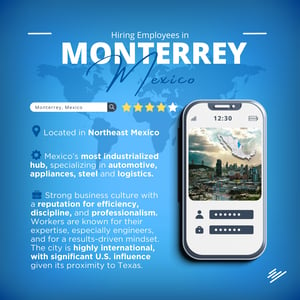
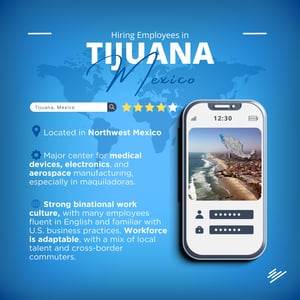
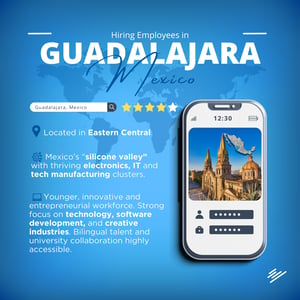
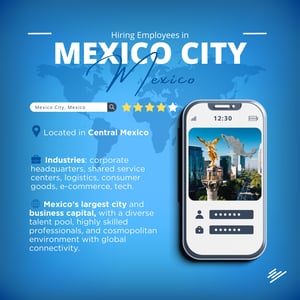
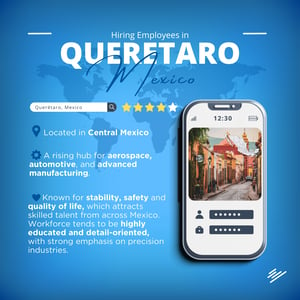
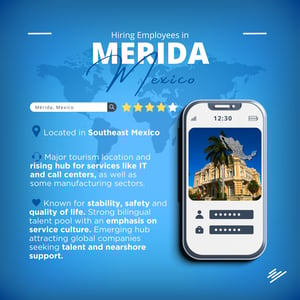
Prodensa has supported hundreds of U.S. companies setting up operations across all five regions over the last three decades, which means we know not just the labor markets but the local authorities, real estate, suppliers, and customs realities that shape the actual launch.
Common mistakes U.S. companies make when hiring in Mexico:
The most expensive mistakes are the quiet ones — the ones that do not surface until an audit or a termination two years later.
-
Companies routinely underestimate the true cost of mandatory benefits, building budgets on gross salary alone and missing 30–40% of the real number.
-
They sign English-only employment contracts that are unenforceable in Mexican labor courts.
-
They register employees with IMSS late and accrue automatic fines.
-
They use Mexican service providers without verifying REPSE status, which voids the deduction of those payments and creates joint liability.
-
And they apply U.S. termination practices — at-will, two weeks' notice, performance-based dismissal — that simply do not exist in Mexican law.
A good EOR or local advisor catches all of these before they cost anything. The best EOR's guide you to understand the Mexican labor law and how to build a high-performing team in Mexico.
When should you move from EOR to your own Mexican entity?
Most companies cross over from EOR to their own Mexican entity somewhere between 15 and 25 employees, when they need to operate under their own entity for contractual or legal reasons, or when long-term cost modeling tips in favor in of-house infrastructure.
EOR is the right tool for entry, testing, and team building. Entity setup is the right tool for permanence and scale.
The transition itself is the highest-risk moment of the whole journey. Done well, employees move from the EOR's payroll to yours with no break in seniority, no IMSS gap, and no morale hit. Done poorly, you create a labor liability event that lasts years.
How does Prodensa help U.S. companies hire and operate in Mexico?
Prodensa has spent more than four decades helping U.S. companies launch and scale in Mexico. The full stack lives under one roof.
-
Mindfacturing® is our binational EOR. Hire in Mexico from the USA in days, with no entity required, fully compliant on both sides of the border, billed in U.S. dollars under a U.S.-friendly contract. Built for the early-stage, scaling, or project-based hiring most U.S. companies face when they enter the country.
-
Entity setup and IMMEX certification is the right next step when you are ready to scale. We handle incorporation, IMMEX certification, VAT certification, and the operational setup that turns a new entity into a functioning manufacturing or services operation.
-
End-to-end project management is the layer underneath all of it — site selection, real estate, HR, customs, tax, government relations, the full set of decisions that determine whether a Mexico operation runs at the bottom or the top of its potential.
If you are thinking about hiring in Mexico from the USA — for one role, a small team, or a full operation — talk to a Prodensa advisor. We will show you the right structure for where you actually are, not where a brochure assumes you should be.
Schedule a meeting to explore the market.

Hiring in Mexico from the USA is genuinely doable, and for most U.S. companies the right starting point is an EOR — fast to set up, compliant by design, and reversible if priorities change. The freelance contractor shortcut is rarely worth the risk to either side. And when growth justifies it, the move from EOR to your own Mexican entity is the natural next step.
Three decades of binational experience tells us the same thing every time: the companies that win in Mexico are the ones that get the structure right early.
Download the "Employment Law" eBook
Prodensa's guide on major regulations companies need to know in 2026.