


Hiring a salesperson in Mexico is often one of the most critical and misunderstood steps for foreign companies entering or expanding in the market. While Mexico offers a deep pool of commercial talent and a strong business culture, sales hiring does not work the same way it does in the United States or Europe.
Differences in compensation expectations, labor regulations, sales culture, and legal structures can quickly turn a well-intentioned hire into a costly misstep. This guide outlines what foreign companies need to know to hire sales talent in Mexico effectively, compliantly, and with long-term success in mind.
Start with the Right Question: What Kind of Salesperson Do You Need?
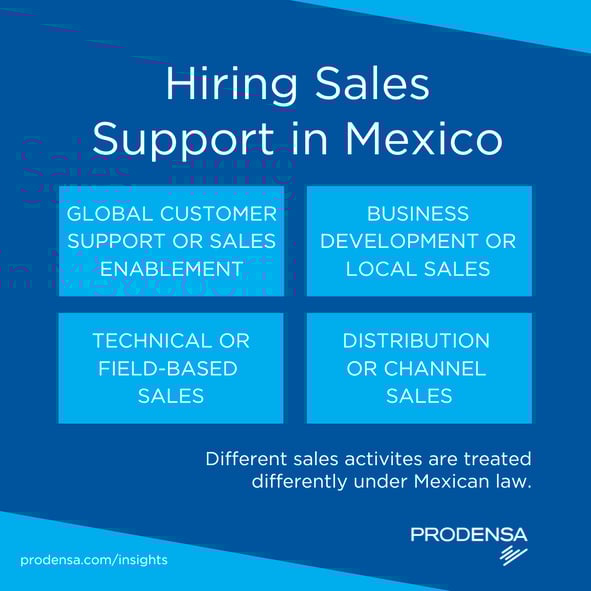
Before exploring hiring solutions in Mexico, it’s important to understand that different types of sales activities are treated differently under Mexican law. Start by clearly defining the sales role you need, then choose a structure that keeps your operation fully compliant.
Key distinctions to clarify up-front:
Global Customer Support or Sales Enablement
Office-based roles that support international customers or global sales teams—without directly selling into the Mexican market—may qualify for export-oriented structures and, in some cases, trade-related incentives. This is often overlooked by foreign companies and can materially affect cost and structure.
Business Development or Local Sales
Roles that involve visiting customers, developing accounts, or actively selling within Mexico typically require the salesperson to be paid through a local Mexican payroll, with full labor and tax compliance.
Technical or Field-Based Sales
Positions that require on-site visits, particularly on manufacturing floors or regulated facilities, often trigger additional authorizations and ongoing regulatory reporting. These roles carry higher compliance requirements and must be structured carefully from the outset.
Distribution or Channel Sales
Direct sales into Mexico introduce regulatory and structural obligations that go beyond hiring. Companies typically must either set up a local entity to manage sales, invoicing, and compliance, or partner with an established distributor that assumes these responsibilities in-market.
Understanding the Mexican Sales Talent Market
Mexico has a strong base of experienced sales professionals, particularly in manufacturing, industrial services, logistics, consumer goods, and B2B services. However, the sales culture is often more relationship-driven than transaction-driven.
Key characteristics foreign companies should understand:
-
Trust and credibility matter: Long sales cycles and personal relationships are common.
-
Decision-making can be hierarchical: Knowing how to navigate organizations is often as important as product knowledge.
-
English proficiency varies: Many candidates have conversational English, but fluency should be validated rather than assumed.
-
Regional differences exist: Monterrey, Mexico City, Bajío, and border regions each have distinct talent profiles and compensation expectations.
Compensation Structures: What Salespeople in Mexico Expect
Sales compensation in Mexico typically combines a fixed base salary with variable commissions, but the balance is often more conservative than in the U.S.
Common expectations include:
-
A stable base salary that provides income security
-
Monthly or quarterly commissions, rather than purely annual plans
-
Commission tied to revenue, margin, or collections, depending on industry
-
Strong interest in benefits stability (healthcare, savings funds, bonuses)
Overly aggressive commission-heavy structures may discourage experienced candidates or lead to high turnover. Designing compensation that aligns with local norms is critical for retention.
Legal and Compliance Considerations You Cannot Ignore
Hiring in Mexico involves formal labor obligations that cannot be bypassed without risk.
Key considerations include:
-
Employee vs. contractor classification: Independent contractor models are high-risk and frequently misused, and not the best experience for the employee.
-
Mandatory benefits: Social security, profit-sharing (PTU), vacation, bonuses, and severance obligations apply.
-
Employment agreements: Contracts must comply with Mexican labor law, regardless of governing law clauses.
-
Non-compete limitations: Enforceability differs from U.S. standards and must be carefully structured.
Misclassification or informal hiring can create tax, labor, and reputational exposure, especially for foreign entities without local infrastructure.
Three Common Ways to Hire a Salesperson in Mexico
Foreign companies typically choose one of the following hiring models:
1. Hiring Through a Local Mexican Entity
Best suited for companies with an established long-term presence.
Pros include full control and scalability; cons include setup time, cost, and ongoing compliance responsibility.
Incorporating a company as a foreigner has some specific requirements to review, and you can find local operations partners, like Prodensa, who can ensure that your operation is in regulatory compliance.
2. Hiring Through an Employer of Record (EOR)
An EOR allows companies to hire sales talent quickly and compliantly without setting up a legal entity.
This model is ideal for:
-
First sales hires
-
Market testing
-
Commercial expansion before operations
There are different types of EOR models depending on the functions and extent of supervision you wish to have with your employees in Mexico.
Binational EOR
Binational EOR structures are designed for companies that use Mexico to support U.S.-based or global operations, rather than selling directly into the Mexican market.
A solution such as Mindfacturing® enables:
-
Local, fully compliant payroll in Mexico
-
Employment aligned with Mexican labor and tax law
-
Billing and commercial alignment with a U.S. parent company
This model is commonly used for sales enablement, inside sales support, customer success, and global commercial functions that operate from Mexico but serve external markets.
Specialized Services
Traditional outsourcing models in Mexico are now highly regulated. In their place, the government introduced REPSE certification (Registro de Prestadores de Servicios Especializados), which verifies that third-party service providers fully comply with labor, tax, and social security obligations when delivering specialized services.
👉 If a salesperson or sales-adjacent role will perform on-site activities at a third-party facility in Mexico, their presence may be subject to REPSE requirements. In these cases, the service provider (not the client) must hold the appropriate REPSE registration so that both the hiring entity and the third party remain compliant.
This makes it critical to evaluate whether the role qualifies as a specialized service, and to work with a provider whose REPSE registration explicitly covers the activities being performed.
This approach may support roles such as:
-
Technical sales or technical support services performed on-site
-
In-plant sales or commercial liaison roles tied to operational facilities
However, REPSE is not a blanket solution. The nature of the activities, degree of supervision, and integration with the client’s core business must be carefully reviewed to avoid misclassification or compliance risk.
👉 Remember, not all sales roles can be placed under an EOR or specialized services model. Roles involving direct selling, pricing authority, on-site client activity, or market development in Mexico often require closer structural evaluation.
3. Contractual Representation for Products
Some companies opt for forming a partnership in order to have their products or services represented by salespeople in Mexico. Being published in a catalogue or included in a product lineup can be a great way to get initial exposure to the market.
"Product representation and distribution are often a good first step into the Mexican market. As companies get more serious about developing the market, they usually look to bring on a dedicated local hire (often through an EOR like Prodensa) or set up a local entity to commercialize their products while relying on an operations partner to handle compliance. This is typically the point where companies want closer customer relationships and the ability to build and grow their own team on the ground."
Lucia Ibarra - Mindfacturing® EOR Coordinator
Recruiting and Interviewing Best Practices
Successful sales hiring in Mexico goes beyond reviewing CVs.
Some things to consider:
- Sales candidates in Mexico often have a wide range of skills, thus a wide range of compensation expectation that depends a lot on the candidate
- Finding the best candidate will often include headhunting, checking industry-specific networks, and even tapping some local reference networks
- Its a good practice to visit the final candidate or have them travel to the corporate office. Having the face-to-face interaction goes a long way to building trust
- The compensation agreement must be defined in the employment contract, and there are some strategies to obtain win-win agreements without added risks.
- Really consider your English requirements. Today, tools with AI can greatly improve bilingual communication, and scaling back this requirement if not strictly needed could greatly increase your candidate pool.
- Dedicating time to training and explaining the context of the business, products and goals are helpful since Mexican employees are often more hands-on.
- Learning the employment culture and drivers helps foreign managers obtain the best results and maintain a positive and enriching environment for a bicultural team.
Ready to Hire your Salesperson in Mexico?
Getting started is easy. A company like Prodensa can provide multiple, turnkey solutions or work with companies to create a customized operational model based on their business strategy and goals. Our solutions include:
- Legal and administrative support to incorporate a new business entity
- Local operations and compliance partnership (from due diligence through ongoing operations) for shared service / engineering centers or manufacturing operations
- Local or binational Employer of Record solutions including options with REPSE
- Recruitment and selection of candidates, compensation benchmarking
- Payroll calculations and administration solutions
Start by exploring employer requirements in Mexico to understand important regulations.
Download our free employment law e-book to get an initial overview of Mexico's federal labor law, aimed at foreign companies.
Reach out for a service quotation.
Answer a few questions about your business plan, and we will let you know the options you have and provide you with an economic quote so you can budget your project.
Let's have a conversation. I would love to know more about your needs and provide you a solution derived from my 15 years of experience supporting foreign companies in Mexico.


