


USMCA compliance is becoming one of the most important strategic priorities for manufacturers operating in Mexico. As the USMCA review process and negotiations continue, companies should remain prepared by strengthening compliance with Rules of Origin, Labor Value Content requirements, labor regulations, and supply chain traceability standards.
Need help with USMCA Compliance?
Whether you are evaluating Rules of Origin, labor compliance obligations, supplier traceability, or manufacturing operations in Mexico, our team can help assess your compliance risks and identify opportunities to strengthen your North American supply chain.
For companies operating in Mexico, this change has important consequences. Profitability will no longer depend only on efficient production and optimized logistics. It will also depend on a company’s ability to manage growing regulatory requirements, including payroll compliance, steel sourcing rules, and the governance of AI systems.
In this new environment, compliance will become the backbone of business strategy.
The Future of USMCA Compliance: Traceability, Data, and Risk Management
The success of nearshoring has traditionally been measured by proximity to market and competitive costs. By 2026, however, the key metric will shift toward full traceability. Increased USMCA enforcement means that customs authorities (CBP in the United States, as well as SAT and ANAM in Mexico) are no longer satisfied with generic origin declarations. They now require documented proof for every link in the supply chain.
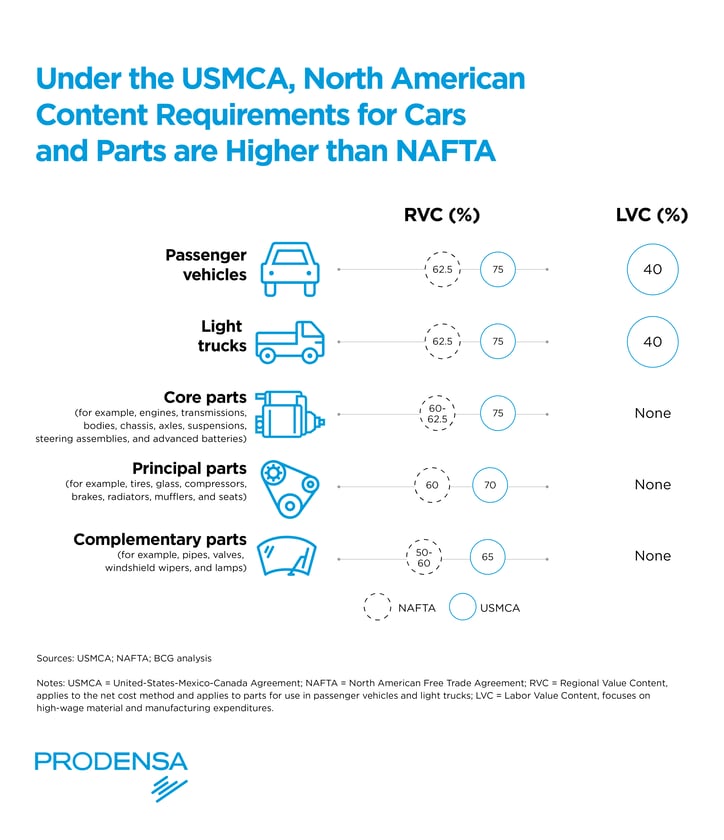
The practical implications of this shift are substantial. Companies must recognize that tariffs are no longer temporary tools, but permanent components of regional industrial policy. If a company cannot demonstrate (through production records and sourcing documentation) that it complies with some of the strictest Rules of Origin requirements in the world (such as the 75% Regional Value Content requirement in the automotive sector), the financial consequences can be immediate.
| Integration Indicator | Data | Risk Management Implication for 2026 |
|---|---|---|
| USMCA Utilization (Mexico) | 85% (March 2026) | Origin certification is essential; mistakes become the new tariff. |
| U.S.–Mexico Trade Deficit | USD $196.9 billion (2025) | Political pressure factor driving stricter content audits. |
| Foreign Direct Investment | USD $40.9 billion (2025) | Increased scrutiny on investments originating from Asian countries. |
As trade deficits grow and investment patterns shift, authorities are placing greater emphasis on origin verification, supply chain transparency, and regulatory enforcement.
USMCA Compliance and Labor Value Content Requirements
The automotive industry faces the greatest compliance challenges. One of the most important requirements is Labor Value Content (LVC), which requires companies to show that 40–45% of a vehicle’s value is produced in facilities where workers earn at least USD $16 per hour.
In a strict enforcement environment, a mistake in determining which activities qualify as “research and development” for LVC calculations can impact the financial viability of entire assembly lines. If a company does not meet certification requirements, it may lose access to preferential tariff treatment and face additional duties. For light trucks, these tariffs can be as high as 25%. As a result, even small compliance mistakes can quickly reduce or eliminate the cost advantages of manufacturing in Mexico.
The shift toward electric vehicles adds another layer of complexity. Manufacturers must also comply with sourcing requirements for critical minerals such as lithium, cobalt, and nickel. To avoid future tariff risks, many companies need to plan and adjust their supply chains several years in advance, especially as new requirements approach in 2026.
Steel Sourcing Requirements for USMCA Compliance
Another example of the growing regulatory burden is the tightening of the rule of origin for steel. It is no longer sufficient for the metal to be transformed within the region; the United States now requires that it be “melted and poured” in North America in order to qualify for preferential treatment. This creates a significant administrative challenge for steel-consuming industries (including construction, home appliances, and auto parts manufacturers) which must now implement traceability systems capable of tracking materials back to the originating steel mill.
The practical impact is that production costs are likely to rise, since steel sourced within the region is often more expensive than steel available in the global market. As a result, managing suppliers is no longer just about finding the best price—it is also becoming an important part of meeting trade and customs requirements.
What Is USMCA Labor Compliance?
The Rapid Response Labor Mechanism (RRM) has transformed Human Resources management into a trade-risk management function. For a facility in Mexico, a complaint filed under the RRM means the immediate suspension of preferential tariff treatment for its products while the investigation remains ongoing.
Today, enforcement is becoming stricter, with a higher rate of complaint acceptance and an expanded scope that now reaches mining, services, and agriculture. Paper-based compliance is no longer sufficient; companies must demonstrate absolute neutrality in union matters and maintain verifiable democratic labor processes.
| Labor Requirement | Action Required by the Company | Non-Compliance Risk |
| Contract Legitimization | Ensure voting processes are personal, free, secret, and direct. | Activation of the RRM and potential export restrictions. |
| Freedom of Association | Avoid any interference in the formation or operation of labor unions. | Direct trade sanctions against the facility. |
| Forced Labor Traceability | Exclude inputs sourced from regions linked to human rights concerns. | Goods may be detained or blocked at the border by CBP. |
For manufacturers, labor disputes can now trigger trade consequences, making workforce governance a critical part of risk management.
USMCA Compliance Checklist for Executives
In the face of this regulatory tsunami, executives must evolve from passive observers into active strategists. Trade-risk management can no longer remain a compliance function—it must become a board-level priority.
Strategic Priorities for the Road Ahead
The ongoing USMCA review process and negotiations continue to create uncertainty for North American integration. While key outcomes remain unresolved, companies can focus on strengthening compliance and operational readiness.. What is at stake is not only the flow of goods across borders, but the long-term viability of operating in one of the world’s most dynamic manufacturing regions.
In this new environment, compliance is no longer a back-office function—it is the key to business continuity.
To better understand how these regulatory changes may affect your operation and what steps you should take today to protect your business, we invite you to click on the link below and download our specialize USMCA resource.

-
Labor Value Content (LVC):
A USMCA requirement that mandates a percentage of a vehicle’s value be produced in high-wage facilities earning at least USD $16 per hour.
-
Rapid Response Labor Mechanism (RRM):
A USMCA enforcement tool that allows labor complaints at specific facilities to trigger investigations and potentially suspend preferential tariff treatment.
-
Melted and Poured Rule:
A steel-origin requirement stating that steel must be melted and poured in North America to qualify for certain USMCA and trade-preference benefits.
-
Rules of Origin:
The criteria used to determine whether a product qualifies for preferential tariff treatment under the USMCA based on where its materials and production activities originate.

What is USMCA compliance?
USMCA compliance refers to a company's ability to meet the trade, labor, sourcing, and documentation requirements established under the United States-Mexico-Canada Agreement. Manufacturers must demonstrate compliance with Rules of Origin, labor provisions, and other regulatory obligations to qualify for preferential tariff treatment.
How do companies prove USMCA compliance?
Companies typically demonstrate USMCA compliance through: certificates of origin, supplier declarations, production records, labor documentation, traceability systems, customs records, etc
Why is compliance becoming more important under the USMCA?
Because enforcement is becoming more rigorous. Customs authorities increasingly require detailed documentation, traceability records, and proof of compliance rather than relying on self-certification alone.
What is the biggest compliance risk for manufacturers in Mexico?
The inability to demonstrate compliance with Rules of Origin, Labor Value Content requirements, labor standards, or supplier traceability requirements during an audit or verification process.
How can a labor complaint affect exports?
Under the Rapid Response Labor Mechanism, a complaint can trigger an investigation and potentially suspend preferential tariff treatment for products exported from the facility involved.
Why are traceability systems becoming critical?
Authorities increasingly expect companies to document the origin of materials, components, and labor practices throughout the supply chain, particularly in automotive, steel, and strategic manufacturing sectors.
How should manufacturers prepare as USMCA negotiations continue?
By conducting origin audits, strengthening labor compliance programs, improving supplier visibility, documenting sourcing practices, and treating compliance as a strategic business function rather than an administrative task.

- The USMCA is evolving from a trade agreement into an enforcement framework. Competitive costs and geographic proximity are no longer enough; companies must be able to prove compliance at every stage of their operations.
- Traceability is becoming the new competitive advantage. Manufacturers that can document the origin of their materials, labor practices, and production processes will be better positioned to withstand audits and regulatory scrutiny.
- Labor compliance is now a trade issue. Human Resources, union relations, and workplace governance have become directly connected to market access and export competitiveness.
- The most resilient manufacturers will be the most prepared. Organizations that invest in compliance systems, internal USMCA audits, and supply chain visibility today will be better equipped to navigate the increasingly complex regulatory environment of North America.