

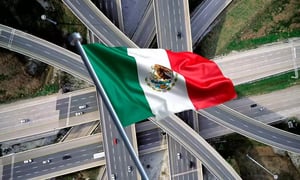
The year 2026 represents a pivotal moment for public infrastructure in Mexico. Under the current federal administration, the country is shifting from a model based on discretionary concessions and public debt accumulation toward a more structured approach focused on infrastructure investment for development and social impact (2026–2030).
This strategy, which projects a historic investment of 5.6 trillion pesos over the current administration, is based on the idea that infrastructure is not an end in itself, but a tool to achieve social development, national sovereignty, and stronger positioning in global value chains.
The 2026 context is shaped by two key forces:
-
the deployment of large-scale multimodal connectivity projects
-
the need to capitalize on nearshoring under a resilience-driven model rather than purely cost-based strategies.
For fiscal year 2026, the Mexican government has allocated 722 billion pesos (approximately 2% of GDP) to priority infrastructure projects across eight strategic sectors: energy, rail, highways, ports, airports, healthcare, water, and education.
Mexican Infrastructure Investment Overview 2026
| Metric | Estimated Value |
|---|---|
| Total projected investment (2026–2030) | 5.6 trillion pesos |
| Budget allocated for 2026 | 722 billion pesos |
| Jobs generated (target) | 1.63 million |
| Investment growth vs. 2025 | +10% |
| Investment as % of GDP (target) | >25% |
These figures highlight how Mexico is scaling infrastructure not just in size, but in strategic impact across industry, employment, and competitiveness.
Energy Sovereignty and the Shift Toward Green Manufacturing
The energy sector is the foundation of industrial development in 2026, absorbing 54% of total strategic investment. The core logic is clear: Mexico’s competitiveness in the nearshoring era depends on reliable, sufficient, and cost-effective energy supply.
The government has prioritized strengthening state-owned companies (like PEMEX and CFE) with a focus on operational efficiency and gradual decarbonization.
-
Sonora Plan: Renewable Energy and Lithium Ecosystem
The Sonora Plan has become one of the most ambitious energy transition projects in the region. By 2026, the Puerto Peñasco solar plant is in advanced expansion phases, aiming to reach 1,000 MW capacity, positioning it among the largest solar plants globally.
This ecosystem integrates energy generation with lithium development in Bacadéhuachi, laying the groundwork for a regional value chain in batteries and semiconductors.
A key component is cross-border integration with Arizona, aligning electromobility capabilities between both regions. This includes not only energy generation but also talent development through university partnerships focused on semiconductors and energy storage systems.
Read more about the Arizona-Sonora Partnership.
-
Hydrocarbon Modernization and PEMEX
By 2026, PEMEX has reduced its debt to its lowest levels in a decade. The company’s 425 billion peso investment strategy focuses on improving efficiency in exploration and production, targeting 1.8 million barrels per day of oil and 4,500 million cubic feet per day of natural gas.
Modernization of refineries such as Tula and Salina Cruz remains a priority to strengthen fuel self-sufficiency and support petrochemical production, including fertilizers for domestic use.
Mexico's PEMEX Investment Strategy 2026
| Component | 2026 Target / Action |
| Additional electricity capacity | 26,000 MW (administration goal) |
| Exploration and production investment | 425 billion pesos |
| Dos Bocas Refinery | Full operation + rail connectivity |
| LNG and pipeline project | Mexico Pacific Limited (Sonora) |
Reliable energy supply continues to be a decisive factor for nearshoring and industrial expansion.
Rail Infrastructure: Passenger and Freight Transformation
The reconstruction of Mexico’s railway system is one of the most visible infrastructure shifts in 2026. The administration aims to build 3,000 km of passenger rail lines, improving mobility while reducing logistics costs and environmental impact.
-
Mexico–Querétaro Train
With an estimated investment of 144 billion pesos, the Mexico–Querétaro train is the most significant passenger rail project of 2026. It spans 226 km of double-track rail, connecting Mexico City (Buenavista station) with Querétaro (La Corregidora station).
The project includes elevated viaducts in urban and industrial areas, allowing diesel-electric trains to reach speeds of up to 160 km/h and up to 200 km/h in certain segments. Travel time between both cities is expected to decrease by 40%, benefiting approximately six million people.
Mexico-Querétaro Train Stations
|
|
Location |
Construction Status 2026 |
|
Buenavista |
Mexico City |
Operational multimodal connection hub |
|
Huehuetoca |
State of Mexico |
Main station under heavy construction |
|
Tula de Allende |
Hidalgo |
Strategic industrial connection station |
|
San Juan del Río |
Querétaro |
Progress in earthworks and civil construction |
|
La Corregidora |
Querétaro |
Northern terminal and regional expansion point |
Progress varies by location, reflecting different roles within the corridor’s infrastructure strategy.
-
AIFA–Pachuca Train
The expansion of the suburban train to Pachuca will connect Felipe Ángeles International Airport with Hidalgo. The 57.5 km line is designed to transport up to 108,000 passengers per day, reducing travel time to 75 minutes.
This project is also critical for logistics during the 2026 FIFA World Cup, improving connectivity between airports and urban centers.
-
Maya Train: From Passenger Rail to Freight System
In 2026, the Maya Train begins its transformation into a high-capacity freight system. With 1,553 km already built across the Yucatán Peninsula, the next phase focuses on cargo infrastructure.
This includes a 70 km rail connection between Mérida and the Port of Progreso, enabling the transport of fuels and bulk goods. The system is designed to support axle loads of up to 32.5 tons, making it more efficient than road transport for long distances.
Read more about the main corridors in Mexico.
-
Interoceanic Corridor (CIIT)
The Interoceanic Corridor connects the Pacific port of Salina Cruz with the Gulf port of Coatzacoalcos. The project has moved beyond its initial rehabilitation phases and is now in full operation for its main railway lines, while continuing to expand its industrial development zones.
Railway and Port Connectivity
The Isthmus railway system is composed of three core lines, with full completion expected in the first half of 2026.
 Line Z: In operation since late 2023, it connects both oceans over a distance of 308.5 km.
Line FA: Connects Coatzacoalcos with Palenque, linking directly to the Maya Train. The Roberto Ayala–Dos Bocas branch, critical for refinery connectivity, is scheduled for completion in March 2027.
Line K: Connects Ciudad Ixtepec with the Guatemala border. In 2026, Section 3 (February) and Section 2 (July) are completed, enabling uninterrupted rail connectivity to Central America.
On the port side, major infrastructure works are underway. In Salina Cruz, the construction of breakwaters and terminal dredging is designed to accommodate large container vessels. In Coatzacoalcos, container yards are being expanded and ASIPONA operational facilities are being modernized.
Industrial Development Poles (PODEBI)
The corridor includes 14 industrial development zones designed to attract manufacturing investment. By 2026, eight have already been concessioned to national and international companies, focusing on industries such as agroindustry, pharmaceuticals, and aluminum recycling.
Industrial Developed Poles in Development, 2026
|
Development Hubs (PODEBI) |
Status 2026 |
Concessionaire Company |
|
Coatzacoalcos I & II |
Concessioned |
Desarrolladora Multimodal del Istmo |
|
Salina Cruz |
Concessioned |
Desarrolladora Multimodal del Istmo |
|
Texistepec |
Concessioned |
Proistmo |
|
Asunción Ixtaltepec |
Delivered |
Marzal (Aluminum Recycling) |
|
San Juan Evangelista |
Concessioned |
Proistmo |
|
Tapachula I & II |
To be tendered |
New bidding process underway |
These hubs are central to unlocking industrial development along the Interoceanic Corridor.
National Water Plan 2024–2030
Sustainable water management is one of Mexico’s top social and infrastructure priorities for 2026. The National Water Plan (2024–2030) treats water not as a tradable commodity, but as a national asset and a human right.
With a total investment of 122.6 billion pesos, the plan aims to close gaps in access and improve efficiency across productive sectors.
Strategic water infrastructure projects
By 2026, 17 large-scale water projects are being executed, benefiting approximately 36 million people. The strategy focuses on modernizing agricultural irrigation, allowing significant volumes of water to be reallocated for human consumption without reducing agricultural productivity.
- Valle de Mexico Metropolitan Area: Implementation of the Comprehensive Plan for Eastern State of Mexico and river sanitation projects such as Lerma-Santiago and Tula.
- Guanajuato: The Solís–León Aqueduct, with an investment of 15 billion pesos, aims to secure water supply for 1.8 million people in the industrial corridor by 2028.
- Baja California: The Rosarito desalination plant is planned as a technological solution to water stress in the border region.
- Sonora and Durango: Construction of dam systems in Hermosillo and the Tunal II dam in Durango to strengthen regional water security.
- Veracruz: The Coatzacoalcos Aqueduct aims to provide drinking water to the growing population linked to the Interoceanic Corridor.
The National Water Plan also includes a national inspection program to report irregularities in water use and the creation of the National Water Registry for Well-Being (Renab), a centralized database that ensures transparency and helps prevent corruption in water concessions.
Risks and Challenges for Infrastructure Development
Despite the scale of investment and the progress of ongoing projects, Mexico’s infrastructure landscape in 2026 is not without challenges. The sustainability of this model depends on the government’s ability to effectively manage and overcome the following obstacles:
-
Energy Demand and Grid Reliability
Electricity demand has grown at rates above 3% annually and has exceeded 10% in industrial regions compared to previous years, according to AMERIC, A.C. The gap between available generation and transmission capacity has become a real risk for the operational continuity of data centers and nearshoring-linked industrial plants. 2026 is a critical year for expanding transmission infrastructure and providing certainty to clean energy schemes, supported by combined-cycle plants to mitigate the intermittency of renewables.
-
Budget Constraints
The 2026 economic package projects a 14% reduction in total infrastructure spending compared to peak investment levels in previous years. This adjustment forces the government to be more selective in project prioritization and to maximize the efficiency of mixed investment models. The financial sustainability of PEMEX and CFE, along with public debt management, remain critical variables closely monitored by the markets.
-
USMCA Review and Legal Certainty
2026 marks the year of the USMCA review, adding additional pressure on Mexico’s infrastructure and regulatory environment. Trade partners in the United States and Canada have raised concerns about the elimination of autonomous institutions and restrictions on foreign investment in key sectors such as mining and telecommunications. Mexico’s ability to provide legal certainty and regulatory transparency will be critical to sustaining foreign direct investment (FDI) flows.

 Supply Chain Regionalization:
The strategic relocation of manufacturing and supply chain operations closer to the final market, particularly within North America, to enhance resilience, efficiency, and regional integration.
Interoceanic Corridor (CIIT):
A strategic infrastructure project connecting the Pacific and Gulf coasts of Mexico through rail and port systems.
PODEBI (Development Poles for Well-Being):
Industrial zones designed to attract investment and support regional economic development.
Energy Security Framework:
A national strategy focused on ensuring reliable, resilient, and autonomous energy supply to support industrial development and long-term economic growth.
-Jan-05-2026-08-00-38-0004-PM.png?width=1200&height=180&name=Ebook%20Banners%20(1)-Jan-05-2026-08-00-38-0004-PM.png)
Why is infrastructure investment critical for nearshoring in Mexico?
Because reliable energy, logistics, and connectivity are essential for maintaining supply chain resilience and production efficiency.
Which sectors are receiving the most investment?
Energy, transportation (rail and roads), ports, water, and industrial infrastructure.
How does infrastructure impact manufacturing decisions?
It directly affects logistics costs, operational reliability, and long-term scalability of production.
What risks should investors consider?
Energy reliability, regulatory uncertainty, and budget constraints remain key factors.
-4.png?width=1200&height=179&name=Ebook%20Banners%20(2)-4.png)
- Infrastructure is becoming a defining factor in Mexico’s competitiveness as a nearshoring destination.
- Energy reliability and logistics connectivity will determine long-term manufacturing success.
- Large-scale public investment is reshaping industrial regions and supply chain design.
- Companies that align their operations with infrastructure development will gain strategic advantages in North America.