


USMCA Automotive Rules of Origin: what they mean for Mexico's auto industry in 2026
No industry focuses on the rules of origin more than automotive. A vehicle that meets them crosses the US-Mexico border duty-free. A vehicle that misses them pays tariffs that can erase the entire cost case for building in North America. And no country sits closer to the center of that calculation than Mexico, the 7th-largest passenger-vehicle producer in the world and the single largest supplier of auto parts to the United States.
The USMCA automotive rules of origin are the strictest in the agreement. They set how much of a vehicle must be North American, how it is calculated, and which core parts must themselves qualify. This guide explains those rules, the dispute that reshaped how they are applied, what the 2026 review could change, and why they matter so much to Mexico's deeply binational auto sector.
Key Takeaways:
- Passenger vehicles and light trucks must hit 75% regional value content, up from NAFTA's 62.5%.
- Vehicles also face a labor value content rule (40-45% of content from plants paying at least US$16/hour) and a 70% North American steel and aluminum mandate.
- Core parts (engine, transmission, chassis, axles, EV battery) must themselves qualify as originating.
- A 2023 USMCA dispute panel sided with Mexico and Canada, allowing a more flexible, aggregated way to count core parts.
- Mexico is central: it supplies about 42% of U.S. imported auto parts, and about 38% of the value in its vehicle exports to the U.S. is actually U.S.-made.
- The 2026 USMCA joint review puts automotive thresholds back on the table.
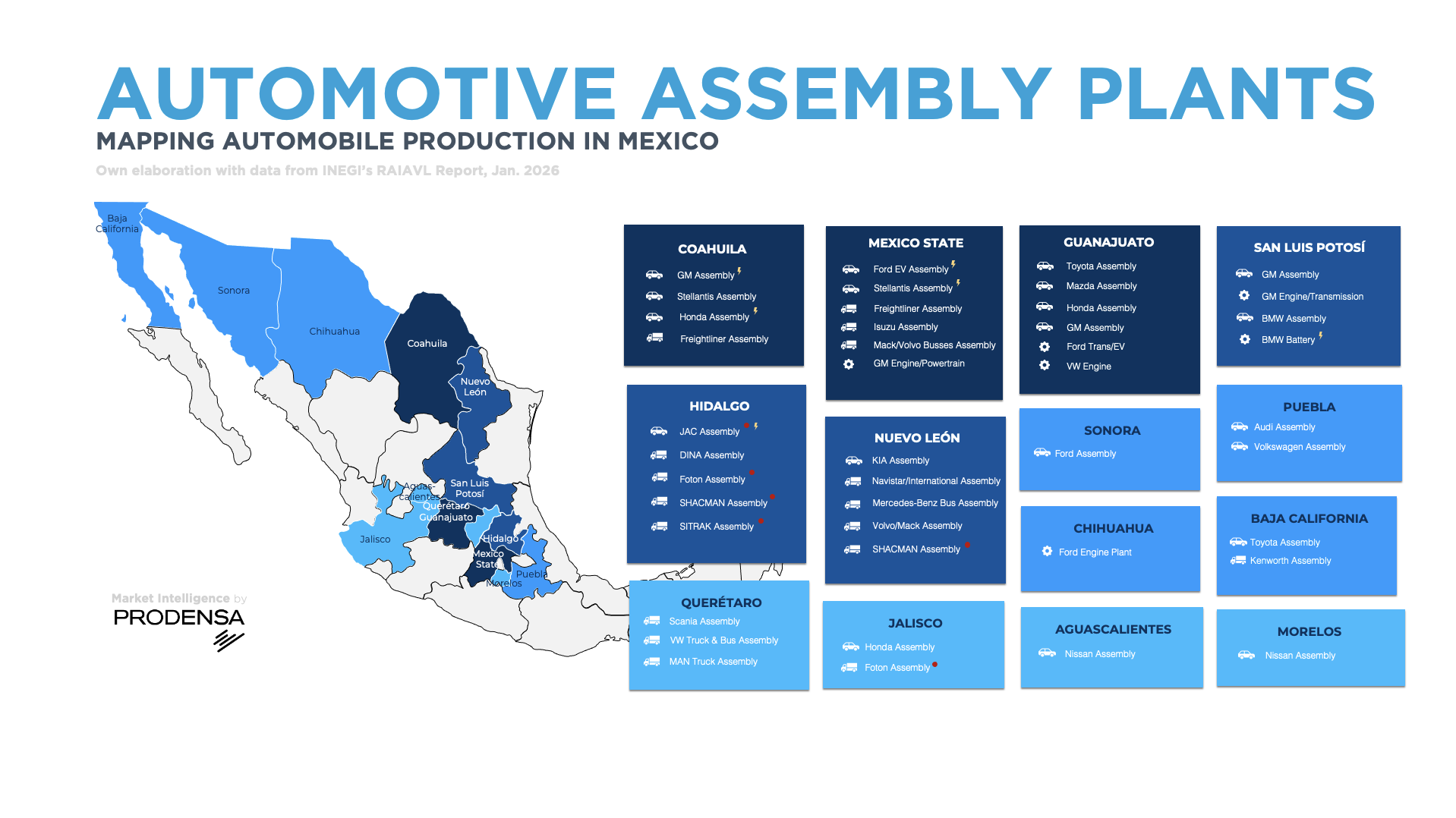
Why this matters: Mexico in the North American auto equation
To understand why these rules carry so much weight, start with the scale of what they govern.
-
Mexico's automotive industry contributes 3.8% of national GDP and roughly 20% of manufacturing GDP.
-
It exports 87% of what it builds, and 79% of those exports go to the United States.
-
More than 1,000 exporting suppliers operate in the country, and US content makes up over 40% of the average Mexican automotive export (INA).
-
In 2025, OEMs in Mexico produced about 3.95 million passenger vehicles and exported 3.39 million, alongside roughly 139,000 heavy vehicles.
-
The auto-parts sector produced about US$119 billion in output and ran a US$35.4 billion trade surplus, supplying close to 42% of all auto parts the United States imports.
This is not a Mexico story. It is a North American one. According to the Peterson Institute for International Economics, about 38% of the value embedded in Mexican vehicle exports to the United States actually originates in the United States.
Auto parts can cross North American borders eight or more times before final assembly, more than half of USMCA-traded goods are intermediate goods, and the regional industry supports over 5 million jobs. When a vehicle built in Guanajuato qualifies under USMCA, it sustains supplier plants in Michigan and Ontario too. That is exactly the integration the rules of origin are designed to protect.
What are the USMCA automotive rules of origin?
Automotive goods face four layered requirements that go well beyond a standard tariff shift:
| Automotive requirement | USMCA standard |
| Regional Value Content (passenger vehicles & light trucks) | 75%, up from NAFTA's 62.5% (phased to the full level) |
| Labor Value Content (LVC) | 40-45% of content from plants paying at least US$16/hour |
| North American steel and aluminum | 70% must be sourced in the region |
| Core parts (engine, transmission, chassis, axles; EV battery) | Must themselves qualify as originating |
Together these make automotive the highest bar in the agreement. A vehicle can carry plenty of North American assembly and still fail if its core parts are non-originating, its steel is from outside the region, or it cannot document the labor value content. Each requirement is a separate test, and the vehicle has to pass all of them.

How regional value content is calculated
USMCA allows two methods to calculate RVC: the net cost method and the transaction value method. For vehicles, the net cost method is the standard. In simple terms, you take the net cost of the good, subtract the value of non-originating materials, and divide by the net cost; the result must clear the required percentage. Most automotive qualification work is the disciplined accounting behind that one ratio, traced across the bill of materials.
The core-parts question and the dispute panel ruling
One technical disagreement defined how these rules are applied. The dispute was whether essential auto parts, such as engines, transmissions, and battery packs, can be treated as 100% originating once they individually meet the 75% RVC threshold, or whether the value of any non-originating content inside them must still be subtracted when calculating the finished vehicle's RVC.
Mexico and Canada argued for the flexible, aggregated approach the agreement's methodologies allow. The United States pushed a stricter reading that would have made qualification materially harder. The USMCA dispute panel sided with Mexico and Canada: once core parts independently meet 75% RVC, automakers may treat them as fully originating when calculating the vehicle's overall content, provided they follow one of the alternative methodologies in the agreement. The stakes were concrete. Vehicles that fail the test face the 2.5% Most Favored Nation tariff that applies to non-FTA passenger vehicles, on top of any other US tariff action in force. This approach would make it significantly more difficult for automakers to qualify for duty-free treatment under the USMCA rules of origin, effectively undermining the flexible methodologies negotiated into the agreement.
That precedent matters beyond the automotive aisle. It established that USMCA disputes are resolved by the negotiated text, not unilateral interpretation, which is the predictability manufacturers need to plan multi-year sourcing.
Political and Trade Policy Context
The disagreement over the USMCA automotive rules of origin is not just a technical issue—it’s also deeply political. It speaks to larger trade tensions within the Agreement, as well as diverging views on how to strengthen North American industry.
Mexico and Canada have consistently argued that their more flexible interpretation of the Agreement aligns with the spirit of trilateral cooperation. The United States’ stricter position, by contrast, has been influenced in part by domestic concerns about labor protections and industrial policy, especially under pressure from auto workers’ unions and U.S.-based manufacturers.
The 2026 USMCA review: automotive rules back on the table
USMCA carries a six-year joint review, and the first one lands in 2026. The U.S. International Trade Commission has launched a review of the automotive rules of origin, and the regional value content thresholds are squarely in scope. For Mexico, this is the single most important trade-policy event of the cycle. If your qualification depends on barely clearing 75%, model a higher bar now and decide where you would add regional content. Building margin into the design is far cheaper than re-engineering a supply chain after a rule changes.
The tariff environment makes qualification non-negotiable
The current US tariff environment raises the stakes. When the gap between the preferential USMCA rate and the applicable non-preferential or Section 232 rate is wide, a missed qualification is not a rounding error, it is a margin event on every unit. The discipline that used to be a compliance task is now a board-level cost lever.
The uncertainty is already visible in the investment data. Total automotive foreign direct investment into Mexico fell to US$9.26 billion in 2025, a 61.4% drop from 2024, as global capital paused amid trade-policy volatility, even though 204 projects were still announced. The companies that keep investing are doing so precisely because they have engineered USMCA qualification into their operations.
Where Mexico's auto industry is investing
Even with the 2025 slowdown, capital is flowing to exactly the places that strengthen origin qualification. Auto-parts suppliers led 2025 activity with 123 projects and US$2.7 billion, aimed at closing the supplier gaps that force reliance on imported inputs.
Electromobility drew 45 projects worth US$1.57 billion in battery components, power electronics, and EV drivetrains. Industrial parks and logistics infrastructure attracted US$4.16 billion. Tellingly, the largest single source of automotive FDI capital in 2025 was Mexico itself at 53.4%, followed by China at 11.3% and the United States at 10.5%, and roughly 70% of industrial growth came from companies already operating in Mexico expanding their footprint, a clear vote of confidence in the platform.
That investment concentrates in the regions built for origin compliance. The Bajío is the third most important automotive cluster in North America and accounts for nearly half of the country's vehicle-production capacity; Guanajuato alone produced over 877,000 vehicles and exported US$40 billion in auto parts in 2025. The northern border states hold more than half of national auto-parts production, and Nuevo León has become Mexico's leading electromobility and advanced-manufacturing hub. Deep, traceable supplier ecosystems in these corridors are what let OEMs reinforce the originating status of their content without scrambling.

How to keep your vehicles and parts qualifying
Automotive compliance is a traceability discipline, not a one-time filing. The essentials:
-
Audit the bill of materials. Identify which core parts qualify and where non-originating content sits, and calculate RVC using a USMCA-approved method.
- Document everything. Maintain records for RVC, labor value content, and the 70% steel and aluminum thresholds, ready for customs verification.
- Engage your suppliers. Tier 1, 2, and 3 partners must understand their role and provide origin declarations you can rely on, not just assert.
- Watch supply-chain changes. A supplier switching materials can quietly drop a part, and then a vehicle, out of qualification.
When it comes time to certify, our certificate of origin guide covers the document and its nine data elements, and our certificate-errors post covers the mistakes that trigger most audits.
How Prodensa keeps automakers and suppliers qualified
We have spent four decades helping manufacturers build and run operations in Mexico's automotive corridors. Our expert teams work together to turn origin compliance into a competitive advantage:
- International Trade Compliance team advises clients on audit preparation and conduct strategic analysis for compliance
- Sourcing & Supply Chain team supports local content development by identifying and qualifying suppliers
- IMMEX Advisory and Operations team operates over 70 individual programs on behalf of foreign manufacturers in Mexico
- Project Management team helps launch new operations, expand or consolidate manufacturing footprints, and take on complex structural changes
- Shelter Operations team helps new operations reduce risk when entering the Mexican market, supporting growth in strategic commodity areas
Understanding the USMCA rules of origin is no longer just a compliance issue—it's a strategic lever that can reduce tariffs, improve operational efficiency, and support long-term competitiveness in North America.
Building or sourcing vehicles and parts across the US-Mexico border?
Contact our USMCA trade advisory team.

Frequently Asked Questions
What is the USMCA regional value content requirement for cars?
75% for passenger vehicles and light trucks, up from NAFTA's 62.5%. Vehicles must also meet a labor value content requirement and a 70% North American steel and aluminum mandate.
What are USMCA automotive core parts?
Essential components such as engines, transmissions, chassis, axles, and, for EVs, the battery. Under USMCA these core parts must themselves qualify as originating for the finished vehicle to be treated as originating.
What is labor value content?
A requirement that 40–45% of a vehicle's content be made by workers earning at least US$16 per hour. It is unique to the automotive rules and is designed to shift higher-wage work into North America.
What happens if a vehicle does not qualify?
It loses preferential treatment and faces the 2.5% Most Favored Nation tariff for passenger vehicles, on top of any other applicable US tariff actions, often enough to erase the cost advantage of North American production.
How important is Mexico to the USMCA automotive supply chain?
Central. Mexico is the 7th-largest passenger-vehicle producer and the top supplier of auto parts to the US, and about 38% of the value in its vehicle exports to the US is US-made, so these rules govern a deeply binational chain.