




The publication of the constitutional reform in Mexico’s Official Gazette (DOF) on March 3, 2026, reducing the maximum workweek to 40 hours, followed by amendments to the Federal Labor Law (LFT) on May 1, 2026, represents a major structural change for Mexico’s manufacturing sector.
With an operational adjustment period ending on December 31, 2026, and gradual implementation formally beginning on January 1, 2027, manufacturers face a challenge that goes beyond regulatory compliance. For international investors, understanding these changes will be essential to protecting profitability and maintaining competitiveness in one of the world’s most dynamic manufacturing markets.
Key Operational Risks for Manufacturers in Mexico
-
Higher Overtime and Payroll Costs
The immediate financial impact of the shorter workweek creates two costly scenarios for manufacturers. According to estimates from the Adecco Institute, manufacturing companies may face two main options:
- Relying on overtime: Companies that maintain current production volumes by regularly using overtime could see an average 36% increase in payroll costs. This increase would be driven by double- and triple-pay overtime rates, with overtime calculated once employees exceed the applicable regular weekly hours.
- Hiring additional employees: Recruiting, training, and onboarding new workers to keep production lines running could lead to an average 22% increase in labor costs. This includes base salaries, employer contributions to IMSS and INFONAVIT, and state payroll taxes.
The challenge is even greater because Mexico’s manufacturing and export maquiladora sector has already absorbed several labor-related cost increases in a relatively short period, including expanded mandatory vacation benefits, pension reform with gradually higher employer retirement contributions, telework regulation, and restrictions on labor outsourcing
Juan José Sierra Álvarez, president of COPARMEX, has warned of the risk of formal job losses if the government does not introduce tax incentives to support employers during the transition.
-
Shift Coverage in Continuous-Production Plants (24/7)
Mexico’s manufacturing industry relies heavily on 24/7 operations and just-in-time delivery models required by global markets, especially the United States. The transition to a 40-hour workweek creates a major challenge for companies that need to maintain continuous shift coverage.
According to estimates from Index, Mexico’s maquiladora and export industries may need to hire approximately 600,000 additional employees to cover the hours lost through the shorter workweek and maintain current production volumes. This could place significant pressure on talent availability in northern border manufacturing hubs such as Ciudad Juárez and Tijuana, which already face challenges related to turnover, urban mobility, and the risk of production disruptions caused by border blockages.
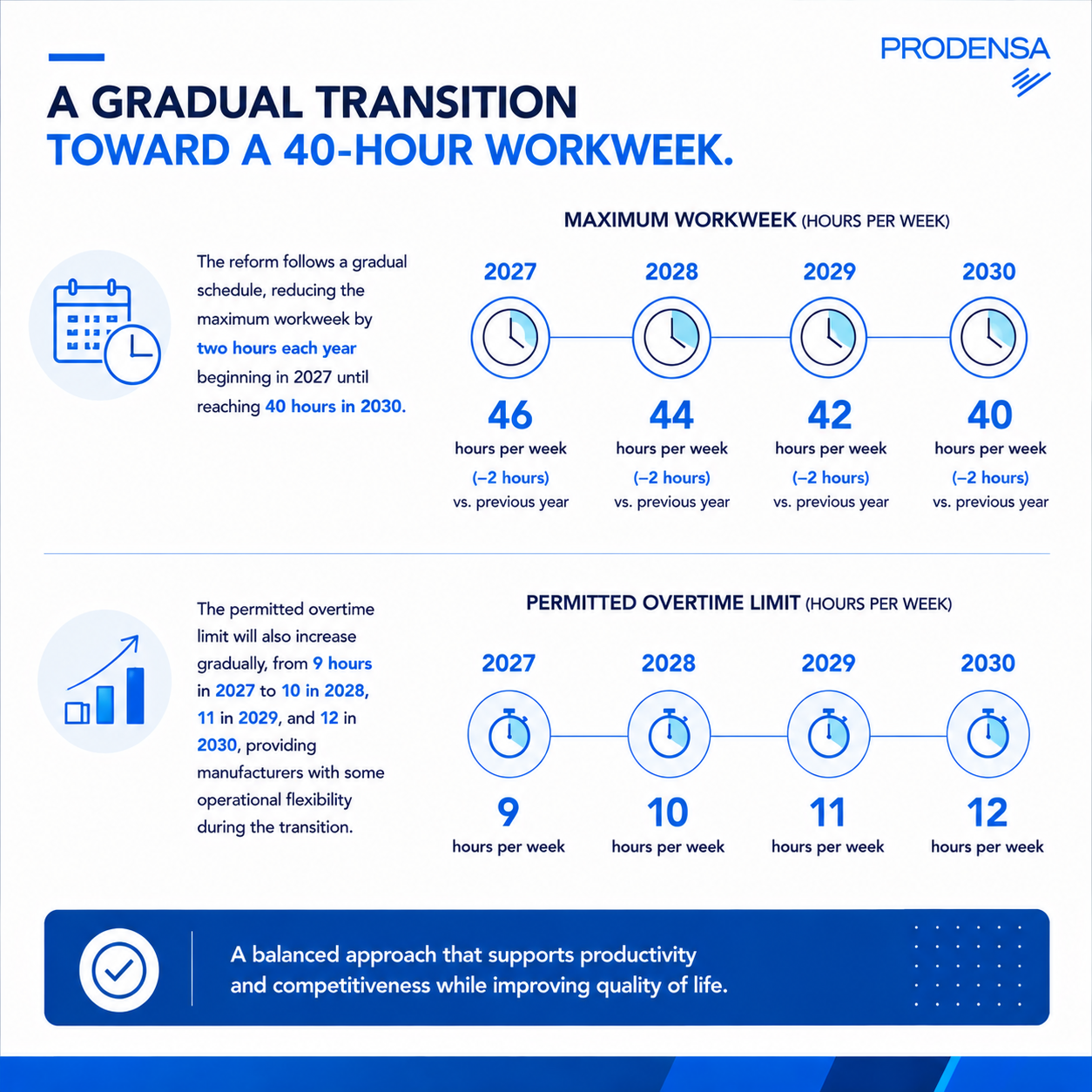
The reform follows a gradual schedule, reducing the maximum workweek by two hours each year beginning in 2027 until reaching 40 hours in 2030. The permitted overtime limit will also increase gradually, from 9 hours in 2027 to 10 in 2028, 11 in 2029, and 12 in 2030, providing manufacturers with some operational flexibility during the transition. However, executives from companies such as BRP, Lear, and Adient have emphasized the importance of maintaining a gradual implementation to help reduce the impact of potential penalties tied to export contracts.
-
Risk of Supply Shortages or Supply Chain Bottlenecks
The impact of the shorter workweek extends beyond manufacturing plants and into the broader supply chain. Companies that maintain current production volumes by relying on overtime could see higher payroll costs, potentially reducing the competitiveness of Mexican plants compared with Southeast Asian markets that continue to operate under standard 48-hour workweeks.
The automotive and auto parts sectors may be particularly exposed. According to industry studies from Kelly Services, 23.44% of automotive companies in Mexico anticipate significant cost increases, while 29.67% expect to completely reorganize their shifts and logistics distribution chains. Managing new working-hour limits without disrupting the flow of materials and finished goods represents a critical challenge for manufacturers that depend on precise supply chain coordination.
Making Up for Fewer Hours Through Efficiency: Key Strategies for Industry
-
Redesigning Shifts and Flexible Work Models
International experience offers several examples of how companies can adapt. Chile, which approved a reduction from 45 to 40 hours per week over a five-year period from 2024 to 2028, introduced greater operational flexibility by allowing overtime to be distributed through average-hour arrangements over four-week cycles or by concentrating the workweek into a four-day work, three-day rest model (“4x3”).
Colombia completed its gradual transition from 48 to 42 hours per week in July 2026, allowing working hours to be distributed by mutual agreement across five or six days, with daily schedules ranging from a minimum of four continuous hours to a maximum of nine regular hours.
In Mexico, several companies have begun testing flexible operating models:
-
Technology, Automation, and Lean Manufacturing
Digitalization is a critical tool for offsetting the reduction in on-site working hours while maintaining profitability. In Chile, the retail and commercial services sector responded to shorter working hours by investing approximately 8% of operating budgets in artificial intelligence and process automation to help address reduced staff availability.
Oracle Mexico shifted its technology development and administrative support teams to a results-based work model. The approach allows greater schedule flexibility, with employees working an average of six effective hours per day, or 30 hours per week, tied to specific deliverables. According to the reported results, this led to a 40% increase in internal productivity.
Walmart introduced compensation tied to productivity goals, including bonuses based on metrics such as the number of customers served per hour or inventory-stocking speed. These incentives reportedly allowed the company to reduce on-site working time by 30% while maintaining the same level of store efficiency.
The Human Factor: Culture and Engagement as Drivers of Productivity
-
Intensive Training to Increase Productivity per Hour Worked
Productivity per hour worked becomes a key indicator of competitiveness.
Switzerland offers an illustrative comparison. In 2025, full-time employees worked an average of 40 hours and 3 minutes per week, with an average annual salary adjusted for purchasing power parity (PPP) of USD $102,611, compared with USD $19,311 in Mexico. This 431% difference shows that reducing working hours does not automatically lead to higher real incomes. Income levels also depend on factors such as multifactor productivity, the adoption of advanced technologies, and cost of living.
Hospital ABC adopted medical and nursing shift models based on the completion of clinical tasks, using six-hour shifts and variable performance bonuses. The new structure significantly reduced employee exhaustion and burnout and reportedly resulted in a 20% improvement in patient service quality.
As companies move toward shorter working hours, intensive technical and operational training becomes increasingly important to help employees maintain or improve their productivity in less time. Companies should invest in:
Turning a Regulatory Challenge into a Competitive Advantage with Prodensa
Mexico’s 40-hour workweek reform, with gradual implementation from 2027 to 2030, is an opportunity for manufacturers to rethink how they operate. Companies that successfully adapt through a combination of shift redesign, technology adoption, OEE optimization, and workforce development can turn this challenge into a competitive advantage.
At Prodensa, we understand the operational and regulatory challenges facing manufacturers in Mexico. Our experience allows us to support international investors with tailored strategies focused on productivity and labor compliance.
The transition to a 40-hour workweek is becoming a new operational reality in Mexico. The key is turning that change into an opportunity to improve efficiency and strengthen long-term competitiveness.

Overall Equipment Effectiveness (OEE): A manufacturing metric used to measure how effectively equipment is being utilized by considering availability, performance, and quality.
Lean Manufacturing: A production approach focused on reducing waste, eliminating unnecessary downtime, and improving efficiency across manufacturing processes.
Upskilling and Reskilling: Training strategies that help employees strengthen existing skills or develop new capabilities as processes, technologies, and job requirements evolve.
Just-in-Time (JIT): A production and supply chain model designed to deliver materials and components when they are needed, minimizing inventory while requiring precise coordination.

How will Mexico’s 40-hour workweek affect manufacturing operations?
Manufacturers may need to redesign shifts, increase overtime, hire additional employees, or improve productivity to maintain current production levels with fewer regular working hours.
What are the biggest cost risks for manufacturers?
The main risks include higher payroll costs from overtime, additional hiring and training expenses, and potential inefficiencies if production schedules are not redesigned in advance.
How can manufacturers maintain productivity with fewer working hours?
Companies can focus on automation, Lean Manufacturing, OEE improvement, preventive maintenance, line balancing, and workforce training to increase output per hour worked.
Will 24/7 manufacturing operations be affected?
Yes. Plants that rely on continuous production may need to reorganize staffing and shift structures to maintain full coverage while complying with the new weekly limits.
What should manufacturers do before the transition begins?
Companies should evaluate their current shift models, overtime exposure, staffing needs, equipment efficiency, and training plans before the first reduction takes effect in 2027.

- Mexico’s transition to a 40-hour workweek will require manufacturers to rethink how they use labor, equipment, and production time—not simply reduce hours.
- The biggest operational pressure will come from maintaining production coverage and output while managing higher overtime, hiring, and training costs.
- For 24/7 plants, the transition will make shift design, staffing models, and supply chain coordination increasingly important.
- Productivity improvements will be critical. Strategies such as OEE optimization, automation, Lean Manufacturing, preventive maintenance, and workforce development can help companies produce more efficiently within fewer working hours.
- Manufacturers that begin preparing before 2027 will be in a stronger position to control costs, maintain service levels, and turn the reform into an opportunity for long-term operational improvement.
.png?width=1200&height=178&name=DIVIDER1%20(1).png)
Notice: The content of this blog is developed by Prodensa for informational and educational purposes regarding nearshoring, foreign trade, human capital, and manufacturing in Mexico. Although we strive to keep the information accurate and up to date, laws and regulations may change. This material is not a substitute for specialized professional advice. Prodensa is not responsible for decisions made based on this content without appropriate professional consultation.