




For more than three decades, North America’s economic integration was built around trade. The North American Free Trade Agreement (NAFTA) and later the USMCA created a framework that expanded the flow of goods, capital, and investment among Mexico, the United States, and Canada. Today, however, the context is different.
Technology has transformed production networks, economic security has become increasingly important, and companies now face the challenge of ensuring continuous access to inputs, infrastructure, talent, and markets.
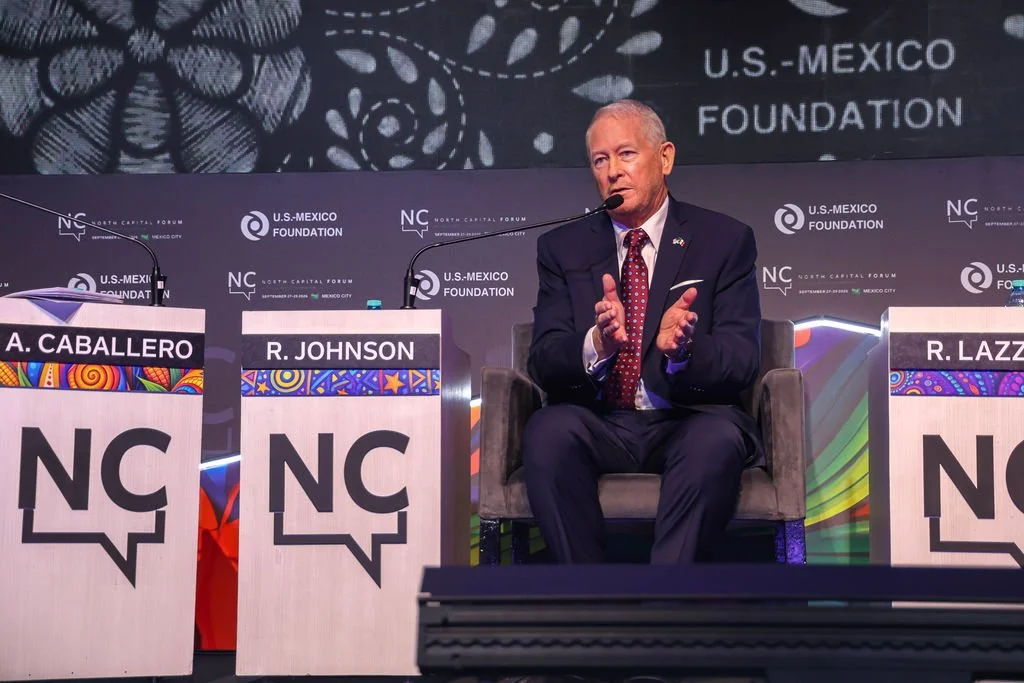
That transformation was one of the main topics discussed during the panel “Belong Together: The North American Ambassadors’ Perspective” at the North Capital Forum 2026, featuring Ronald D. Johnson, U.S. Ambassador to Mexico; Roberto Lazzeri, Mexican Ambassador to the United States; and Cameron MacKay, Canadian Ambassador to Mexico.

Despite the differences among the three countries, one clear business message emerged from the conversation: North American integration is already deeply established and difficult to reverse, but its next phase will require new capabilities to fully capture its potential.
North America Is Already Integrated, the Challenge Is Making It More Resilient
The panel opened with a fundamental question: Do Mexico, the United States and Canada truly belong together? All three diplomatic representatives answered yes, although each approached the question from a different perspective.
For Johnson, the discussion starts from a different premise: the three countries do not simply belong together—they are already deeply connected.
Geography, social ties, and integrated production networks have created a level of interdependence that would be difficult to unwind. Johnson pointed to the extensive borders the United States shares with both Canada and Mexico, as well as the constant movement of people, capital, and goods across the region.
MacKay spoke about the relationship between Canada and Mexico, noting that although they are the two most geographically distant countries within North America, their connection continues to grow through air travel, infrastructure, and trade. During peak travel periods, there are around 400 weekly flights between the two countries, while millions of people cross North American borders and billions of dollars in goods move across the region every day.

For companies, this means North America should not be viewed as three separate markets. An investment decision in Mexico can have direct implications for U.S. suppliers, Canadian customers, cross-border logistics, regulatory compliance, and access to critical inputs.
Likewise, a disruption at one point in the supply chain can affect operations hundreds or even thousands of miles away. That is why the next phase of North American integration will depend on more than reducing trade barriers. It will also require building supply chains that can withstand regulatory, technological, logistical, and geopolitical changes.
From Free Trade to Economic Security
One of the most relevant ideas discussed during the panel was the evolution of economic integration. Roberto Lazzeri noted that many of the assumptions on which international trade was built have changed, driven in part by technological advances and the increasing interconnection of production systems.
 In this context, he suggested that trade agreements may evolve toward a model that places greater emphasis on economic security, supply chain resilience and the ability to ensure reliable access to critical inputs and goods.
This shift is especially important for manufacturing companies. For years, many sourcing strategies focused primarily on finding the lowest-cost supplier. Today, the equation needs to include a broader set of questions:
- What is the cost of a disruption?
- How long can a plant continue operating if a critical component stops arriving?
- What happens if a rule of origin changes?
- Can the company prove the origin of its goods?
- Does it have visibility into its suppliers?
- Can it respond quickly to an audit or regulatory change?
Resilience, therefore, is becoming a cross-functional business capability that involves foreign trade, tax, customs, operations, procurement, finance, and technology.
Mexico: Trade Dependence or Competitive Advantage?
Mexico plays a key role in this transformation, with approximately 80% of Mexican exports going to the United States. However, Lazzeri cautioned against viewing that figure too simplistically.
From his perspective, the Mexico–U.S. relationship cannot be described only as one between an exporter and an importer. It is a co-production system.
Mexico and the United States participate jointly in production processes that can cross the border several times before a finished product reaches the end consumer. This integration gives Mexico a competitive advantage, but it also increases the need for operations that can meet the requirements of both markets.
A company manufacturing in Mexico for export to the United States needs more than a competitive plant. It must understand rules of origin, tariff classification, foreign trade programs, documentation, traceability, tax and customs compliance, logistics and customer requirements.
And the more integrated the supply chain becomes, the greater the impact of any mistake in those areas. Productive integration creates significant opportunities, but it also requires a higher level of operational sophistication.

The Next Generation of Infrastructure Will Be Physical and Digital
Technology is another factor that could reshape North America’s competitiveness. When discussing how the relationship among the three countries could evolve, Johnson highlighted the role technology can play in making the movement of goods across borders faster and more efficient.
He specifically pointed to the use of artificial intelligence in border processes to accelerate the flow of products and improve the ability to distinguish between low-risk movements that can be processed quickly and those that require closer review.
For CEOs, this means supply chain transformation will depend on more than new roads, ports, railways and industrial parks. It will also require digital and data infrastructure that connects operations, authorities, suppliers, and customers.
The manufacturing company of the future will need near real-time visibility across its operations—and that visibility will have to extend well beyond the four walls of the plant.
Compliance Will Become Part of Competitive Strategy
The discussion around security introduced another important dimension for companies: compliance and traceability.
Johnson noted that companies have a responsibility to understand who they are doing business with. He also highlighted the role of sanctions and tools such as OFAC measures in addressing financial flows linked to criminal organizations.
From the Mexican perspective, Lazzeri emphasized the importance of understanding the legal frameworks of regional partners and maintaining strong communication to avoid unexpected issues.
The principle he referenced is especially relevant for business operations: a “no surprises policy”—keeping counterparties informed and reducing the risk of unforeseen consequences.
In an environment where supply chains cross multiple jurisdictions, due diligence becomes a key risk management tool.
Knowing your suppliers, business partners, product flows, documentation, and operating structures can determine whether a company is able to respond effectively to a disruption—or becomes exposed to sanctions, interruptions, and financial losses.
What Does This Mean for Companies Looking to Grow in Mexico?
The ambassadors’ discussion points to a clear conclusion: North America will remain deeply integrated, but competing within the region will become increasingly demanding.
 The combination of economic security, supply chain resilience, technology, compliance, infrastructure, and trade diversification is creating a new standard for companies.
In this environment, having an efficient operation is no longer enough.
Companies need to anticipate change. They need to understand the rules before investing, design the right operating structures, assess risks before they become costs, and build operations that can adapt to an environment that will continue to evolve.
How Can Companies Build an Operation in Mexico That Is Competitive Today and Resilient to North America’s Future Changes?
The next phase of North American integration creates significant opportunities for companies that are prepared, but it also makes operating in the region more complex.
From site selection and operational setup to tax and customs compliance, foreign trade, talent, infrastructure, supply chains and expansion, companies need a partner that understands how each part of the operation affects the others.
That is where Prodensa can become a strategic partner. With an integrated view of business operations in Mexico, Prodensa can support companies from the initial evaluation of an investment through startup and the long-term consolidation of their operations.
As North America moves toward more resilient supply chains, greater technological integration, and new compliance requirements, the real advantage is not simply entering the Mexican market. It is building an operation that is prepared to compete across the entire region.
North America is already integrated. The next challenge is making sure your company is, too.
.png?width=1200&height=178&name=DIVIDER1%20(1).png)
Notice: The content of this blog is developed by Prodensa for informational and educational purposes regarding nearshoring, foreign trade, human capital, and manufacturing in Mexico. Although we strive to keep the information accurate and up to date, laws and regulations may change. This material is not a substitute for specialized professional advice. Prodensa is not responsible for decisions made based on this content without appropriate professional consultation.