


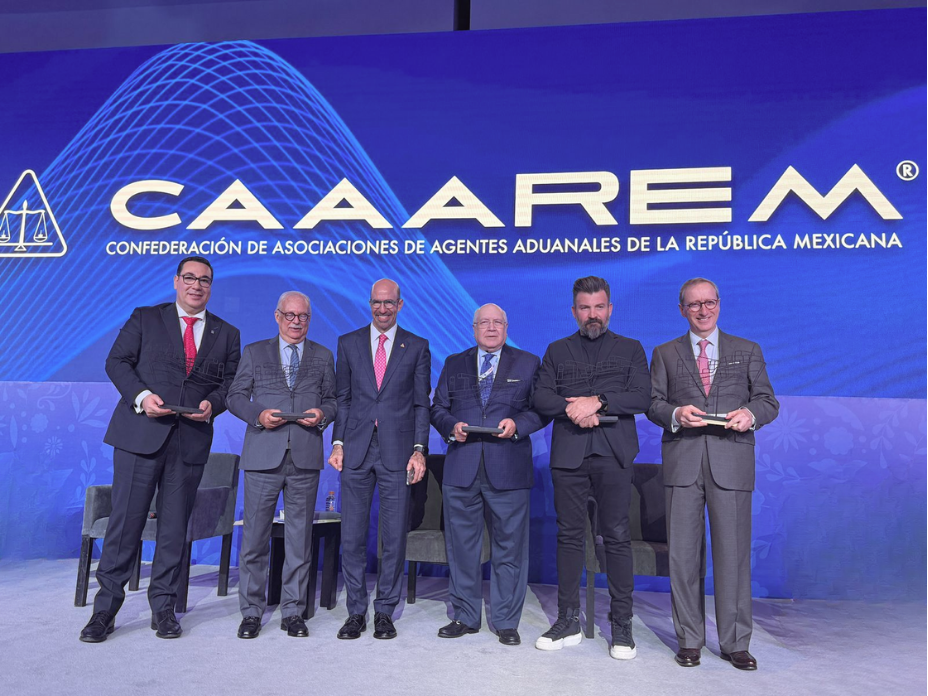
Emilio Cadena, CEO of Prodensa, recently took part in the 85th National Congress of Customs Brokers (CAAAREM), where he shared a forward-looking perspective on the future of the USMCA (T-MEC). As part of our editorial series based on Emilio’s participation at the event, we explore why the 2026 review should not be seen as a threat, but as Mexico's historic opportunity to lead North America's next era of regionalization. This blog highlights the most relevant insights for international companies doing business in Mexico.

The panel, titled "The Challenges of the USMCA Review After Liberation Day," was moderated by Fernando Con y Ledesma, President of the Mexican Association of Shipping Agents, and featured Sergio Espinosa, Commercial Manager of Hutchison Ports; Gerald Schwebel, President of NASCO (North American Strategy for Competitiveness); Emilio Cadena, CEO of Prodensa and Chairman of the US-Mexico Foundation; and Juan Pablo Cervantes, President of the International Section of COMCE Nacional.
Why the USMCA Must Adapt to Geopolitical Shifts and Regional Supply Chain Trends
When the USMCA was signed in 2020, the global landscape was different. Today, geopolitical tension, national security concerns, and supply chain resilience have replaced cost-efficiency as the main priority. It would be naïve to think that a trade agreement built under pre-pandemic conditions will remain untouched in 2026.
Back in the NAFTA era, production was driven by locating the cheapest possible manufacturing base—a model that propelled both Mexico and China to the forefront. In the 2000s, sustainability began to reshape global supply chains. Now, in the post-pandemic, post-Trump era, trade is dictated by geopolitics. That means reducing risk, building resilience, and prioritizing regional partnerships.
Why the USMCA Is a Strategic Asset in Today’s Geopolitical Landscape
The COVID-19 crisis revealed major vulnerabilities. Over 80% of active pharmaceutical ingredients (APIs) in generic drugs come from China. India relies on China for about 70% of the same materials. In electronics, not a single plant in the Americas or Europe currently manufactures printed circuit boards. That puts the entire West at the mercy of strategic chokepoints.
That’s why the USMCA matters more than ever. It offers a framework to regionalize supply chains and reduce reliance on Asia. The agreement isn’t just still relevant—it’s a critical tool for national and economic security.
USMCA: A High-Impact Trade Agreement Backed by Economic Data
Some might question whether the USMCA will survive future political cycles. But the data tells a clear story:
-
Mexico and Canada together represent the largest market for U.S. exports.
-
While the next 13 top U.S. trading partners buy around $200 per capita, Mexico and Canada purchase over $4,000 per person.
-
Mexico alone imports approximately $2,600 per capita annually from the United States.
These numbers confirm that the North American market is irreplaceable. From a jobs perspective, there’s a near-perfect correlation: for every manufacturing job created in Mexico, a counterpart is created in the U.S. This is not competition; it’s a binational production partnership.
Tariff Differentials Show the Urgency of Staying Inside the Agreement
 Before USMCA, the average U.S. tariff hovered around 3.6%. Today, companies operating
outside of the agreement face duties of 25% to 30%. The economic incentive is clear: comply with USMCA rules or pay significantly more.
This shift in tariff structures means that USMCA is no longer a "nice to have" — it's a strategic imperative, particularly for foreign manufacturers and IMMEX companies who benefit from regional duty-free trade.
Strengthening Trust in North American Trade Through IMMEX and IBP Programs
Roughly 3,700 companies in Mexico operate under IMMEX certification and are approved as IBPs (Importers with Trusted Programs). These firms are at the center of Mexico’s trusted supply chain, especially when security and compliance are top priorities for the U.S. and Canada.
For North America to compete against Asia, trust and transparency must be non-negotiable. Strengthening IMMEX companies and ensuring robust customs procedures will be key to winning investor confidence.
Think Like China. Build Like Mexico.
If China can have over 50 car manufacturers, why can’t Mexico build and brand its own industrial infrastructure beyond the maquila model? This is the time to invest in our own capabilities—from automotive platforms to strategic sectors such as aerospace, semiconductors, and energy.
To seize the opportunity, we must develop a true industrial policy that prioritizes:
-
Infrastructure development
-
Talent formation
-
Regulatory certainty
Mexico must act not only as a manufacturing hub but as a full-value-chain partner. That’s what it means to lead in the new era of regionalization.
USMCA 2026 Review: A Strategic Opportunity for Mexico to Lead Regional Trade
The review of the USMCA in 2026 will not be a simple renewal process—it will be a defining moment for the future of North American trade. Mexico has the momentum, the geography, and the expertise to play a leadership role in nearshoring strategies, turnkey operations, and overall efforts toward regional integration.
But success requires bold decisions. The world is moving fast, and geopolitics will shape supply chains more than labor costs ever did. To stay competitive, Mexico must double down on investment, regulatory confidence, and industrial innovation.
The future is regional. The moment is now. The path to leadership in nearshoring, manufacturing in Mexico, and shelter services starts with strategic alignment to the USMCA framework.
 PRODENSA Key Points:
-
The 2026 USMCA review is a strategic turning point, not a threat.
-
Geopolitical changes demand a regional approach to supply chains.
-
USMCA offers competitive advantages in tariff savings and market access.
-
Data confirms Mexico's role as a top trade partner and job creator for the U.S.
-
IMMEX and IBP programs are essential to maintaining trust and compliance.
-
Mexico must invest in infrastructure, talent, and policy to lead regionalization.
-
Now is the time for bold industrial policy—beyond maquila models.
-
Aligning with USMCA is crucial for companies pursuing nearshoring, manufacturing in Mexico, turnkey operations, and shelter services in Mexico.