

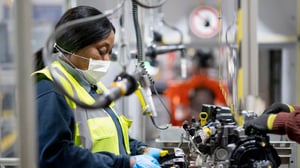
Manufacturing around the world is changing fast, pushed by new digital tools and the shift toward cleaner, more sustainable production. Looking ahead to 2030, the biggest challenge isn’t just adopting new technologies—it’s the growing gap between what today’s workforce can do and what modern factories now require.
This gap (known as the skills gap) means millions of jobs could go unfilled, leading to trillions of dollars in lost economic output and slowing down innovation worldwide.
⏱️ Limited time? Jump to the Executive Summary
The Global Talent Shortage Explained
Projections for the end of this decade show a shortage of talent affecting all countries alike. In the United States, studies by Deloitte and The Manufacturing Institute warn that, if urgent measures are not taken, up to 2.1 million manufacturing jobs could go unfilled by 2030. This is not just an operational issue, but a significant economic risk: it is estimated that U.S. GDP could lose $1 trillion in that year alone.
What is concerning is that this shortage persists even when many people are seeking employment; companies are unable to hire for both entry-level production roles and highly specialized positions.
At a global level, the situation is equally severe. Various consulting firms estimate that by 2030 there will be a shortage of around 85.2 million skilled workers, a problem exacerbated by rapid technological advancement and stricter migration policies. In regions such as Europe, the industry faces a “polycrisis”: political uncertainty and rising costs combine with the difficulty of finding qualified personnel to lead the transition toward a greener and more digital economy.
The 2030 Talent Gap: By the Numbers
| Talent Gap Indicator | 2030 Projection | Estimated Impact |
|---|---|---|
| Unfilled jobs in the U.S. | 2.1 million | $1 trillion annual GDP loss |
| Global skilled labor shortage | 85.2 million | Global competitiveness crisis |
| Jobs created by green and digital transitions | 170 million | Massive reskilling need |
| Hard-to-fill manufacturing vacancies | 36% | Delays in innovation and delivery |
| Workers requiring reskilling globally | 375 million | Reconfiguration of education systems |
Sources: Deloitte & The Manufacturing Institute, WEF, Korn Ferry, McKinsey
This talent crisis is not a sudden phenomenon, but the culmination of long-standing demographic and educational trends. The massive retirement of the “baby boomer” generation (estimated at 2.7 million people in the United States alone by 2025) is causing a critical loss of institutional knowledge and traditional technical skills that are not being replaced at the same pace by younger generations.
Additionally, the public perception of manufacturing as a “dirty” or low-tech sector persists among Generation Z, limiting the flow of new talent into the industry.
The Industry 5.0 model: people-centered manufacturing
The solution to the skills shortage is not simply to add more machines to replace people, but to move toward the Industry 5.0 model. While Industry 4.0 focused primarily on the efficiency of digital systems and data connectivity, Industry 5.0 incorporates an ethical and social perspective, prioritizing people, sustainability, and adaptability.
This shift redefines the role of the worker: no longer just an operator managing machines, but a coordinator of intelligent systems who contributes creativity, intuition, and critical thinking—qualities that artificial intelligence still cannot fully replicate.
-
Human-machine collaboration (cobots)
In Industry 5.0, technology is seen as a tool that enhances human capabilities, not replaces them. The concept of the collaborative robot, or “cobot”, is central to this vision, enabling humans and machines to work together in close proximity to optimize mass customization processes that require both mechanical precision and human judgment.
This collaboration not only increases productivity but also improves job satisfaction by allowing machines to handle dangerous or repetitive tasks while workers focus on solving more complex problems.
-
Health and well-being as productivity indicators
Industry 5.0 recognizes that industrial success cannot be separated from worker well-being. Future production systems are incorporating technologies to monitor and improve both physical and mental health. This includes the use of extended reality (XR) to provide real-time assistance and reduce cognitive load, as well as wearable sensors that detect physical risks before injuries occur.
Creating safe, inclusive, and motivating work environments therefore becomes a fundamental competitive advantage for attracting talent in an increasingly demanding labor market.

The dual challenge: digital and green skills
Looking toward 2030, the industry faces what is known as the “dual transition”: digitalizing to become more efficient and decarbonizing to become more sustainable. The combination of these processes requires hybrid skills that are currently difficult to find.
-
Digitalization and automation
Modern manufacturing is data-intensive. There is a need for individuals capable of managing digital twins, artificial intelligence, and connected industrial networks. It is no longer enough to know how to use a computer; one must understand data and how to use it to make real-time decisions.
The problem is even greater for small and medium-sized enterprises, as 63% report difficulties in finding personnel with digital competencies. The demand for industrial cybersecurity skills is also increasing.
-
Sustainability skills
The green transition requires mastery of concepts such as circular economy, recycling, and carbon footprint measurement. “Green talent” is increasingly scarce: demand is growing twice as fast as supply.
Technicians and engineers must be able to manage processes that use biological resources and optimize energy and water consumption to meet climate targets.
Required Capabilities by 2030
| Competency Area | Required Skills | Production Impact |
| Artificial Intelligence | Algorithm management, AI ethics, generative AI | Process and quality optimization |
| Collaborative Robotics | Cobot programming, preventive maintenance | Operational safety and flexibility |
| Circular Economy | Design for reuse, biomass management | Waste and cost reduction |
| Data Analytics | Big Data interpretation, digital twins | Predictive maintenance and OEE |
| Soft Skills | Critical thinking, emotional intelligence, resilience | Adaptability and crisis management |
These capabilities converge into hybrid skill sets—where digital, operational, and human competencies intersect to drive productivity, resilience, and sustainable manufacturing performance.
Scenarios for 2030: the role of AI and talent
The World Economic Forum outlines four possible employment scenarios for 2030, depending on the pace of AI advancement and workforce readiness.
-
Supercharged progress: AI advances rapidly and workers are highly prepared. Productivity increases, some traditional jobs disappear, but higher-value roles emerge. People act as coordinators of AI systems, and talent is sourced globally.
-
The displacement era: AI advances rapidly, but workers fail to adapt. Companies automate to address labor shortages, displacing more workers than the education system can retrain. This creates social risks and instability.
-
Copilot economy: AI progresses more gradually and is used to enhance human capabilities. Technology is integrated pragmatically, improving efficiency without causing mass layoffs. This is the most stable and collaborative scenario.
-
Stagnant progress: Technology advances slowly and workers lack key skills. Productivity remains low and concentrated in a few countries, while others lose competitiveness and inequality increases.
To avoid negative scenarios, companies must invest in systems that allow them to identify current skills and accurately anticipate future needs.

Strategic Workforce Planning (SWP)
Talent planning to address 2030 risks requires a multidimensional approach that combines knowledge retention with the acquisition of new capabilities. The traditional reactive hiring model is insufficient in an environment of chronic talent scarcity.
-
The “Three B’s” framework: Build, Buy, Borrow
To close the talent gap, companies must combine three approaches:
Case studies: strategies for 2030
Demographics and attracting new generations
The manufacturing sector must urgently address its image problem to compete for young talent. While older workers tend to value stability and the economic prestige of the industry, younger generations prioritize flexibility, a sense of social purpose, and technologically advanced work environments.
-
Inclusion and diversity as a business imperative
The talent gap cannot be closed if half of the population feels it does not belong in the sector. Women remain significantly underrepresented in manufacturing, and many who are currently in the industry are considering leaving due to a lack of flexibility or clearly defined career paths. Initiatives such as the STEP Women’s Initiative are not merely corporate social responsibility programs, but economic survival strategies aimed at expanding the available talent pipeline.
-
The aging workforce challenge in developed economies
In Europe and the United States, one in four manufacturing workers will be over the age of 55 by 2030. This creates an imminent risk of knowledge loss. Companies must implement formal mentorship programs and succession planning strategies that leverage technologies such as augmented reality, enabling experienced workers to visually document their processes and guide apprentices—capturing critical institutional knowledge before it exits the workforce.
Toward talent resilience by 2030
The lack of skills in manufacturing is not an impossible problem to solve, but an opportunity to transform the industry. Data indicates that, by 2030, the sector’s survival will depend on shifting from a model that "extracts value from labor" to one that "invests in people."
Companies that succeed in combining advanced technology with a human-centered approach will not only close their talent gaps, but also lead the new global economy.
Talent planning must be as important today as financial or production planning. The trillions of dollars at risk show that action is required now. By 2030, the true competitive advantage will not lie in having the fastest machines or the best algorithms, but in having a resilient, adaptable workforce capable of guiding those technologies toward a sustainable and prosperous future.

🛆 Industry 5.0:
A manufacturing paradigm that integrates advanced automation with a human-centered approach, prioritizing collaboration between people and intelligent systems.
🛆 Skills Gap:
The mismatch between the current capabilities of the workforce and the skills required by modern, technology-driven production systems.
🛆 Strategic Workforce Planning (SWP):
A proactive approach to identifying, developing, and deploying talent aligned with future business and technology needs.
🛆 Dual Transition:
The simultaneous shift toward digitalization and decarbonization across industrial sectors.

What is the manufacturing skills gap and why does it matter?
It is the growing mismatch between available talent and required skills, impacting productivity, innovation, and growth.
How will Industry 5.0 change the workforce?
It will require workers to collaborate with AI and automation, focusing on creativity, problem-solving, and system coordination.
Which skills will be most in demand by 2030?
Digital (AI, data, cybersecurity), sustainability (circular economy, energy optimization), and soft skills (critical thinking, resilience).
What strategies can companies use to close the talent gap?
Adopt the Build, Buy, Borrow model and invest in continuous upskilling and reskilling programs.
Why is talent becoming the main competitive advantage?
Because technology alone is not enough—companies need skilled people to operate, adapt, and extract value from it.

-
Talent is the new bottleneck in manufacturing.
Companies that fail to address skills gaps will face operational and strategic limitations. -
Industry 5.0 is redefining workforce value.
Human capabilities—creativity, adaptability, and judgment—are becoming critical differentiators. -
Reskilling is no longer optional.
Continuous workforce development is essential to remain competitive in a fast-changing environment. -
Workforce strategy must be proactive.
Companies that anticipate skill needs will outperform those that react too late.
Executive Summary
- The global manufacturing sector faces a critical skills gap that could leave millions of jobs unfilled by 2030.
- Up to 85.2 million skilled workers may be missing globally, threatening productivity and innovation.
- Industry 5.0 shifts the focus from automation to human-centered manufacturing and collaboration with AI.
- The “dual transition” (digital + green) is creating demand for hybrid skills that are currently scarce.
- Companies must adopt Strategic Workforce Planning (Build, Buy, Borrow) to remain competitive.
- Talent—not technology—will be the defining advantage for manufacturing success by 2030.