

Supply chains are no longer a cost center.
They are a source of profit (or a liability).
For decades, the formula for success in supply chains was extreme efficiency, massive scale, and the lowest possible unit cost. We operated under the assumption that the world was a stable place and that any disruption was simply a statistical anomaly.
Today, that assumption is dead.
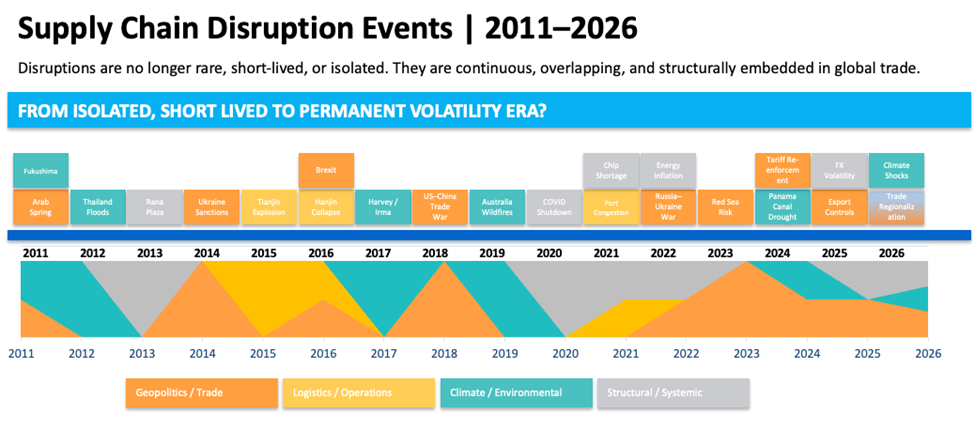
A timeline of the “unexpected”
When we look back at the last 20 years, it becomes clear that so‑called “once‑in‑a‑lifetime” events (from global pandemics and financial crises to trade wars and blockages in major trade routes) have become our new normal. The hard lesson we have learned is that a supply chain optimized solely for cost reduction breaks under volatility. We are no longer dealing with isolated incidents; we are living in an era of permanent structural volatility.
The brutal honesty of TCO
The concept of Total Cost of Ownership (TCO) has moved from being a theoretical metric to becoming the true pulse of the income statement. It is no longer enough to look only at where labor is cheapest, because the real cost today includes variables that were once secondary:
- Constant exposure to new tariffs and rules of origin
- Extreme volatility in freight costs and the risk of capacity shortages
- The financial cost of holding higher inventory levels to hedge against uncertainty
- Currency market fluctuations
- The invisible penalties of arriving late to a market that does not wait
When these costs rise and cannot be passed on to the consumer, profitability simply evaporates.
Proximity as the new synonym for relevance
For companies that serve consumer markets, being close is a matter of survival. Businesses trapped in rigid, distant manufacturing models are paying an “inflexibility tax.” A regional manufacturing footprint not only helps comply with trade rules; it allows companies to capture demand in real time and protect margins when the wind changes direction.
Flexibility is the business model, not the insurance policy
The companies winning today are not necessarily those that produce at the lowest cost, but those with the greatest ability to adapt. Yet the reality inside many organizations is concerning:
- A lack of resources dedicated exclusively to supply chain strategy
- Overloaded operating teams with no time for strategic analysis
- A long‑standing fear of investing in contingency plans or “what‑if” scenarios
Meanwhile, CFOs are watching profitability disappear from heavy infrastructures designed for a world that no longer exists.
Supply chain reengineering is not a project with an end date; it is a permanent capability. The winning organizations will be those that design for optionality, review their supply strategy as frequently as they review pricing, and treat the location of their plants as a dynamic strategic variable—not a fixed decision.
The question is no longer whether another disruption will happen, but whether your structure is ready to absorb the impact. Preparation starts by questioning where, how, and why you manufacture.