

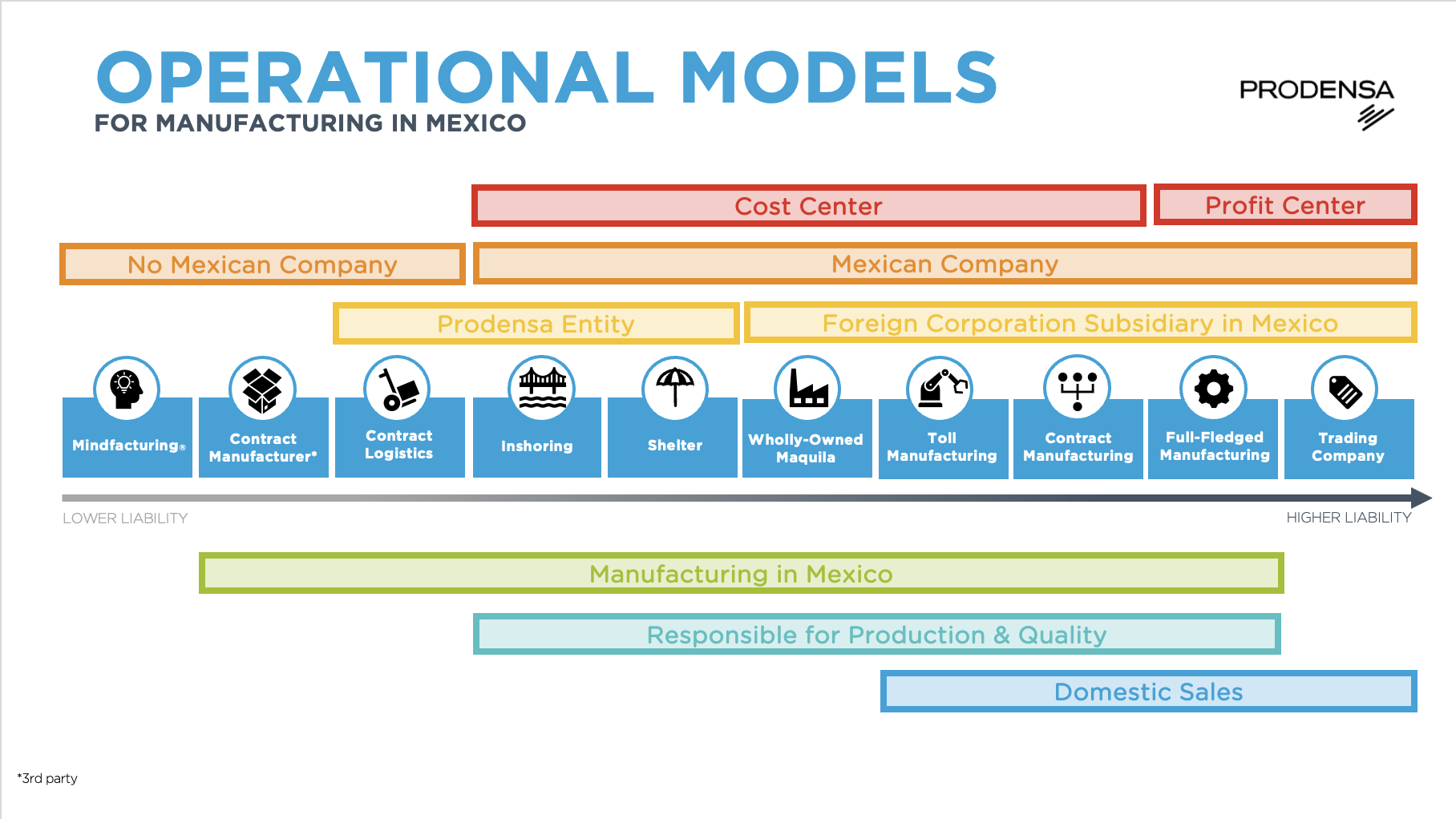
Companies entering Mexico choose from several market entry strategies, and each one trades speed, control, and risk differently. The options range from a shelter (maquiladora) program and a wholly-owned subsidiary to an employer of record, contract manufacturing, and full turnkey operations. For most manufacturers, the fastest, lowest-risk path is a turnkey or shelter model that puts you into operation in weeks to a few months instead of building everything from scratch.
Mexico offers cost-effective operations, proximity to North American markets, and skilled labor. But regulatory requirements, labor laws, and administrative complexity can slow you down. Choosing the right entry strategy is what turns that opportunity into a running operation.
Key Takeaways:
-
There are seven common ways to enter Mexico: shelter, wholly-owned subsidiary, EOR, contract manufacturing, inshoring, joint venture/acquisition, and distributor (or trading company). Other hybrid models exist for highly strategic operations.
-
The fastest paths (EOR, contract manufacturing, inshoring) let you operate without forming your own Mexican legal entity.
-
A wholly-owned subsidiary gives full control but takes ~4–6 months and carries direct liability.
-
Turnkey operations accelerate entry by consolidating setup, compliance, and operations under one partner.
- The right choice depends on your timeline, headcount, control needs, and risk appetite.
What are the main market entry strategies for Mexico?
Seven models cover the most common scenarios we see in Prodensa.
| Strategy | What it is | Speed | Best for |
| Shelter (maquiladora) | Operate under a provider's established and IMMEX entity | From 4 months to 10+ months | Market entry, pilots, and companies with limited experience in Mexico |
| Wholly-owned subsidiary | Form and run your own Mexican entity | About 4 to 6 months | Large, long-term operations wanting full control |
| Employer of Record (EOR) | Hire staff under a provider's entity, no company setup | 1-2 weeks | Building a team or testing the market |
| Contract Manufacturing | Outsource production to a Mexican manufacturer | Fast | Producing without owning a plant in Mexico |
| Inshoring | Hiring manufacturing services from the U.S. | From 4 months | A complete launch under a provider's binational maquila infrastructure |
| Trading Company | Sell through a local partner, no production | Fast | Testing demand or sales-only entry |
| Joint Venture / Acquisition | Partner with or acquire a local company | Variable | Instant capacity, supplier base, or market access |
For the shelter-versus-entity decision specifically, see our shelter vs. wholly-owned subsidiary comparison.
Why turnkey operations accelerate market entry
A turnkey model for operating in Mexico means that a single provider helps you launch your operations infrastructure, providing a one-stop-shop to start up your business. That consolidation is what compresses the timeline and provides various advantages:
-
Single point of responsibility — one partner drives the project and aligns stakeholders, reducing miscommunication.
- Integrated project management — operational stages overlap under one methodology, improving speed and control.
- Risk reduction — the partner owns planning, legal compliance, permits, and execution, backed by local expertise.
- Cost control — a defined budget from the outset eliminates surprise costs and gives financial clarity.
- Supplier network — a curated, ready supplier base removes months of bidding.
- Quality and consistency — ISO-level standards and past-project knowledge applied to every launch.
The role of business support services
For companies without an integral need of a complete start up scope, back-office or business support (BPO) services let companies operate in full compliance in partnership with the same type of provider. These services
- Facility setup and management: ready-to-use office or industrial space, compliant with infrastructure requirements. See our listings.
- Administrative and legal compliance: permits, licenses, and local regulatory filings.
- HR and payroll: recruitment, labor contracts, payroll, and benefits. Download our payroll eBook.
- Customs and trade compliance: import/export requirements and USMCA tariff qualification.
- Supply chain and logistics: local supplier relationships and transportation.

Legal and administrative advantages of market entry without an entity
There are numerous market entry strategies in Mexico that allow businesses to access Mexico without incorporating an entity. The advantages:
- No legal entity required: operate under a support or shelter model and avoid the tax and regulatory liabilities of forming a Mexican company.
- Fast-track entry: with infrastructure, recruitment, and compliance already in place, you can start in weeks instead of months or years.
- Tax and trade benefits: qualified programs enable duty-advantaged imports and preferential access under USMCA.
- Simplified workforce management: outsourced HR and payroll reduce labor-law risk. For a team-only entry, an employer of record like Mindfacturing® is the leanest option.
- Risk and cost savings: consolidated services minimize legal exposure and lower overhead versus an independent entity.
How to choose the right market entry strategy
Four questions can usually narrow down the options, and an operations partner like Prodensa can walk through the pros and cons of each finalist. A feasibility analysis further validates the business plan with a cash flow analysis.
- Timeline - a need to operate quickly to fulfill a contract versus creating a long-term regional strategy will provide different options and implications
- Control - want full operational control from day one? comfortable sharing infrastructure? These are major decisions
- Risk Appetite - many strategies aim to reduce risk of investors in Mexico, but owning the business from day one could bring advantages
- Scale and horizon - pilots and mid-size launches will have different cost constraints. Many companies choose to start with a shelter operation and then graduate
How Prodensa helps you enter Mexico
Prodensa has helped global companies launch and run operations in Mexico for 40 years, across every entry model. We match you to the right strategy, then execute it end to end, from site selection and setup to compliance and ongoing operations, under one accountable partner.
If you're looking for a partner that can provide multiple market entry strategies, reach out to Prodensa to start a conversation.

 How to do Business in Mexico
From our keystone Manufacturer's Guide to private seminars or master classes on the major areas of business compliance in Mexico, Prodensa can support the development of your business plan.
Check out our Industry research and Academy videos.
Market Entry Feasibility Analysis
Building out a cost model is an important step the validating your business plan before investment. Prodensa leverages 40 years of operations to project the most realistic costs for achieving your goals in Mexico
See the data we include in our feasibility analysis.
Site Selection & City Evaluation
If you have already validated your business plan and operations model and need a site selection for market entry analysis, check out our resources:
Download our Site Selection Guide and see our industrial real estate listings.
Frequently Asked Questions
What are the main ways to enter the Mexican market?
Shelter (maquiladora), wholly-owned subsidiary, employer of record, contract manufacturing, inshoring, joint venture or acquisition, and distributor. Each trades speed, control, and risk differently. Other hybrid models exist for more strategic operations.
What is the fastest way to start operations in Mexico?
An EOR can hire in 1–2 weeks; a multitenant modality with a shelter provider can get you up and running in months. A dedicated shelter model or wholly-owned subsidiary could take 10+ months if certain permits are required.
Do I need a legal entity to operate in Mexico?
No. There are multiple models that allow you to do business without a legal entity in Mexico, including contract manufacturing or inshoring, employer of record, or hiring certain BPO functions.
What is a turnkey operation?
A model where one provider handles setup, compliance, and operations end to end, so you launch fast under a single point of responsibility.
Shelter vs. subsidiary — which is better?
Shelter for speed, low risk, and market entry; subsidiary for full control and long-term scale. Many companies start under a shelter and graduate to their own entity.