


Multinational companies investing in Mexico are highly concerned with minimizing risks related to taxes and customs duties, especially in a complex and constantly changing regulatory environment. Compliance with foreign trade regulations requires strict adherence to several laws, including the Customs Law, the Value Added Tax Law, the General Import and Export Tax Law, the Federal Tax Code, and even the Income Tax Law.
A Broader Regulatory Ecosystem: SAT and ANAM
Today, companies no longer interact with a single authority. Since 2022, the National Customs Agency of Mexico (ANAM) has been in operation as a decentralized administrative body of the Ministry of Finance and Public Credit, with authority over customs matters and federal customs revenues.
ANAM concentrates customs operations and control, while the Tax Administration Service (SAT) continues to review foreign trade transactions outside customs to verify compliance with tax laws. The Ministry of Economy, other government agencies, and certain state authorities are also part of this ecosystem.
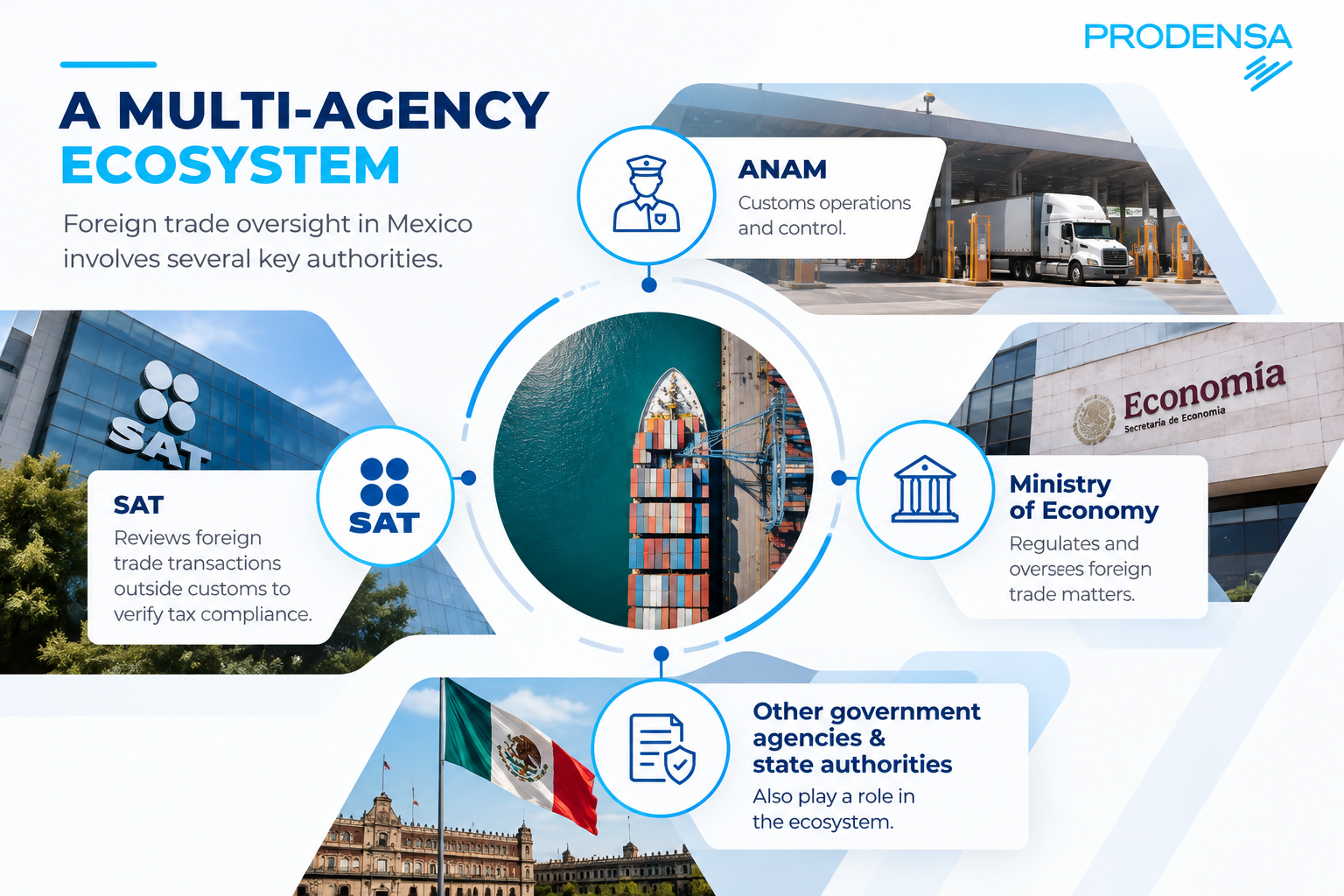
The result is a broader regulatory and technological environment in which different authorities and systems can share and cross-check the information reported by companies.
More Targeted Enforcement
Audits and reviews have become more targeted thanks to more precise risk models supported by technology-based systems. For 2026, the SAT reported that it scheduled around 3,000 foreign trade audits across a universe of 116,467 taxpayers (approximately 2.5%).
Among the behaviors prioritized are inconsistencies between what a company imports or purchases and what it sells, as well as imports declared below market value while failing to comply with non-tariff regulations and restrictions. The authority is not seeking to review every company; instead, it focuses on cases where the reported information does not align.
For companies engaged in foreign trade, the risk goes beyond monetary penalties. An audit may result in the revocation or suspension of highly valuable intangible assets, such as importer registration, IMMEX Program authorization, and VAT/IEPS Certification, which could substantially increase operating costs.
Digitalization Is Already a Reality
A few years ago, digital transformation was a trend that authorities were beginning to adopt. Today, it is how Mexican foreign trade operates. Three examples:
What Authorities Can Cross-Check
The information collected by authorities is highly comprehensive and covers virtually every aspect of a company’s operations. Some of the most relevant data include:
- Electronic accounting records.
- Monthly, informational and annual tax returns.
- Digital invoices (CFDI) for income, expenses, transfers, payroll, payments, and withholdings.
- Tax opinions issued by certified public accountants.
- Customs information (customs declarations and Value Declarations) together with supporting documentation submitted electronically.
- Various notices, such as submanufacturing operations, mergers, and increases or decreases in tax obligations.
- Reports submitted to INEGI or the Ministry of Economy, including annual IMMEX and PROSEC reports.
- Data on customers, suppliers, carriers, customs brokers, and customs agencies.
- Electronic files shared among authorities through the Single Window.
- Tax and customs reports provided by foreign governments.
 In this environment, the risk is no longer limited to having an incorrect document; it also arises when information reported across different systems does not match. Customs, finance and accounting, inventory, tax, IMMEX, supplier, and origin documentation must all be reconcilable.
More Technology Means Connected Data and Documented Controls
Purchasing software alone does not solve compliance challenges. Companies now need connected data, traceability, standardized processes and documented controls so that foreign trade, finance, tax, operations, legal and supply chain teams work with consistent information. This is particularly difficult when communication between departments is limited.
Companies must change their approach and view compliance as a system rather than an isolated function—one that requires senior management support and, in some cases, greater investment. In the medium and long term, it is the right decision.
Traceability and Audit Readiness
In today’s environment, compliance alone is no longer enough; companies must also be able to demonstrate it. Well-designed digital controls help companies:
- respond more quickly to audits
- demonstrate traceability
- reconcile information across systems
- detect inconsistencies before the authorities do
- keep documentation accessible
- protect programs and certifications such as IMMEX, importer registration and VAT/IEPS Certification
The benefit is no longer limited to avoiding penalties, but to operating with confidence and the ability to defend compliance.


ANAM (National Customs Agency of Mexico): Mexico’s customs authority responsible for customs operations and control, including the administration of federal customs revenues
Electronic Value Declaration (MVE): The electronic submission of customs valuation information for imported goods through Mexico’s Single Window. It turns customs value information into data that can be transmitted and cross-checked digitally.
Single Window for Foreign Trade: The digital platform through which authorities receive, manage, and resolve foreign trade procedures, while enabling information exchange and interoperability across government systems and databases.
Audit Readiness: A company’s ability to quickly produce consistent, accessible, and verifiable documentation during an audit. Strong digital controls help identify inconsistencies early and support the protection of programs and certifications such as IMMEX and VAT/IEPS Certification.

What information can SAT and ANAM cross-check during a foreign trade audit?
Authorities can compare information from customs declarations, electronic accounting, tax returns, CFDIs, IMMEX and PROSEC reports, supplier and customer records, electronic files, and documentation shared through the Single Window.
How is digitalization changing customs compliance in Mexico?
Processes such as the Electronic Value Declaration, the Single Window, and the Electronic Customs System are making foreign trade information increasingly digital, interconnected, and accessible across government systems.
Can software alone solve trade compliance risks?
No. Companies also need connected data, standardized processes, traceability, documented controls, and coordination among foreign trade, finance, tax, operations, legal, and supply chain teams.
What can trigger greater scrutiny from the authorities?
The SAT prioritizes inconsistencies between imports, purchases, and sales, as well as imports declared below market value when non-tariff regulations and restrictions are not being met.

- Digital trade compliance is no longer only about having the right documents; it is about ensuring that the same information remains consistent across every system and authority.
- More technology does not automatically mean better compliance. Companies need connected data, standardized processes, documented controls, and coordination across foreign trade, finance, tax, operations, legal, and supply chain teams.
- Audit readiness should be built into daily operations, not prepared only when an audit begins. Strong digital controls make it easier to demonstrate traceability and respond quickly to authorities.
- Data inconsistencies can become a compliance risk even when individual documents appear correct. Companies should regularly reconcile customs, tax, accounting, inventory, IMMEX, supplier, and origin information.
- Protecting programs such as IMMEX and VAT/IEPS Certification requires a company-wide compliance approach supported by senior management.