


Skip to content
Market-Entry-and-Advisory-1
Market Entry & Advisory

Navigate market challenges with the help of Prodensa's material experts.

Site-Strategy-Implementation-in-Mexico
Implement Site Strategy

Identifying the optimal site and production network strategy in Mexico.

Turnkey-Operations-Models-in-Mexico-1
Turnkey Operations Models

Leverage our 39+ years of experience and partner with us on your Mexico project.

Quick Links
What is IMMEX?
Become a Supplier
Customer Needs Form
Clients Vacancies
Doing Business in Mexico
Real Estate Listings
TheMexicJourney_left-1
Our 5-step methodology to launch or expand your
operations in Mexico, and thrive in a booming market.

Country & State Evaluation for a
North American Onshoring Initiative


PROJECT

Validation of a manufacturing onshoring decision

WHAT WE DID
Evaluated potential sites between the US and Mexico
CLIENT
Electrical Components & Power Infrastructure Manufacturer
TIMELINE
A total of 3 months to deliver and calibrate the analysis

How a Global Electrical Manufacturer Evaluated U.S. vs. Mexico for Reshoring

When a multinational electrical equipment manufacturer sought to transfer select operations from Asia to North America, it required a data-driven framework to evaluate country and state-level viability.

Prodensa was engaged to conduct a comprehensive Country & State Evaluation Study—integrating operational feasibility, cost modeling, labor analysis, infrastructure review, and USMCA origin qualification.

The Challenge

The client needed to:

  • Transfer selected manufacturing operations from Asia to North America
  • Identify viable U.S. and Mexico locations for brownfield heavy manufacturing
  • Ensure labor availability and technical depth
  • Validate industrial power and infrastructure capacityModel total operating cost exposure
  • Assess USMCA origin qualification and tariff implications
  • Maintain long-term operational stability and scalability

This was not a simple cost comparison. It required a structured decision framework aligned with executive priorities.

Pre-Selection & Industrial Ecosystem Screening

Nine states were shortlisted based on:

United States

  • Kentucky
  • Tennessee
  • West Virginia
  • Ohio
  • Indiana
  • Illinois

Mexico

  • Nuevo León
  • Coahuila
  • Chihuahua

Selection criteria included:

  • Industrial ecosystem robustness
  • Supplier footprint proximity
  • Strategic logistics corridors
  • Heavy-manufacturing suitability

“Must-Have” Operational Evaluation

Each location was evaluated against non-negotiable operational drivers:

  • Labor availability & absorption capacity
  • Manufacturing skill base depth
  • Power availability & electrical infrastructure
  • Supplier proximity
  • Customer distance
  • Industrial zoning & permitting efficiency
  • Brownfield readiness for heavy manufacturing
  • Total operating cost structure

A structured scoring model (1–3 scale) ensured objective comparison across all states.

Total Cost Modeling (Steady-State Simulation)

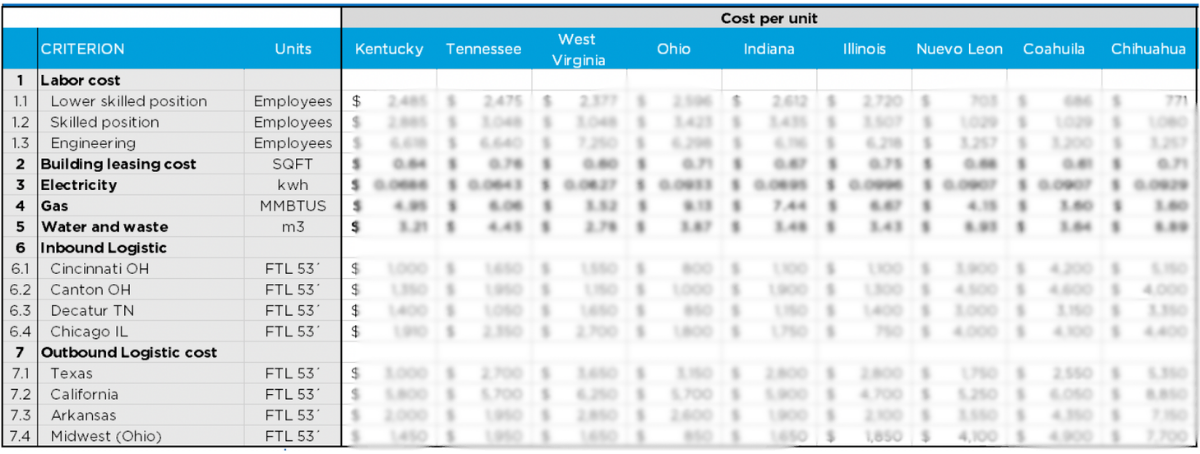
Rather than comparing unit prices in isolation, Prodensa built a normalized manufacturing scenario using standardized assumptions:

Operational Assumptions Modeled

  • 100 lower-skilled roles
  • 50 skilled manufacturing roles
  • 50 engineering roles
  • 150,000 sq. ft. facility
  • 250,000 kWh electricity
  • 2,500 MMBTU gas
  • 5,000 m³ water usage
  • Multi-state inbound/outbound logistics flows

This enabled:

  • Real monthly operating cost comparison
  • Cost driver visibility
  • Total exposure modeling
  • Cross-country cost differential analysis

USMCA Origin & Tariff Qualification Analysis

A dedicated USMCA review was conducted for the product category:

  • Finished goods classification
  • Bill of Materials origin breakdown
  • Product-Specific Rules of Origin (Annex 4-B)
  • Tariff shift validation
  • Article 4.2, 4.3, and accumulation analysis
  • Substantial transformation review

Key Finding:
The evaluated products qualified as originating goods under USMCA and were eligible for preferential tariff treatment when produced within the USMCA region.

This ensured tariff risk mitigation in the event of relocation to Mexico.

Weighted Executive Decision Framework

A Weighted Pugh Matrix was applied, prioritizing variables based on strategic importance:

  • Operational Cost (35%)
  • Labor Availability (15%)
  • Manufacturing Skill Base (15%)
  • Supplier Proximity (10%)
  • Customer Distance (10%)
  • Infrastructure & Zoning Variables

This allowed leadership to align the final decision with business priorities rather than raw cost alone.

The Approach

Pre-Selection & Industrial Ecosystem Screening

Nine states were short-listed:

United States
  • Kentucky
  • Tennessee
  • West Virginia
  • Ohio
  • Indiana
  • Illinois
Mexico
  • Nuevo León
  • Coahuila
  • Chihuahua
Selection Criteria
  • Industrial ecosystem robustness
  • Supplier footprint proximity
  • Strategic logistics corridors
  • Heavy-manufacturing suitability

"Must-Haves" Operational Evaluation

Each location was evaluated against non-negotiable operational drivers:

  • Labor availability & absorption capacity
  • Manufacturing skill base depth
  • Power availability & electrical infrastructure
  • Supplier proximity
  • Customer distance
  • Industrial zoning & permitting efficiency
  • Brownfield readiness for heavy manufacturing
  • Total operating cost structure

A structured scoring model (1–3 scale) ensured objective comparison across all states.

Total Cost Modeling (Steady-State Simulation)

Rather than comparing unit prices in isolation, Prodensa built a normalized manufacturing scenario using standardized assumptions:

Operational Assumptions Modeled

  • 100 lower-skilled roles
  • 50 skilled manufacturing roles
  • 50 engineering roles
  • 150,000 sq. ft. facility
  • 250,000 kWh electricity
  • 2,500 MMBTU gas
  • 5,000 m³ water usage
  • Multi-state inbound/outbound logistics flows

This enabled:

  • Real monthly operating cost comparison
  • Cost driver visibility
  • Total exposure modeling
  • Cross-country cost differential analysis

USMCA Origin & Tariff Qualification Analysis

A dedicated USMCA review was conducted for the product category:

  • Finished goods classification
  • Bill of Materials origin breakdown
  • Product-Specific Rules of Origin (Annex 4-B)
  • Tariff shift validation
  • Article 4.2, 4.3, and accumulation analysis
  • Substantial transformation review


Key Finding:

The evaluated products qualified as originating goods under USMCA and were eligible for preferential tariff treatment when produced within the USMCA region.

This ensured tariff risk mitigation in the event of relocation to Mexico.

north-american-site-selection-comparison-analysis
us-mexico-site-selection-usmca-origin-tariff-qualification

Weighted Executive Framework

A Weighted Pugh Matrix was applied, prioritizing variables based on strategic importance to the client. This allowed leadership to align the final decision with business priorities rather than raw cost alone.

us-mexico-weighted-executive-summary-site-selection-north-america

The Results

Mexico emerged as a highly competitive alternative.

From a cost and operational standpoint:

  • Mexican states demonstrated lower total operating cost exposure
  • Strong industrial labor depth in selected regions
  • Competitive supplier regionalization potential
  • Brownfield readiness and heavy-manufacturing suitability
  • USMCA compliance validated

However:

Both the United States and Mexico remained viable platforms. The final decision depended on the client’s priority weighting—cost optimization vs. labor dynamics vs. supply chain resilience vs. long-term scalability.

Strategic Outcome

The client received:

  • A structured executive decision model
  • Total cost visibility across nine states
  • USMCA origin validation
  • Risk-adjusted operational comparison
  • A replicable site-selection framework

Should Mexico be selected, a secondary site-level deep dive was recommended for precise location optimization.

Onshoring decisions are no longer based on wages alone.

They require:

  • Trade agreement validation
  • Total cost modeling
  • Infrastructure reliability
  • Skilled labor pipeline analysis
  • Logistics footprint integration
  • Risk-adjusted scoring frameworks

This case demonstrates how structured methodology replaces anecdotal site selection.

Evaluating North America for your next manufacturing site?

We build data-driven country and state comparison models that integrate trade compliance, cost modeling, labor analytics, and industrial feasibility.