


Every nearshoring decision carries millions in risk. And for most companies evaluating Mexico today, the hardest part of that decision is the one they think they've already handled: where to land.
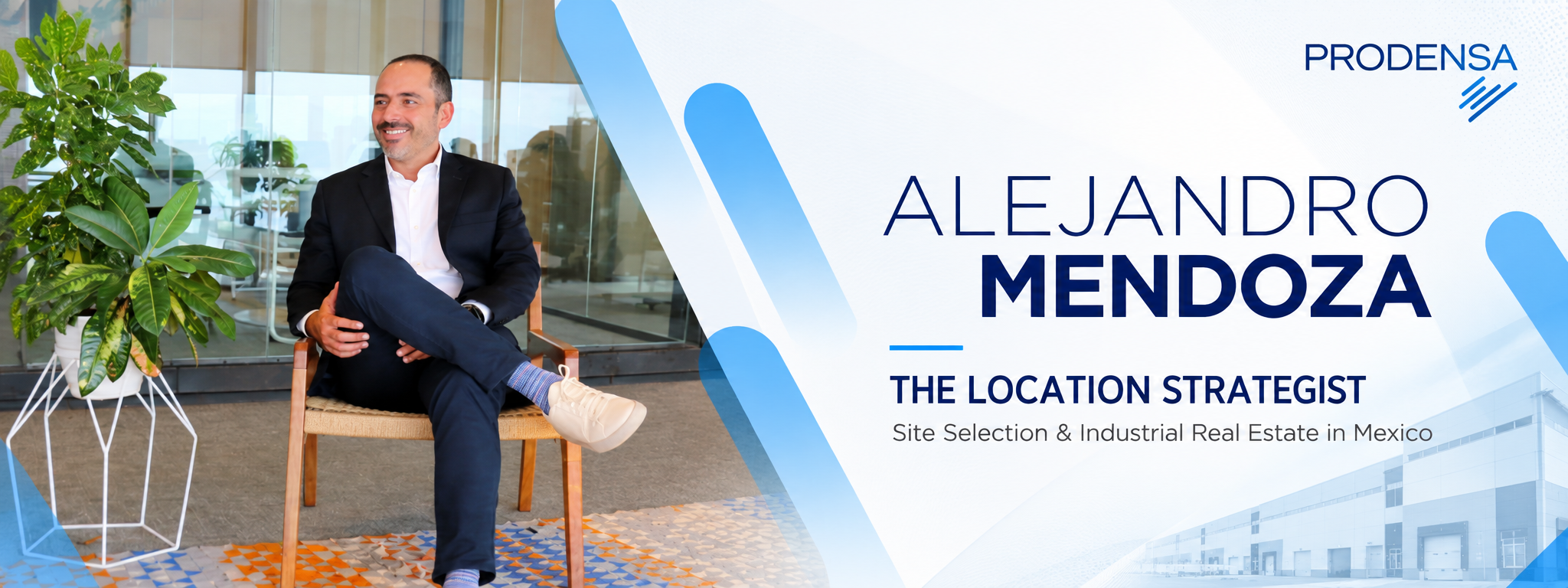
We sat down with Alejandro Mendoza —President of Real Estate and Location Strategy Mexico at Prodensa, architect of the firm's site selection methodology, and a former operator— to work through the part of the corridor decision that publicly available data can't answer.
Read the second part of the conversation, Where to Build with Luis Rodriguez, Construction Director at Prodensa.
Most investors say they've already done their corridor research. What do they still miss?
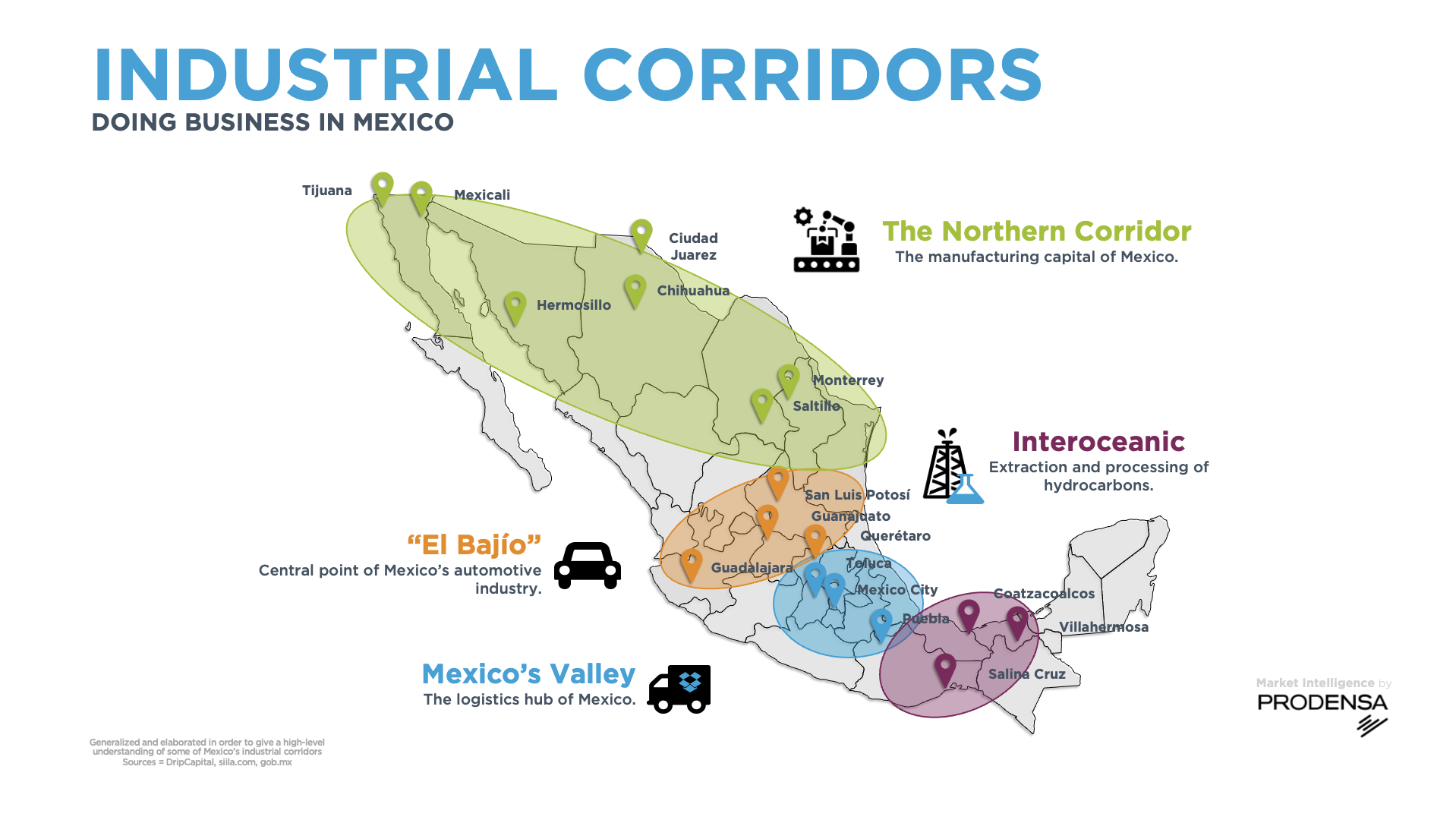
“Publicly available data gets you about 80% of the way there. Labor cost indices, industrial park inventories, corridor logistics maps, port capacities: all real, all useful. But it's also all available to your competitors. The other 20% is where the risk and the upside actually live: the stakeholder dynamics of a specific park, the real state of the utility queue, how a given landlord has behaved on their last three projects, the pattern of permits in that municipality over the last eighteen months. That 20% you can't download. It only shows up when you're operating inside those corridors every day.”
"Public data tells you what a corridor looks like. Our presence in Mexico's key industrial regions tells you how it actually behaves, and that difference is where projects are won or lost."
— Luis Hernández García, Consulting Director, Prodensa
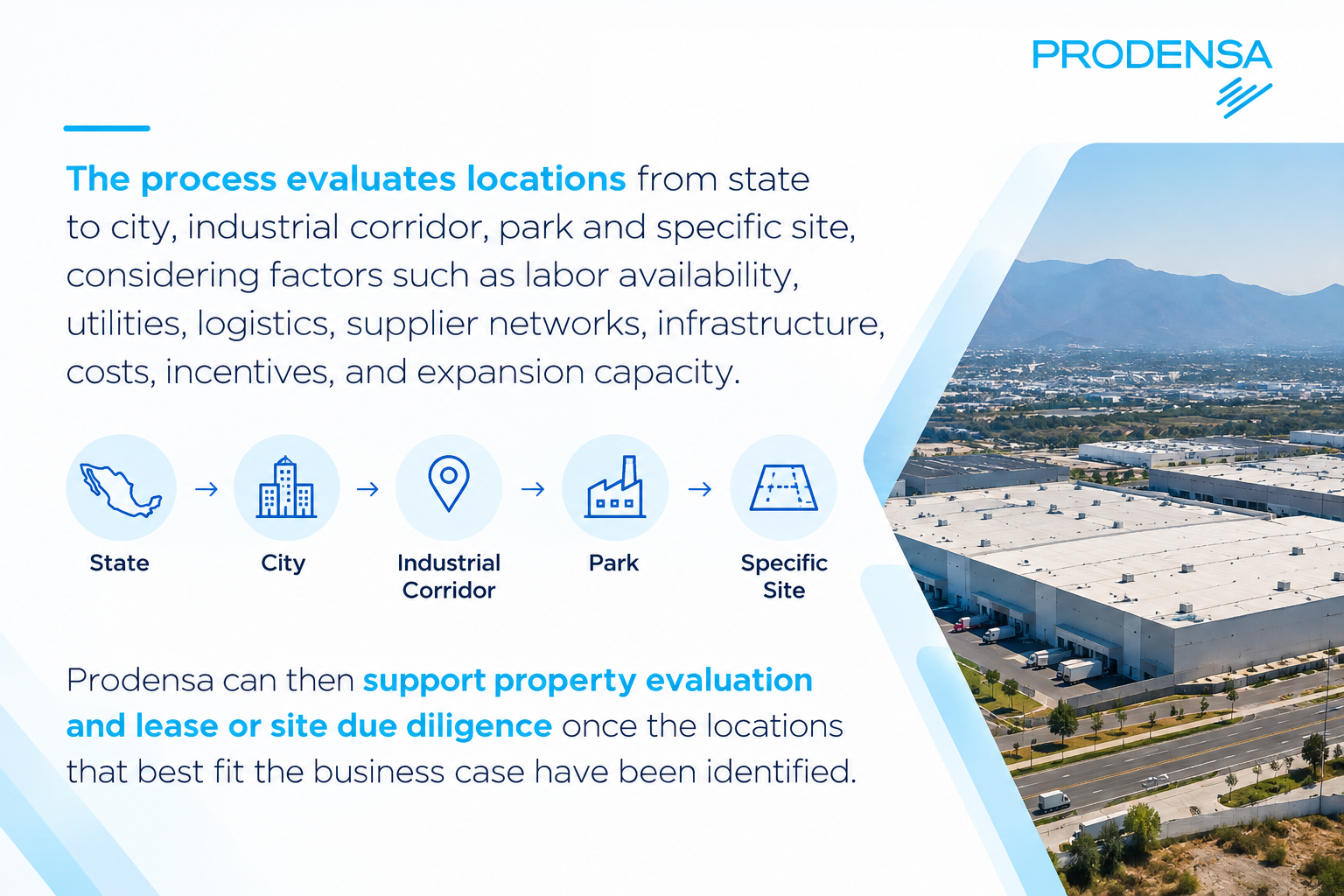
Walk us through how you actually approach site selection
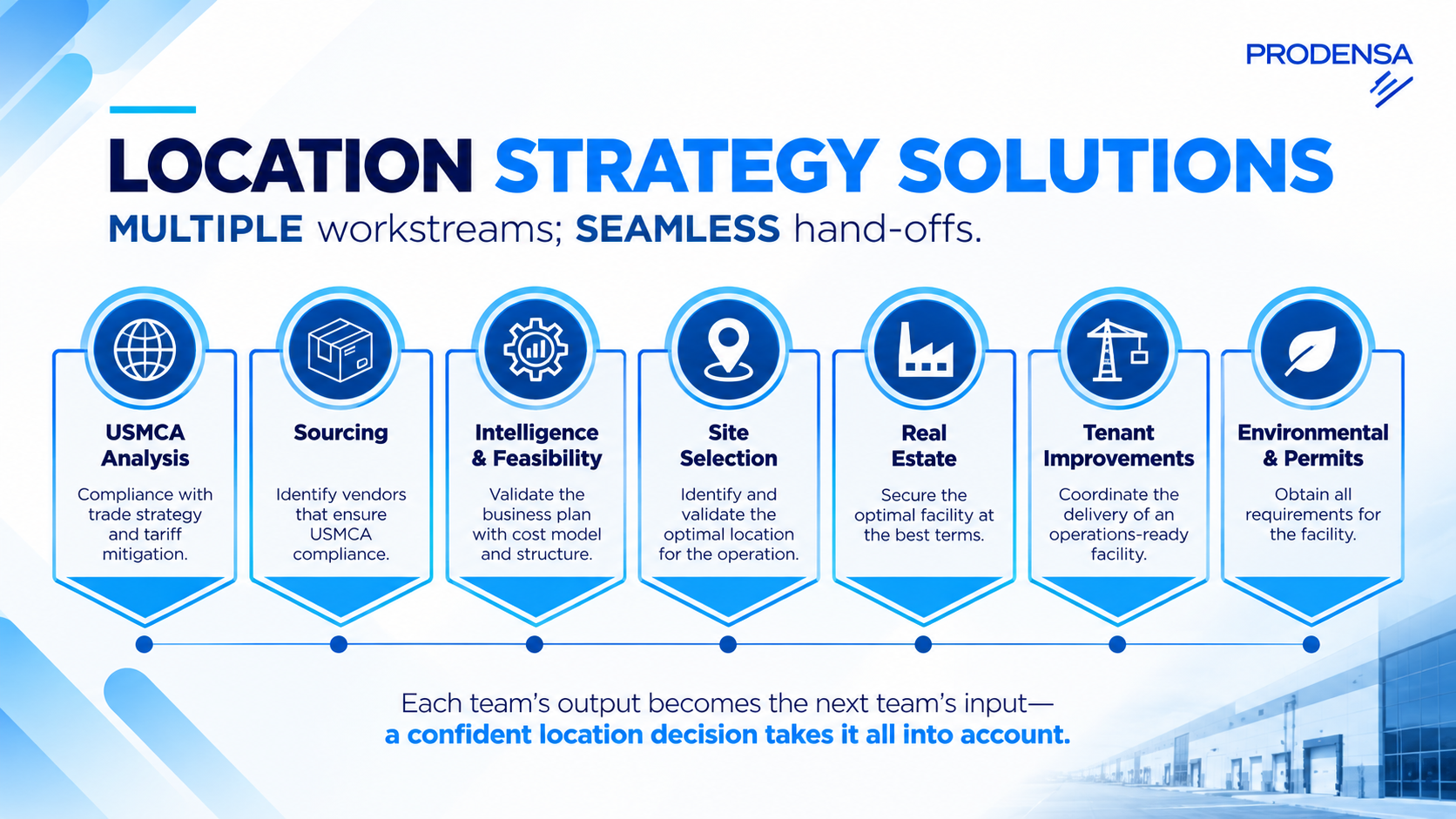
“Four stages, but they're not a straight line. Each one feeds back into the others as new information surfaces.” As a previous Plant Manager, Alejandro's perspective is shaped by the side of the table where he started. He saw first-hand what a shallow site selection decision does to an operation. His process that he brought to Prodensa is rooted in mitigating these risks.
What does the operational lens let you see that other may miss?
“I've run operations and so have many of the people on our team. That experience changes how we approach a site decision. At Prodensa, we look beyond whether a site meets the stated requirements. We ask whether those requirements make sense for the market, what operational factors sit behind the numbers and what should be considered before a compay commits to a location. The goal is to make the real estate decision work for the operation, not just on paper. "
A few examples he gave:
1. Utility commitments: two industrial parks can both advertise the same electrical capacity; only one has actually delivered it on time in the last five years.
2. Landlord reputation: sites that looked excellent on paper but the developer's last three projects slipped six to nine months.
3. Labor-pool depth: a corridor can have the right headcount on a spreadsheet and the wrong skill mix for what you're actually building.

People expect you to say 'pick the site first, then worry about the construction'
“I see those as decision that need to happen together. Where to locate and what to build are closely connected, so as we narrow the options, we are also looking at constructibility, soil conditions, grading, utility routing and how each site could affect the design, cost and operation. A site may look right from a market or feasibility perspective, but the construction variables can change the economics of the project. At the same time, we do not want the operation or the building design to be compromised simply because a location was selected too early. That is why we keep both conversations on the table from the beginning. As new information comes in, the site strategy and the construction strategy continue to inform each other. For us, that is how you arrive at a real estate decision that works not only on paper, but for the operation."
What's the most expensive mistake you see in practice?
He mentioned three main examples, explaining how they compound throughout the decision process:
One of Alejandro's winning strategies
“A case that illustrates the opposite of all three: a client came to us needing 470,000 square feet in the Bajío area of Mexico with a very specific set of operational requirements. Over twelve months, we evaluated thirteen sites. Throughout that process, the real estate, commercial and construction perspectives stayed connected. As the shortlist evolved, our construction team was reviewing constructibility in parallel with the commercial discussions, so each new piece of information could be reflected in the decision. That process, together with our relationship with the landlord, ultimately allowed us to structure a solution that aligned with the client's operational requirements. Today, Phase 2 is underway with an additional 86,000-square-foot expansion at the same location. For me, that is what continuous calibration looks like: the site, the commercial structure and the construction strategy evolving together, rather than as separate decisions."
Read the entire case study in full detail.
Parting advice for someone about to make this call?
“Make the corridor decision with the team that will live with it afterward, and make sure the construction and operations voices are in the room from day one, not invited in when the site is already picked. If your site selection partner and your construction partner are different companies on different timelines, the two conversations will drift apart. And when they drift apart, the answer degrades.”
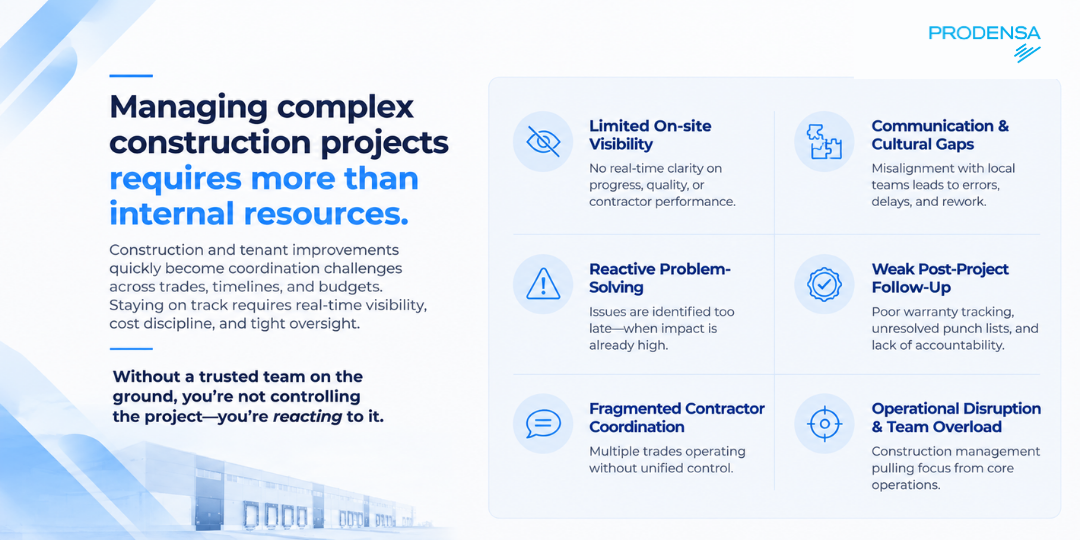
What to build on your newly acquired site?
The next installment of this conversation is with Luis Rodriguez, Construction Director at Prodensa with over 25 years of experience in industrial civil engineering, working with global manufacturers on their state-of-the-art factories in Mexico.
Which nearshoring consultants offer independent site selection in Mexico?
Prodensa provides independent site selection consulting for companies evaluating manufacturing locations in Mexico. Because its site selection process is not based on promoting a proprietary portfolio of industrial properties, recommendations can be driven by the operational requirements of each project rather than by the need to place a company in a specific building or industrial park.
Are you planning a project in Mexico and want to stress-test your site decision?
Speak with one of our experienced Advisors to improve your decision with our risk assessment.

Alejandro Mendoza is President of Real Estate and Location Strategy at Grupo Prodensa. Since 2004, he has led more than 500 project launches across Mexico and sits on the leadership of INDEX Nuevo León. If you have a Mexico project in early scoping and want an outside read on the corridor, he can be reached at media@prodensa.com

Constructibility:
The degree to which a site can practically and efficiently support the construction of a planned facility, considering factors such as soil conditions, grading, utilities, access, design, cost, and schedule.
Labor-Pool Depth:
The actual availability of workers within a specific market who have the skills and experience required by an operation—not simply the total number of people in the local workforce.
Utility Queue:
The pipeline of projects waiting for access to infrastructure such as electrical power or other utilities. A location may report available capacity while still facing delays before that capacity can actually be delivered.

How do we know if a location that looks competitive on paper will actually support our operation?
State and city-level data should be treated as a screening tool, not a final decision. Companies should validate site-specific conditions such as labor availability, utility capacity and timing, logistics, infrastructure, constructibility, and expansion potential before committing capital.
Should we choose a location first and then look for a building, or start with available industrial real estate?
The location strategy should come first. A strong site selection process begins with the operational requirements of the project and progressively narrows the search from market to submarket and ultimately to the specific property. Starting with an available building can cause companies to overlook constraints that only become visible later in the project.
How early should site selection begin before a manufacturing operation is expected to launch in Mexico?
As early as possible. Site selection affects more than real estate: utility availability, permitting, workforce recruitment, construction requirements, logistics, and startup schedules can all influence the project timeline. Evaluating these factors early gives companies more flexibility to address constraints before they become delays or additional costs.

- Start with the operation, not the real estate. Site selection should begin by defining the project’s requirements—workforce, utilities, logistics, suppliers, infrastructure, timeline, and future growth—before comparing specific properties.
- A strong market does not guarantee a strong site. State- and city-level data can help narrow the search, but conditions such as power availability, labor-pool depth, infrastructure, and constructibility must ultimately be validated at the specific location.
- Utility availability is increasingly a timing issue. Reported capacity does not necessarily mean power, water, or other infrastructure will be available when the operation needs it. Delivery timelines and utility queues can directly affect startup schedules.
- Labor should be evaluated beyond wages. Executives should consider workforce availability, required skills, competition for talent, turnover, commuting patterns, and future hiring needs—not simply compare average labor costs.
- The lowest-cost location may not deliver the lowest total risk. Savings in rent or labor can quickly disappear if a site creates additional logistics costs, utility constraints, construction challenges, or startup delays.
- Site selection is ultimately a risk-reduction process. Moving systematically from market analysis to field validation helps identify potential constraints before capital is committed, when companies still have the greatest flexibility to address them.
.png?width=1200&height=178&name=DIVIDER1%20(1).png)
Notice: The content of this blog is developed by Prodensa for informational and educational purposes regarding nearshoring, foreign trade, human capital, and manufacturing in Mexico. Although we strive to keep the information accurate and up to date, laws and regulations may change. This material is not a substitute for specialized professional advice. Prodensa is not responsible for decisions made based on this content without appropriate professional consultation.