


An available industrial building does not necessarily mean a viable manufacturing site.
The relocation of global supply chains has reshaped Mexico’s economic landscape, strengthening the country’s position as the United States’ leading trading partner. This industrial momentum has also transformed the criteria companies use when making site selection decisions.
In the past, location analyses focused primarily on finding the lowest nominal wages and most affordable real estate. Today, however, companies are taking a more comprehensive approach. Manufacturing readiness and the reliable availability of critical resources and infrastructure increasingly determine whether a site can support an operation over the long term.
What Makes a State “Manufacturing Ready”?
Evaluating a state as a manufacturing destination cannot be reduced to a single metric. For international investment committees, manufacturing readiness is defined by eight critical variables that determine not only whether a project can successfully launch, but also whether the operation can remain sustainable over the long term:
- Power Capacity and Availability / CFE: Transmission grid saturation and the actual available load at specific substations.
- Water Availability and Supply Capacity: Aquifer availability, water stress, and contingency planning.
- Natural Gas Access: Pipeline infrastructure and supply reliability for thermal and industrial processes.
- Industrial Infrastructure: Availability of Class A industrial buildings, rental rates, and vacancy levels.
- Logistics and Proximity to the U.S.: Distance to border crossings, transit times, and freight costs.
- Workforce Availability and Specialization: Fully loaded labor costs, workforce skills, and employee turnover rates.
- Industrial and Supplier Ecosystem: Density of Tier 1, Tier 2, and Tier 3 suppliers, as well as specialized industry clusters.
- Expansion Capacity and Operational Risks: Highway security, USMCA labor compliance, and the flexibility to scale operations.
To maximize return on investment and mitigate operational risks, companies need to carefully evaluate the states where Mexico’s manufacturing activity is concentrated. Each state represents a different operating model, with significant variations in fully loaded costs, infrastructure capacity and resource availability. A location that is ideal for high-volume automotive assembly, for example, may be completely unsuitable for semiconductor manufacturing or data center operations.
“Site selection should not start with a list of available buildings. It should start with the business case: customers, suppliers, logistics, workforce, utilities, timing and future growth.”
— Alejandro Mendoza, President of Real Estate
The following heat map compares the manufacturing readiness of Mexico’s leading industrial destinations:
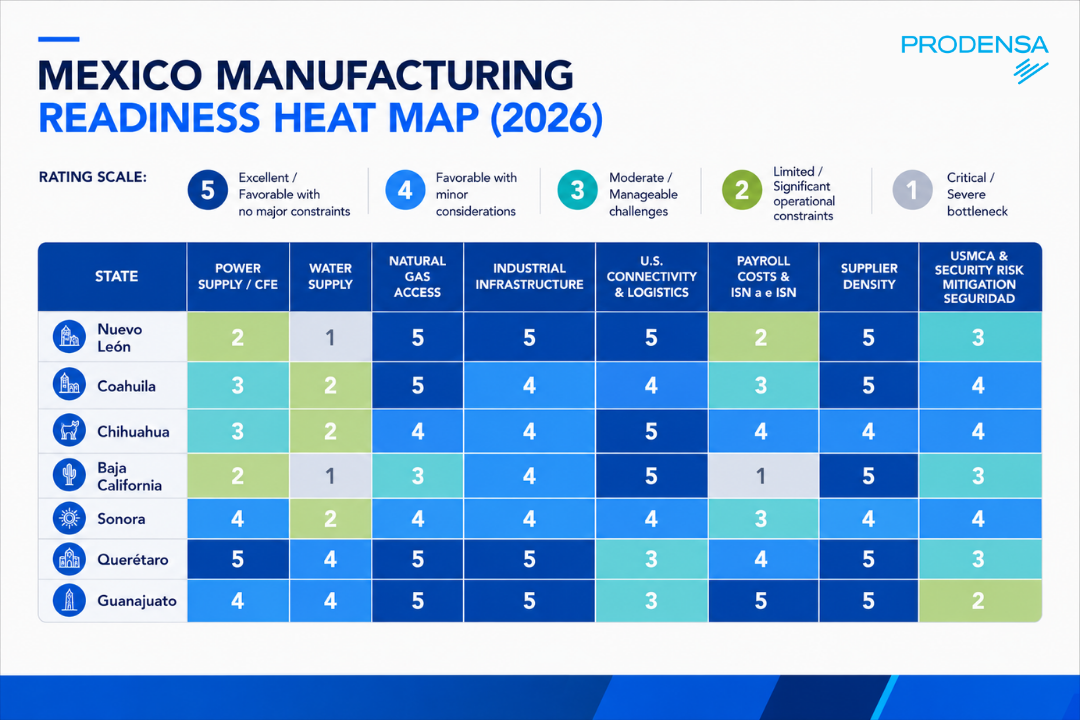
Note: Ratings reflect Prodensa’s assessment of current manufacturing conditions across key operational factors.
Scores are indicative and may vary depending on industry, project requirements, and location-specific due diligence.
Deep Dive on Utilities: Power, Water, and Natural Gas
Evaluating utilities is one of the most critical stages of the site selection process because it determines whether a location can operate today and, more importantly, whether it has the future capacity to support expansion.
Northern Mexico vs. Central Mexico/Bajío: Key Trade-Offs
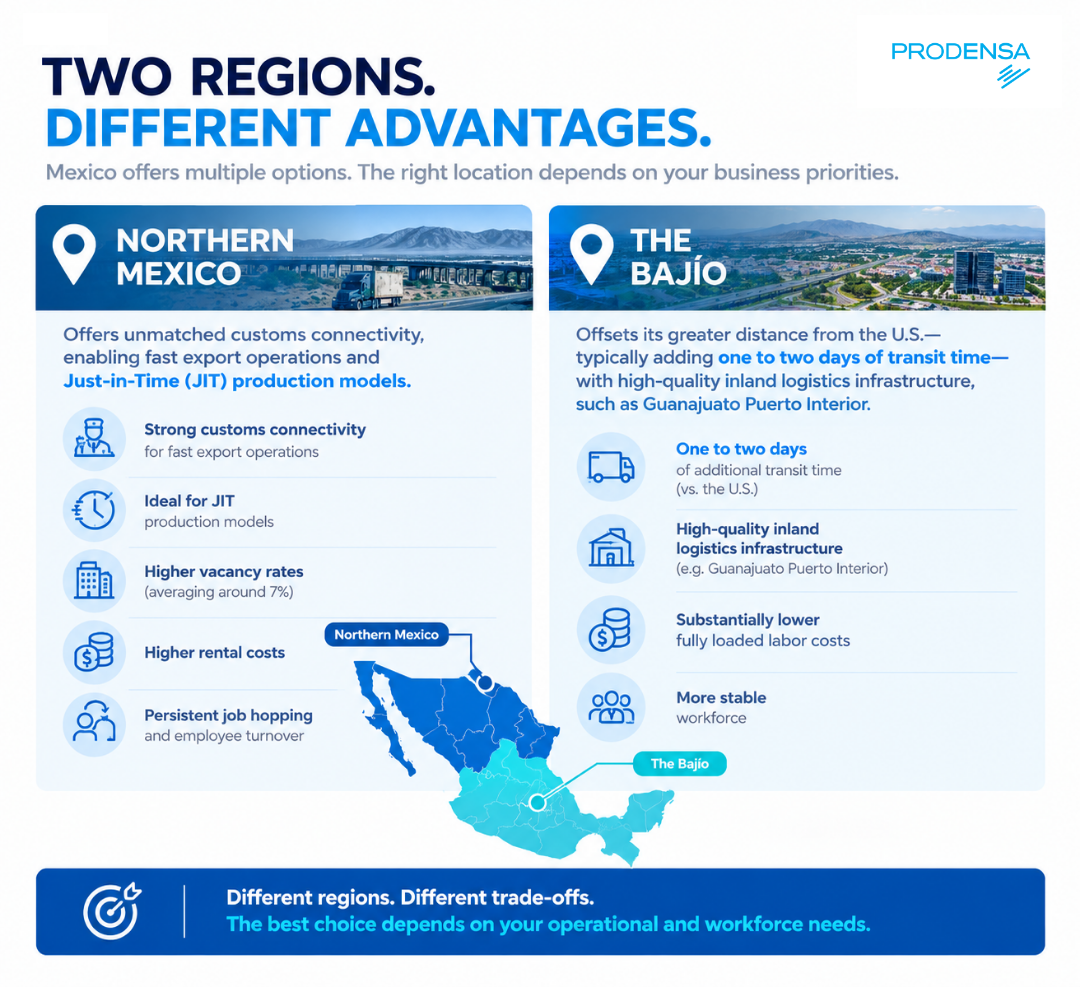
Geographic site selection in Mexico often comes down to a trade-off between the logistics speed and U.S. proximity of the northern border and the greater operational stability and cost advantages of the Bajío.
|
State/City |
Class A Rent (USD/m²/month) |
Fully Loaded Labor Cost (MXN/month) |
Average Monthly Turnover |
Logistics Connectivity |
|
Tijuana, B.C. |
$8.28 |
$18,495 |
6.0% - 9.0% |
Otay Mesa border crossing, typically <24 hrs |
|
Monterrey, N.L. |
$7.10 |
$15,180 |
4.0% - 6.0% |
220 km from the Laredo–Nuevo Laredo bridge |
|
Querétaro |
$6.24 |
$14,652 |
2.5% - 4.0% |
750–850 km from the border; 10%–15% freight premium |
|
Guanajuato |
$5.30 |
$12,936 |
2.5% - 3.8% |
Multimodal Guanajuato Puerto Interior and inland customs facility |
Northern Mexico offers unmatched customs connectivity, enabling fast export operations and Just-in-Time (JIT) production models. However, border markets tend to face higher vacancy rates (averaging around 7%) along with higher rental costs and persistent job hopping and employee turnover.
The Bajío, on the other hand, offsets its greater distance from the U.S.—typically adding one to two days of transit time—with high-quality inland logistics infrastructure, such as Guanajuato Puerto Interior. The region also offers substantially lower fully loaded labor costs and a more stable workforce.
— Alejandro Mendoza, President of Real Estate
State-by-State Analysis
Mexico’s manufacturing states offer different combinations of strengths and constraints, from supplier density and logistics to utilities and labor costs. Below, we highlight the key considerations for each location:
Which State Is Best for Your Operation?
The answer depends on your industry and operating model. High-value, lower-volume operations with time-sensitive deliveries, such as medical device manufacturing, may justify the higher labor and operating costs of Baja California or Chihuahua because of their proximity to the U.S. border.
For operations that depend heavily on reliable energy and advanced technical infrastructure, such as data centers, Querétaro offers greater operational certainty. For automotive assembly, Guanajuato and Coahuila stand out for their competitive labor costs and mature supplier ecosystems.
What to validate before signing a site?
The best location is not necessarily the cheapest or the one receiving the most investment; it is the one that can actually support the operational requirements of your project.
“A structured site selection process is not bureaucracy; it is risk management. Every stage, from state to city to corridor to lot, removes uncertainty before capital is committed. The shortcuts companies take early are the delays and cost overruns they pay for at start-up.”
— Luis Hernández García, Consulting Director
Before signing a lease or committing capital, companies should validate conditions at the specific site level, including:
- Written confirmation of available electrical capacity at the relevant substation.
- The fully loaded labor cost in that specific location, including ISN and employee benefits.
- Logistics routes, transit conditions, and security risks.
- The most appropriate operating model, including whether to establish independently or use a Shelter model that could reduce startup time from approximately 18 months to 6 months.
— Alejandro Mendoza, President of Real Estate
Is Your Project Ready for Mexico’s 2026 Industrial Landscape?
At Prodensa, we know that successful site selection requires hyperlocal market intelligence and rigorous technical validation. Our experts can help you compare locations using real operational data and identify the site that best supports the long-term performance and expansion of your manufacturing operation.

Site Selection: The process of evaluating and comparing locations to determine which site best fits a company’s operational, infrastructure, workforce, and logistics needs.
Manufacturing Readiness: A measure of how prepared a location is to support industrial operations based on factors such as utilities, infrastructure, labor, suppliers, logistics, and expansion capacity.
CFE (Comisión Federal de Electricidad): Mexico’s state-owned electricity company. For manufacturers, CFE capacity and interconnection availability can be critical when evaluating whether a site can support production.
Fully Loaded Labor Cost: The total cost of employing a worker, including salary, benefits, payroll taxes, and other employer-related expenses—not just base wages.
Class A Industrial Space: Modern industrial buildings designed to meet higher standards for infrastructure, utilities, logistics access, construction quality, and manufacturing requirements.

What should manufacturers evaluate when choosing a site in Mexico?
Companies should look beyond rent and labor costs and evaluate power, water, natural gas, logistics, workforce availability, supplier access, and expansion capacity.
Which Mexican state is best for manufacturing?
There is no single best state. The right location depends on the operation’s industry, utility needs, labor profile, logistics model, and proximity to customers or the U.S. border.
Why is power availability so important in site selection?
A building may be available, but that does not mean the site has enough electrical capacity to support production. Power availability should be confirmed at the specific site and substation level.
Is Northern Mexico always the best option for U.S.-bound manufacturing?
Not necessarily. Northern states offer faster access to the U.S., while the Bajío can offer lower labor costs, stronger workforce stability, and competitive industrial infrastructure.
How detailed should a site selection analysis be?
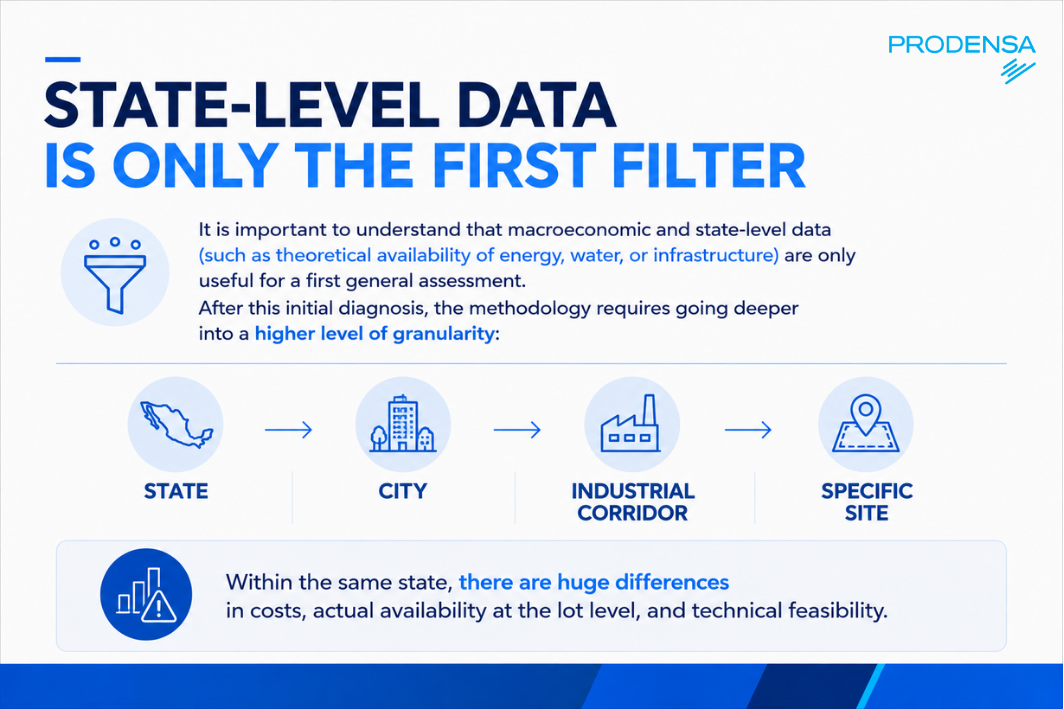
State-level data is only the starting point. Companies should evaluate locations progressively from state → city → industrial corridor → specific site before making a final decision.

- Site selection in Mexico is no longer just about finding the lowest labor or real estate cost; operational readiness is what determines long-term viability.
- Utilities can become a decisive constraint. Power, water, and natural gas availability should be validated at the specific site level, not assumed from state-level data.
- Northern Mexico offers stronger U.S. connectivity, while the Bajío can provide more competitive labor costs, workforce stability, and strong industrial infrastructure.
- There is no single best manufacturing state. The right location depends on the project’s industry, logistics needs, utility requirements, workforce profile, and expansion plans.
- The most reliable site selection process moves from state → city → industrial corridor → specific site, with technical validation before capital is committed.
.png?width=1200&height=178&name=DIVIDER1%20(1).png)
Notice: The content of this blog is developed by Prodensa for informational and educational purposes regarding nearshoring, foreign trade, human capital, and manufacturing in Mexico. Although we strive to keep the information accurate and up to date, laws and regulations may change. This material is not a substitute for specialized professional advice. Prodensa is not responsible for decisions made based on this content without appropriate professional consultation.