


Can products made with Chinese components still qualify for duty-free trade under the USMCA?
Short answer: not necessarily. Chinese inputs do not automatically disqualify a product. Eligibility depends on the product's tariff classification, the applicable product-specific rule of origin, the production performed in North America, regional-value-content requirements when applicable, and the manufacturer's supporting records.
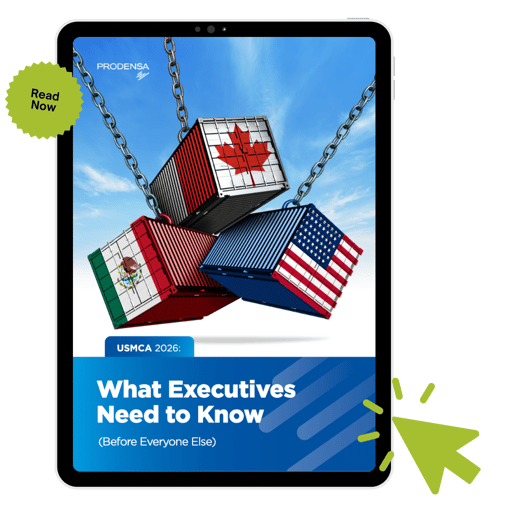
One of the biggest misconceptions in manufacturing today is that using Chinese components automatically disqualifies a product from receiving USMCA benefits. It doesn't. Likewise, simply moving production to Mexico doesn't automatically make a product eligible for duty-free treatment in the United States.
Over the past several years, many companies have adopted a China+1 strategy, relocating portions of their operations to Mexico while continuing to source components, raw materials, or subassemblies from Asia. The result is a highly integrated supply chain where products may be designed in the United States, assembled in Mexico, and built with inputs from multiple countries.
This shift is unfolding by design rather than by accident. Washington's push for stricter rules of origin and higher regional-content thresholds is driven primarily by two objectives: national security and the rebuilding of domestic manufacturing capacity. After decades in which supply chains were optimized almost exclusively for cost, U.S. policymakers increasingly treat where a product is made as a strategic question, not only an economic one. Inputs once evaluated on price alone—semiconductors, electronics, and advanced components—are now also assessed for the dependencies and security exposure they create. For manufacturers, the practical implication is that origin rules are likely to keep tightening, and a compliance strategy built only for today's thresholds should anticipate a stricter tomorrow.
"Made in Mexico" does not automatically mean "USMCA-Qualified"
A product assembled in Mexico does not automatically qualify for duty-free treatment under the USMCA, but using Chinese components does not automatically disqualify it either.
USMCA does not prohibit the use of Chinese materials. Instead, it establishes a detailed framework of Rules of Origin that determine whether a finished product qualifies for preferential tariff treatment when traded between the United States, Mexico, and Canada. Depending on the product, qualification may depend on factors such as tariff classification, regional value content, or the manufacturing processes performed within North America.
The framework is also becoming more demanding in sectors that policymakers consider strategically sensitive. Industries with dual civilian-and-defense relevance—automotive, aerospace, drones, semiconductors, robotics, and advanced manufacturing—tend to carry the most stringent product-specific rules, precisely because they sit at the intersection of economic competitiveness and national-security planning. Companies operating in these categories should expect origin requirements to be interpreted and enforced more rigorously than in lower-sensitivity product lines, and should build that expectation into their sourcing decisions.
Can Chinese components be used in a USMCA-qualifying product?
Short answer: yes. A product manufactured in Mexico may contain Chinese components and still qualify under the USMCA, provided the finished good satisfies the specific rule of origin that applies to its tariff classification.
The questions is more, "does this product satisfy the applicable Rule of Origin under USMCA?" For many manufactured goods, the answer depends on whether sufficient manufacturing takes place within North America. Some products qualify because the production process changes the tariff classification of the imported materials. Others must meet a minimum percentage of North American value, while certain industries are subject to additional product-specific requirements.
A company may continue purchasing electronics, castings, or specialized components from China while relocating assembly, testing, engineering, or higher-value manufacturing activities to Mexico. Depending on the product and how it is manufactured, that strategy may still allow the finished good to qualify under USMCA.
However, qualification should never be assumed.
Each product must be evaluated individually based on its Harmonized System (HS) classification and the corresponding Rule of Origin established under the agreement. Two products manufactured in the same facility using similar Chinese components may have entirely different eligibility outcomes because the applicable rules differ by product category.
The four tests that determine whether the product qualifies or not
Most manufactured goods are evaluated through one or more of the following criteria:
- Wholly obtained or produced. Usually relevant to agricultural, mineral and natural products rather than most complex manufactured goods.
- Produced exclusively from originating materials. The product is manufactured in North America entirely from materials that already qualify as originating.
- Tariff shift. The USMCA recognizes that manufacturing can fundamentally transform imported materials into a new product.
- Regional value content. RVC measures how much of the finished product's value was created using originating materials, labor and production within the region.
Additionally, some goods must undergo a prescribed process in the USMCA territory, regardless of whether another test appears to be met. These requirements vary by tariff classification.
Key takeaway: there is not single USMCA qualification test. For companies operating complex global supply chains, qualification is often achieved through careful product design, sourcing decisions, and manufacturing strategy rather than by eliminating every non-North American input.
Most common mistakes manufacturers make when evaluating USMCA eligibility
Mistake 1: Assuming Mexican assembly is enough. Location along does not establish preferential treatment.
Mistake 2: Applying "substantial transformation" as a universal USMCA test. Avoid relying on this phrase alone. The product-specific treaty rule should drive the analysis.
Mistake 3: Using an estimated Bill of Materials. Incorrect values or supplier-origin assumptions can invalidate the calculation.
Mistake 4: Treating supplier declarations as permanent. Origin status can change when the supplier, component, production process or price changes.
Mistake 5: Ignoring indirect Chinese content. A component purchased from a North American supplier is not necessarily originating merely because the supplier is located in North America.
Mistake 6: Certifying before completing the analysis. A certificate of origin documents the conclusion; it does not create eligibility.
USMCA qualification is only one part of the tariff analysis
Key point: a product can satisfy USMCA origin rules and still face other tariffs or customs requirements. Conversely, failing to qualify under USMCA does not necessarily make the overall supply-chain model unviable. The company must compare the full landed cost.
Companies should assess:
- Whether the finished product qualifies under USMCA.
- Whether Chinese inputs incur duties when entering Mexico.
- Whether IMMEX allows temporary importation.
- Whether PROSEC or Mexico’s Rule 8 could reduce input duties.
- Whether U.S. Section 301 or other trade-remedy measures apply to the finished product.
- Whether non-originating-material rules or duty-deferral restrictions create additional costs.
Get a Free Consultation
With our Business Advisory team.
This landscape is also shifting at the Mexican border. Mexico has begun applying higher tariffs to a range of imports from countries with which it has no free-trade agreement—a category that centers on China. The measure reflects a broader regional dynamic: North America is working to build a manufacturing base capable of reducing reliance on Chinese production, and the United States has considerable economic leverage to encourage its trading partners to align. For manufacturers, the takeaway is practical rather than political. Chinese inputs that once entered Mexico with minimal duty may now carry additional cost, and that cost can change the economics of a sourcing decision even when the finished product still qualifies under USMCA.
Should manufacturers replace their Chinese suppliers?
Short answer: in many cases, it's not automatically required.
The objective should not be to eliminate Chinese sourcing altogether. It should be to determine whether the current supply chain supports the company's commercial, operational, and trade objectives.
For some manufacturers, maintaining strategic suppliers in China while expanding production in Mexico remains the most competitive solution. For others, selectively localizing a handful of critical components may unlock significant tariff savings without disrupting the broader supplier network.
When maintaining Chinese suppliers makes sense:
- The product already satisfies its origin rule.
- Chinese inputs are not large enough to jeopardize regional value content.
- No practical North American alternative exists.
- The duty savings do not justify changing suppliers.
In these situations, companies may achieve both USMCA compliance and operational efficiency without fundamentally changing their sourcing strategy.
When localization may be the better business decision:
- A critical input prevents the tariff shift.
- Regional value content is consistently below the required threshold.
- Documentation from the supplier is unreliable.
- Enforcement or tariff exposure outweighs the cost advantage.
- A North American source improves lead time, inventory and resilience.
Importantly, localization does not always require replacing an entire supplier base. In many cases, changing a relatively small number of strategically selected components can significantly improve USMCA qualification while preserving the broader global supply chain.
A five-step framework for designing a USMCA-compliant supply chain
Successfully leveraging USMCA isn't about completing a certificate of origin before shipping a product. The most competitive manufacturers build compliance into their sourcing and production strategy long before the first unit leaves the factory.
Step 1: Map your supply chain. Identify where your critical components originate—not just your Tier 1 suppliers, but the materials behind them. Understanding your true sourcing footprint is the foundation of any origin analysis.
Step 2: Review the applicable rules of origin. Determine the correct HS classification for the finished product and evaluate the product-specific Rule of Origin. Qualification requirements vary by product, so assumptions can be costly.
Step 3: Evaluate alternative sourcing scenarios. Assess whether targeted changes (such as localizing a high-value component or modifying a manufacturing process) could improve USMCA eligibility without disrupting the entire supply chain.
Step 4: Look beyond tariffs. Compare the total business impact of your sourcing strategy, including duties, logistics, inventory, lead times, compliance costs, and supply chain resilience.
Step 5: Make compliance an ongoing process. Origin status should be reviewed whenever suppliers, production processes, or product costs change. Regular assessments help ensure continued eligibility and reduce compliance risk.
The Prodensa view
The question is not whether manufacturers must remove China from their supply chains. The better question is whether each Chinese input supports (or undermines) the product's North American trade strategy.
.png?width=39&height=51&name=Monica%20Lugo%20(1).png) Monica Lugo - Director Institutional Relations
Monica Lugo - Director Institutional Relations
"The companies that gain the greatest advantage from the USMCA are not necessarily the ones that eliminate Chinese suppliers. They are the ones that intentionally design their supply chain around the agreement's Rules of Origin."
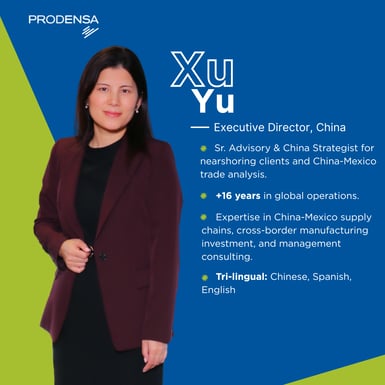
.png?width=39&height=50&name=Xu%20Yu%20(1).png) Xu Yu - Executive Director, China Strategist
Xu Yu - Executive Director, China Strategist
"The right question isn't "China or Mexico". Today's most resilient manufacturers are building supply chains that leverage the strengths of both. China continues to offer depth in component manufacturing, electronics, tooling and specialized production. Mexico provides proximity to the U.S. market, a highly developed manufacturing workforce, preferential access under USMCA, and shorter, more responsive supply chains. The more valuable question is, "which parts of our value chain create the greatest advantage in China, and which should be located in North America?".
Conclusion: qualification must be designed, not assumed.
Contact us to schedule a free consultation with our Business Advisor team.

Contact media@prodensa.com to obtain quote or speaking engagement info.
Frequently Asked Questions
1. Can products made in Mexico with Chinese components qualify under USMCA?
Yes. Products manufactured in Mexico may qualify for USMCA preferential treatment even if they contain Chinese components. Eligibility depends on whether the finished product satisfies the applicable Rule of Origin, which may include tariff shift requirements, Regional Value Content (RVC), or product-specific manufacturing processes.
2. Does using Chinese components automatically disqualify a product from USMCA?
No. USMCA does not prohibit the use of non-originating materials. Instead, manufacturers must determine whether the finished product meets the Rule of Origin established for its tariff classification.
3. Does assembling a product in Mexico make it USMCA compliant?
Not necessarily. Manufacturing or assembly in Mexico alone does not guarantee USMCA eligibility. The finished product must satisfy the agreement's product-specific Rules of Origin before preferential treatment can be claimed.
4. What are Rules of Origin under USMCA?
Rules of Origin are the criteria used to determine whether a product qualifies for preferential tariff treatment under USMCA. Depending on the product, qualification may require a tariff classification change, Regional Value Content (RVC), specific manufacturing processes, or a combination of these requirements.
5. What is Regional Value Content (RVC)?
Regional Value Content measures the percentage of a product's value that originates within North America. Some products must meet a minimum RVC threshold to qualify for USMCA benefits, while others rely primarily on tariff shift requirements.
6. Can IMMEX make a product USMCA compliant?
No. IMMEX and USMCA serve different purposes. IMMEX allows manufacturers to temporarily import materials into Mexico under specific customs benefits, while USMCA determines whether a finished product qualifies for preferential tariff treatment when traded between the United States, Mexico, and Canada.
7. Should manufacturers replace their Chinese suppliers to qualify under USMCA?
Not necessarily. Many manufacturers successfully qualify under USMCA while continuing to source certain components from China. The best approach depends on the applicable Rule of Origin, the value of non-originating materials, and the company's overall supply chain strategy.
8. How can manufacturers determine whether their products qualify under USMCA?
Manufacturers should review the product's Harmonized System (HS) classification, identify non-originating materials, evaluate the applicable Rule of Origin, calculate Regional Value Content when required, and maintain documentation supporting their origin determination.