




In Mexico, freight trucking is a strategic variable that directly affects the financial and operational viability of any industrial project. The transportation sector contributes 6.3% of national GDP, with road freight accounting for 5.7%, compared with the relatively marginal contributions of air transportation (0.3%), rail (0.2%), and maritime transportation (0.1%).
More than 60% of total overland freight volume and 70% of high-value industrial cargo move through the country’s road network. As a result, highway infrastructure directly influences total cost of ownership, working capital turnover, and the ability to meet delivery windows under Just-in-Time manufacturing models.
The current environment is defined by a paradox. On one hand, Mexico’s 2025–2030 Highway Plan includes MXN 647.832 billion in investment led by the SICT, along with MXN 193 billion channeled through Banobras, to improve 11,366 kilometers of roadway through 1,200 active project sites. On the other hand, critical corridors remain congested, toll-free roads continue to deteriorate, the country faces a shortage of 90,000 heavy-truck drivers, and 86.3% of cargo thefts are concentrated in just ten states.
In other words, Mexico is investing more than ever in road infrastructure while still facing operational constraints that investors must factor into their decisions.
Being close to a highway does not necessarily mean being connected to a competitive logistics corridor. Connectivity should be measured in time, capacity, and statistical reliability—not simply in linear kilometers.
The Role of the Highway Network in the Logistics Ecosystem
Road freight is the critical connection point that keeps other transportation modes moving efficiently within Mexico’s national logistics system.
- At major seaports such as Manzanillo, Lázaro Cárdenas, Veracruz, and Altamira, trucking performs cargo evacuation through drayage services, directly influencing container yard turnover.
- In connection with the rail system, trucking feeds intermodal terminals and inland dry ports through first- and last-mile transportation.
- At U.S. border crossings, the efficiency of transfer terminals depends heavily on the capacity of the access roads leading to international bridges in Laredo, Pharr, Tijuana, and Ciudad Juárez.
Any lack of fluidity across these road interfaces can immediately reduce the performance of the entire supply chain.
-
The Hidden Cost of Poor Connectivity
Selecting a site with inadequate road access can create indirect financial penalties that erode profitability: higher freight rates or even refusal of service when road geometry is unsuitable; accelerated fleet wear caused by deteriorated pavement; missed delivery windows that trigger contractual penalties; and additional working capital tied up in higher safety-stock levels to prevent shortages on the assembly line.
-
Capacity and Reliability Matter More Than Distance
An industrial park located 100 kilometers from a logistics node but connected through a congested two-lane highway with steep grades and high accident rates can perform significantly worse than a site 200 kilometers away that is connected through a four- or six-lane highway with continuous traffic flow and intelligent traffic management.
Mexico’s 2025–2030 Highway Plan: Key Investments for Industrial Site Selection
The SICT Sectoral Program establishes the physical and budgetary targets for the modernization of Mexico’s national road network. The plan combines direct public funding with mixed-financing and Banobras-backed schemes.
SICT’s consolidated budget totals MXN 647.832 billion to improve 11,366 kilometers of roadway through 1,200 project sites. Current progress stands at 15%, with 1,796 kilometers completed and 4,223 kilometers under active construction.
|
Project Category |
Project Investment (MXN MILLION) |
Length / Targets |
Strategic Impact on Industrial Site Selection |
|
Priority Roads |
$154,616 |
3,161 km (11 corridors) |
Modernizes regional arteries and connects isolated production areas with major trunk corridors |
|
Highways (SICT) |
$100,631 |
802 km (18 routes) |
Expands capacity along corridors with high volumes of heavy export freight |
|
Banobras Intervention |
$193,000 |
Additional 1,582 km |
Channels private and mixed capital into strategic toll highways |
|
Bridges and Interchanges |
$25,134 |
47.6 km (402–619 projects) |
Removes road bottlenecks, urban crossings, and at-grade rail crossings |
|
Community Roads |
>$32,000 |
4,554–5,545 km (523 roads) |
Improves feeder connectivity in less-developed regions |
|
Megabachetón Program |
Annual SICT allocation |
>85,000 km covered |
Routine maintenance and resurfacing of the federal toll-free road network |
Flagship Projects with High Impact on Industrial Corridors
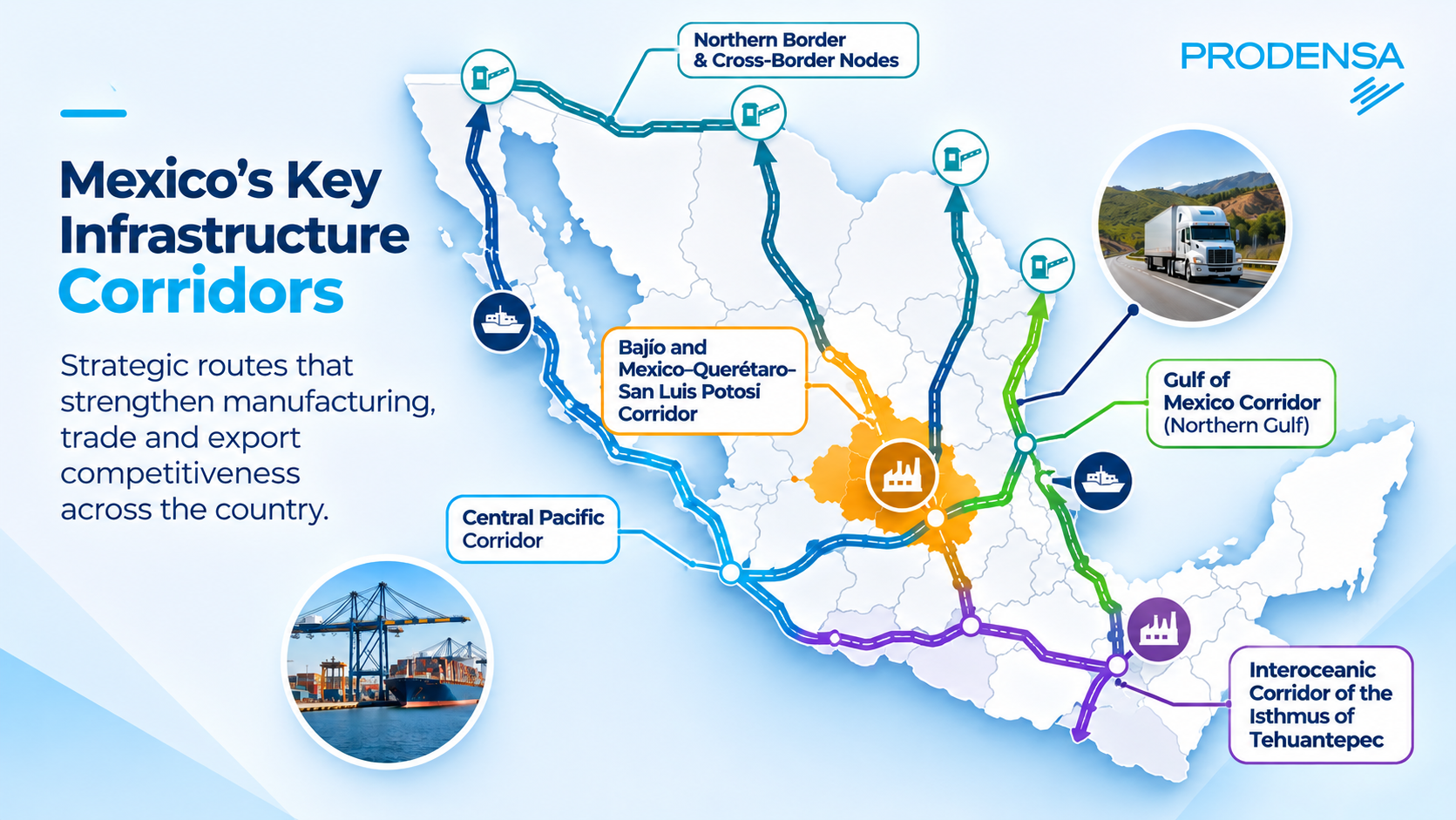
These corridors highlight the main routes shaping industrial connectivity, freight movement, and investment opportunities across Mexico.
The flow of foreign direct investment and institutional capital into mixed-investment highway concessions is an indicator of confidence in cross-border trade flows under the USMCA. These concession models help toll roads maintain international standards for maintenance, digital signage, and emergency response, supporting the continuity and reliability of logistics operations.
Top Logistics Corridors Driving Industrial Investment in Mexico
These logistics corridors stand out for their role in connecting Mexico’s key industrial regions, border crossings, and export routes.
|
Logistics Corridor |
Capacity and Infrastructure |
Projects and Upgrades |
Security Assessment |
Recommended Industrial Pro |
|
Bajío–Central Mexico (Highway 57-D) |
Very high capacity / significant congestion |
Mexico–Querétaro expansion; La Pitahaya |
High risk / active security operations |
Automotive, aerospace, electronics |
|
Northern Gulf (Tamaulipas) |
Expansion to four lanes underway |
503 km corridor; Altamira Viaduct; Tampico II Bridge |
Moderate / improving |
U.S. exports, chemicals, agribusiness |
|
Isthmus of Tehuantepec (CIIT) |
High trunk-route capacity |
Acayucan–La Ventosa (199 km, four lanes) |
Moderate |
Transoceanic manufacturing, bulk cargo, industrial inputs |
|
Central Pacific |
High capacity / critical bottlenecks |
Pátzcuaro–Uruapan; Tepic–Compostela |
High risk in specific segments |
Consumer goods, Asian components, export agriculture |
|
Northern Border (Laredo/Reynosa) |
Very high cross-border capacity |
Border bypasses; bridge modernization |
Moderate to high risk at access points |
Final assembly, direct nearshoring, JIT operations |
SOURCE: Prodensa Analysis
-
Bajío and the Mexico–Querétaro–San Luis Potosí Corridor: this corridor continues to concentrate the highest level of industrial activity in the country. However, congestion along Highway 57-D means that new developments should prioritize access to peripheral bypasses, such as the La Pitahaya–Northeast Querétaro Bypass connection, allowing freight traffic to avoid major urban bottlenecks.
-
Interoceanic Corridor of the Isthmus of Tehuantepec: this corridor provides a strategic platform for manufacturing operations that require connectivity between the Pacific and Atlantic basins. The four-lane modernization of the Acayucan–La Ventosa highway reduces travel time between Coatzacoalcos and Salina Cruz to approximately two hours, strengthening the competitiveness of the Development Hubs for Well-Being.
-
Gulf of Mexico Corridor (Northern Gulf): this corridor is emerging as a key alternative for relieving export traffic from the Bajío and central Mexico toward Tamaulipas. The modernization of 503 kilometers and the removal of urban crossings in Altamira are expected to reduce travel times by up to four hours.
-
Central Pacific Corridor (Lázaro Cárdenas–Manzanillo–Guadalajara): this is a critical corridor for the movement of components arriving from Asia. Expansions along the Pátzcuaro–Uruapan and Tepic–Compostela routes are improving container flows toward western Mexico and the Bajío.
-
Northern Border and Cross-Border Nodes Nuevo Laredo, Reynosa, Ciudad Juárez, and Puerto Colombia: remain priority locations for projects focused on direct exports to the United States. Competitiveness depends largely on the speed of customs clearance at international bridges and the availability of controlled-access bypasses that help freight traffic avoid local congestion.
From Proximity to Performance: Highway Connectivity in Industrial Site Selection
Mexico is investing more than ever in highway infrastructure, but the gap between investment and operational quality is what separates a site that is simply “well located on the map” from one that is truly profitable to operate.
Road connectivity should be treated as an asset with its own useful life and risk profile, not as a static data point. A site located 50 kilometers from a congested highway may be less competitive than one 150 kilometers away from a corridor with sufficient capacity, route redundancy, and stronger security conditions.

For investment committees, highway analysis should be incorporated into site due diligence through three filters: current road capacity and performance; corridor security and reliability; and the implementation timeline for committed public infrastructure investment.
At Prodensa, we combine public infrastructure investment, logistics performance, and corridor security to turn highway connectivity into a measurable site selection criterion.
Before committing to a site, request a road connectivity assessment that includes level of Service, route redundancy, actual travel times to ports or border crossings, and the status of 2026–2030 infrastructure projects. The difference between simple proximity and competitive connectivity is the difference between a predictable logistics cost and one that gradually erodes margins.

-
Level of Service (LOS): A measure used to evaluate traffic flow and road performance, from free-flow conditions to severe congestion.
-
Route Redundancy: The availability of alternative routes that help maintain freight movement when the primary corridor is disrupted.
-
Drayage: Short-distance freight transportation between ports, rail terminals, warehouses, and nearby logistics facilities.
-
Highway Connectivity: The combination of travel time, capacity, reliability, security, and access—not simply distance to a highway.

How should highway connectivity be evaluated during site selection?
Beyond distance, companies should assess travel time, road capacity, congestion, security, route redundancy, and access to ports or border crossings.
Can a site farther from a highway be more competitive?
Yes. A site with reliable access to a high-capacity corridor may outperform a closer location connected through congested or poorly maintained roads.
Which road-related risks can increase logistics costs?
Cargo theft, congestion, poor pavement conditions, local traffic restrictions, limited route alternatives, and driver shortages can all increase operating costs.
Why does route redundancy matter?
Alternative routes help maintain operations when the primary corridor is affected by accidents, construction, security incidents, or congestion.
What should companies review before committing to a site?
A road connectivity assessment should include Level of Service, actual travel times, corridor security, route redundancy, and the status of planned infrastructure projects.

- Highway connectivity should be evaluated as part of Site Selection. Distance alone does not determine performance; capacity, congestion, security, and access conditions can significantly affect operations.
- The closest site is not always the most competitive. A location farther from a logistics node may perform better if it is connected through a higher-capacity, more reliable corridor.
- Road conditions directly affect logistics costs. Congestion, poor maintenance, security risks, and local restrictions can increase freight costs, insurance, transit times, and inventory requirements.
- Infrastructure projects can change the value of a location. Companies should consider both current road performance and planned highway investments when evaluating long-term site competitiveness.
- A Site Selection decision is also a logistics connectivity decision. Reviewing Level of Service, route redundancy, actual transit times, and corridor security before committing to a site can reduce operational risk and unexpected costs.

Notice: The content of this blog is developed by Prodensa for informational and educational purposes regarding nearshoring, foreign trade, human capital, and manufacturing in Mexico. Although we strive to keep the information accurate and up to date, laws and regulations may change. This material is not a substitute for specialized professional advice. Prodensa is not responsible for decisions made based on this content without appropriate professional consultation.