

.jpg?width=300&name=alvaro-reyes-qWwpHwip31M-unsplash%20(1).jpg)
Manufacturing in Mexico: Launching a Maquila Operation
For manufacturers evaluating Mexico, getting from a business case to the first production run involves much more than finding a building and hiring a workforce.
A maquila manufacturing operation in Mexico brings together corporate setup, real estate, labor, customs, tax, environmental compliance, and manufacturing readiness.  And many of those activities need to happen in the right sequence.
Mexico offers manufacturers proximity to the United States, an established industrial base, experienced manufacturing talent, extensive supply chains, and preferential access to major markets through agreements such as the USMCA.
Starting a maquila operation typically requires companies to establish the appropriate operating structure, secure a facility, prepare their workforce and administrative systems, obtain the necessary customs and IMMEX authorizations, and complete environmental and operational requirements before production ramps up.
.png?width=1200&height=400&name=Ebook%20Banners%20(10).png)
What is maquila manufacturing in Mexico?
A maquila, from the term maquiladora, is generally a manufacturing operation in Mexico that processes, transforms, assembles, or repairs goods for export.
Many maquila operations use Mexico's IMMEX Program, which allows authorized companies to temporarily import qualifying goods used in an export manufacturing or service process under preferential customs treatment.
A maquila is the manufacturing operation. IMMEX is the government program commonly used to support the import-export model behind that operation.
IMMEX does not simply mean that every import enters Mexico "tax-free". The treatment of duties, VAT, temporary imports, and other obligations depends on the merchandise, customs regime, certifications, and programs available to the company.
This is why international trade planning should be part of the startup strategy, not something addressed shortly before the first shipment arrives.
What do you need to start a maquila operation in Mexico?
Although every manufacturing project is different, most startups involve several interconnected workstreams:
- Corporate and legal structure
- Facility selection and legal possession
- Banking, accounting, and administrative systems
- Workforce registration and recruitment
- Customs and importer registrations
- IMMEX authorization
- VAT/IEPS planning and certification, when applicable
- PROSEC or other trade programs, when applicable
- Environmental, health, and safety compliance
- Machinery installation and production readiness
Some activities can happen simultaneously. Others depend on milestones being completed first. The sequencing is one of the most important parts of launching a manufacturing operation in Mexico.

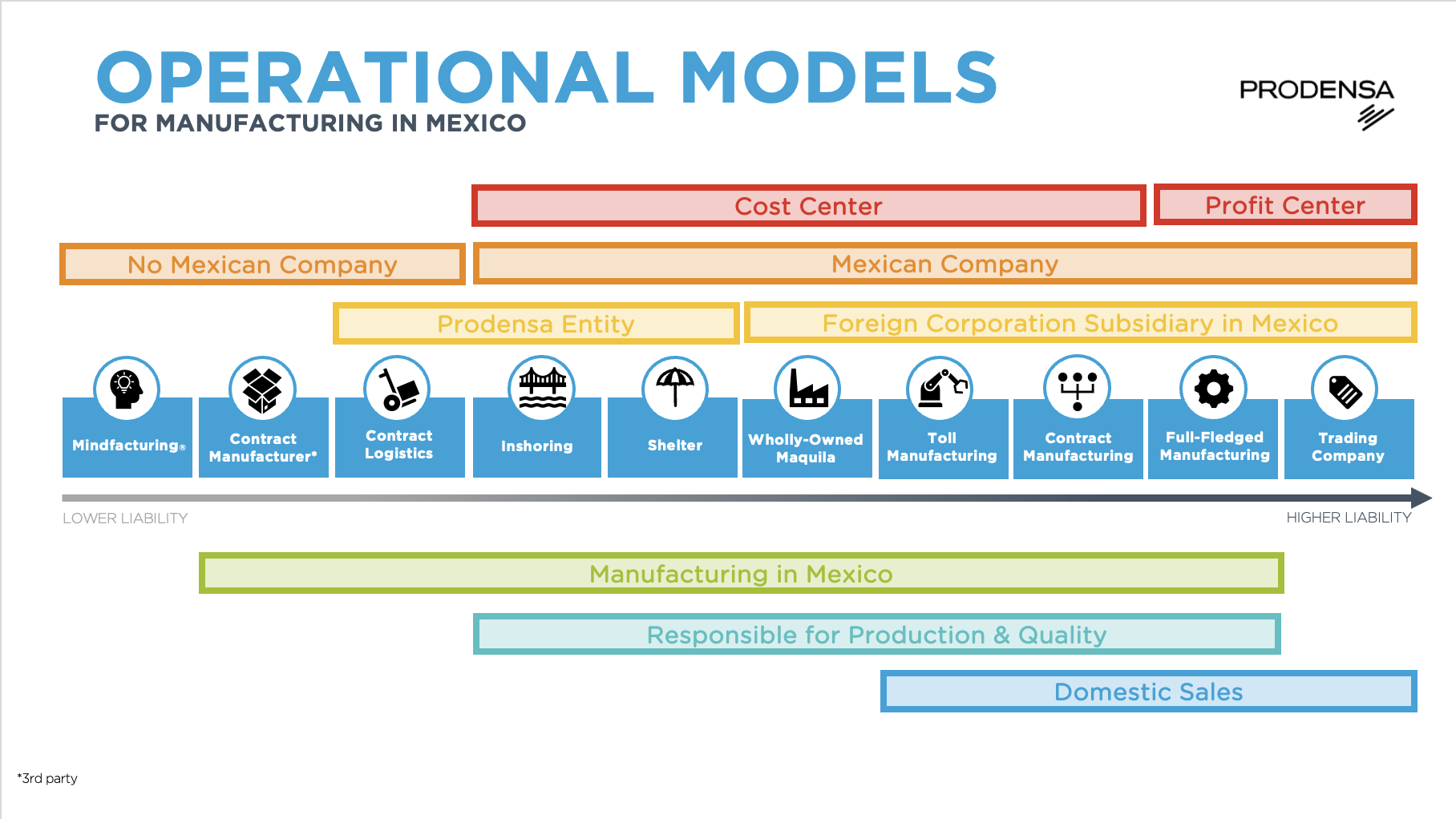
1. Define the right operating structure.
Before incorporating a company or signing a lease, manufacturers should first determine how they want to operate in Mexico.
For some companies, the right answer is establishing their own Mexican legal entity and eventually operating under their own IMMEX authorization.
Others may intentionally use a shelter structure, depending on the project, desired speed to market, internal capabilities, long-term strategy and risk profile.
This decision influences almost everything that follows, including:
- Who employs the workforce
- Who imports machinery and materials
- Who holds permits and registrations
- How compliance responsibilities are divided
- How the company could eventually transition to an independent operation
For that reason, the operating model should be evaluated as part of the business case.
2. Incorporate the Mexican entity.
For companies establishing an independent operation, one of the first major milestones is creating the Mexican legal entity.
Obtain the Incorporation Deed and RFC.
The company must complete the appropriate corporate formation process and register with Mexico's tax authority, the Servicio de Administración Tributaria (SAT), to obtain its Federal Taxpayer Registry number, or RFC.
The specific corporate structure should be selected with legal and tax considerations in mind. Common structures include the Sociedad Anónima and Sociedad de Responsabilidad Limitada, although the appropriate vehicle depends on the project.
Companies should also establish the necessary powers of attorney and legal representation in Mexico.
Open Mexican Bank Accounts
Once the entity is established, local banking capabilities are normally required to support activities such as:
- Payroll
- Supplier Payments
- Taxes
- Operating Expenses
- Local Purchasing
Banking can become a startup bottleneck when it is left too late in the project, so it should be incorporated into the implementation schedule early.
3. Secure legal possession of the manufacturing facility.
Having a facility selected is not the same as having a facility legally and operationally ready. For an IMMEX application, the company must be able to demonstrate legal possession of the location where the authorized activities will take place. This makes the lease particularly important.
The IMMEX authorization process includes requirements related to the term remaining on a lease or similar agreement, which means a company should review the regulatory implications before signing the facility agreement.
A lease decision made only from a real estate perspective can create problems later in the trade-compliance process.
Complete tenant improvements.
The facility must also support the manufacturing process that the company intends to perform. Depending on the project, this can involve:
- Production areas
- Warehousing
- Administrative offices
- Employee facilities
- Areas for temporary-import inventory
- Electrical and mechanical infrastructure
- Fire protection
- Security
- Environmental requirements
Connect utilities.
Electricity, water, natural gas, telecommunications, and other utilities should be planned around the actual production requirements of the facility. For manufacturing start ups, utility capacity is often what matters most.
This is particularly important for projects involving energy-intensive machinery, specialized gases, clean rooms, process water, or other technical requirements.
4. Build the administrative structure.
A maquila cannot operate effectively on manufacturing systems alone. The Mexican entity also needs an administrative foundation capable of supporting fiscal, labor, purchasing, and customs compliance.
Implement accounting and ERP systems.
The ERP and accounting structure should be configured around Mexican fiscal requirements from the beginning. Trying to adapt a corporate system after transactions have already begun can create unnecessary reconciliation and reporting problems. Companies should define how they will manage areas such as:
- Accounting
- Invoicing
- Purchasing
- Fixed assets
- Inventory
- Payroll
- Accounts payable
- Tax reporting
For an IMMEX operation, the relationship between ERP data and customs inventory controls becomes particularly important.
Establish purchasing controls.
Purchase orders, invoices, payments, receipts, vendors and supporting documentation should follow a controlled process. This becomes especially relevant for VAT recovery, audits, customs compliance, and the reconciliation of transactions across different systems.
5. Prepare the workforce.
Mexico has deep manufacturing experience, but that does not mean talent can simply be hired at the last minute. Industrial labor markets can vary considerably by city, and even by industrial corridor.
Benchmark compensation and benefits.
Before recruiting begins, manufacturers should understand the competitive labor environment surrounding the selected facility. A useful compensation analysis should consider more than base salary. Depending on the market, companies may compete through benefits such as:
- Transportation
- Cafeteria services
- Attendance incentives
- Bonuses
- Savings fund
- Uniforms
- Private medical benefits
- Additional paid benefits
The goal is not simply to determine what a position costs. It is to understand what it takes to attract and retain the workforce needed to achieve the production plan.
Register as an employer and begin recruiting.
The Mexican entity will need the appropriate employer registration with the Mexican Social Security Institute (IMSS). Recruitment should then be aligned with the manufacturing ramp-up plan.
This is especially important for operations requiring specialized technicians, engineers, bilingual personnel, quality professionals, maintenance teams, or a large hourly workforce.
Mexico restricts traditional personnel subcontracting. Specialized services remain possible under specific conditions, including the applicable REPSE framework, so companies should distinguish between direct employment, specialized services, and other workforce models when designing their organization.
6. Prepare the customs structure.
For maquila manufacturing in Mexico, customs readiness can determine whether a plant launches on schedule or sits waiting for machinery and materials.
Register in the Importers Registry.
Companies that will import goods into Mexico generally need the applicable registration with SAT's Padrón de Importadores. Depending on the tariff classification and type of goods being imported, additional sector-specific registrations may also apply.
Certain products and materials are subject to greater controls, which makes early tariff classification critical. Before machinery or raw materials begin moving, companies should understand:
- HTS/tariff classifications
- Import requirements
- Applicable NOMs
- Sector-specific registrations
- Country of origin
- Duties and taxes
- Temporary versus permanent import treatment
Waiting until a shipment is already in transit to answer these questions can create expensive delays.
7. Apply for the IMMEX Program.
The IMMEX Program is one of the most important instruments supporting export manufacturing in Mexico. It allows authorized companies to temporarily import eligible goods used in manufacturing, transformation, repair, or qualifying export-service activities under the conditions established by the program.
To obtain an IMMEX authorization, a company must demonstrate that a legitimate export project exists and satisfy requirements related to its operation, facility, productive process, and corporate compliance.
Among the program's ongoing commitments, IMMEX companies must generally maintain annual foreign sales of more than US$500,000 or exports representing at least 10% of total invoicing.
Companies must also maintain compliance after receiving the authorization. That includes properly controlling temporary imports, respecting applicable return periods, maintaining authorized locations and activities, and completing required reporting.
IMMEX is not a one-time permit.
One of the biggest misconceptions about IMMEX is that the difficult part ends once the authorization is approved. In reality, approval is when the ongoing compliance process begins. A manufacturer needs the systems and processes to answer questions such as:
- What was temporarily imported?
- Where is it located?
- What finished product consumed it?
- Was it returned or exported within the applicable period?
- Can the customs documentation be reconciled with the physical inventory and ERP?
This is where tools such as the Annex 24 inventory control system become essential.
8. Evaluate VAT/IEPS Certification.
Another common misconception is that receiving IMMEX authorization automatically eliminates VAT on temporary imports. It does not.
Mexico generally applies VAT to imports. Qualifying companies can separately apply for the Registro en el Esquema de Certificación de Empresas, Modalidad IVA e IEPS, which can provide a fiscal credit equivalent to 100% of the VAT and IEPS caused on qualifying temporary imports.
The certification has its own eligibility and compliance requirements. Companies operating under this structure also need to understand their ongoing obligations involving inventory and credit-control systems, including the relationship between Annex 24 and Annex 30.
This is an area where customs processes, tax compliance, and inventory accuracy directly intersect.


9. Determine whether PROSEC applies.
The Sector Promotion Programs, or PROSEC, are another tool manufacturers should evaluate as part of their import strategy. PROSEC can allow qualifying manufacturers in designated industries to import certain inputs using preferential ad-valorem duty rates. The benefit depends on the company's sector and the specific tariff classifications involved. For that reason, PROSEC should not be viewed as a blanket duty exemption.
Instead, companies should review their bill of materials and import classifications to determine whether the program creates a meaningful cost advantage. This analysis has become even more important as Mexico's tariff environment has continued to evolve across certain products and industries.
10. Prepare machinery and production equipment.
Machinery and equipment planning should be coordinated with customs, facility and construction workstreams. Equipment may be:
- Imported temporarily
- Imported permanently
- Purchased locally
- Provided under another permissible commercial structure
The appropriate treatment depends on ownership, the operating model, IMMEX structure, tax considerations, and the intended use of the equipment.
Before shipping equipment to Mexico, companies should confirm its tariff classification, applicable import requirements, installation needs, electrical specifications, and whether any permits or standards could affect entry.
10. Complete environmental, health and safety requirements.
Environmental and workplace safety compliance should be incorporated into site selection and facility preparation, not treated as a final approval step. Requirements vary according to the location and manufacturing process.
Depending on the operation, companies may need to evaluate:
- Environmental impact
- Air emissions
- Waste
- Water use and discharge
- Hazardous materials
- Civil protection
- Fire risk
- Land use
- Construction permits
- Workplace safety requirements
For example, NOM-002-STPS-2010 establishes the requirements related to fire prevention and protection in workplaces. A facility that works perfectly from a real estate perspective may not necessarily be ideal from an environmental or permitting perspective. This is why EHS due diligence should begin before major capital commitments are finalized.
The sequence matters when starting a maquila operation in Mexico.
The individual requirements are only part of the challenge. The bigger challenge is understanding what depends on what. For example:
You may need legal possession of a facility to advance on one authorization. You may need corporate and tax registrations before opening bank accounts or completing other processes. You may need IMSS registration before building the workforce. Your customs strategy may affect how machinery should be imported. Your production process may affect the permits required for the building. Your VAT/IEPS strategy may affect how inventory systems should be configured.


A manufacturing start up therefore works best as one integrated project, rather than separate legal, HR, customs, construction, and operations initiatives working independently.
Starting a maquila is a manufacturing project as well as a compliance project.
The attraction of maquila manufacturing in Mexico goes well beyond labor cost.
Mexico provides access to sophisticated manufacturing clusters, skilled talent, North American supply chains, export infrastructure, and a network of trade agreements that has made the country an important part of global manufacturing strategies.
But capturing those advantages requires more than opening a plant. Entity formation, real estate, workforce planning, customs, IMMEX, tax, EHS, systems, and production readiness need to work as one coordinated setup strategy.
At Prodensa, we help manufacturing evaluate, establish, and operate in Mexico through every stage of that process: from feasibility and site selection to start up, IMMEX, shelter operations, trade compliance, workforce solutions, and the transition to a mature manufacturing operation.
Planning a manufacturing operation in Mexico? Let's talk about the structure, timeline, and compliance strategy behind your project.
Frequently asked questions:
What is maquila manufacturing in Mexico?
Maquila manufacturing in Mexico generally refers to an export-oriented manufacturing operation in which goods are assembled, transformed, processed, or repaired in Mexico. Many maquila operations use the IMMEX Program to temporarily import qualifying machinery, components, and materials used in the export process.
Is a maquila the same thing as IMMEX?
No. A maquila or maquiladora refers to the manufacturing operation or model. IMMEX is a Mexican government program that provides a regulatory framework for qualifying temporary imports used in export manufacturing and services.
Does IMMEX mean imports are tax-free?
Not automatically. IMMEX provides specific customs benefits for qualifying temporary imports, but VAT, duties, certifications, tariff classifications, and other rules still need to be evaluated. VAT/IEPS certification, for example, is a separate registration from IMMEX.
What are the export requirements for IMMEX?
Companies operating under IMMEX generally commit to annual foreign sales exceeding US$500,000 or exports representing at least 10% of total invoicing, along with the other operational and compliance requirements of the program.
Does a company need a Mexican legal entity to start a maquila?
Companies establishing their own standalone manufacturing operation generally create the appropriate Mexican corporate structure. However, manufacturers can also evaluate alternative operating models such as a shelter structure depending on their objectives and long-term Mexico strategy.
How long does it take to start a maquila operation in Mexico?
There is no single timeline that applies to every project.
The schedule depends on factors such as the operating model, facility readiness, utilities, workforce size, industry, machinery, permitting requirements, customs registrations, IMMEX authorization, and whether specialized materials are involved.
For this reason, the project timeline should be built around dependencies rather than a generic number of weeks or months.
What industries use maquila manufacturing in Mexico?
The model is widely used across manufacturing industries including automotive, aerospace, electronics, medical devices, appliances, industrial equipment, and other export-oriented sectors.