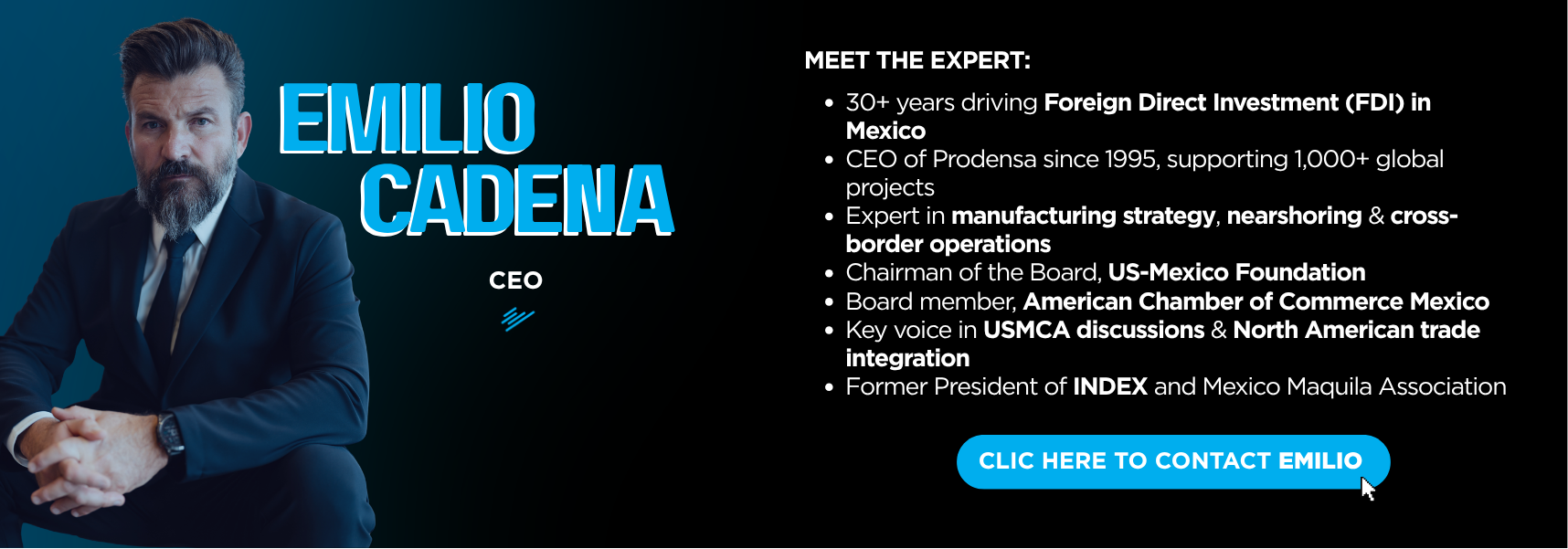


Thirty years may seem like a long time. Yet when I look back, I feel as though everything has gone by far too quickly. What surprises me most is not that three decades have passed since I joined Prodensa, but the extraordinary transformation Mexico has experienced during that time.
When I began this journey, export manufacturing looked very different. Industrial parks were only beginning to take shape, supply chains had a very different reach and the companies arriving in Mexico faced challenges that were completely different from those they encounter today. We ourselves offered very different services from the ones we provide now.
Today, we support advanced manufacturing projects, data centers, aerospace companies, cutting-edge technologies and some of the most innovative organizations in the world.
What is truly remarkable is that this transformation took place within a single generation.
Sometimes we become so focused on solving the challenges of the day that we forget to stop and recognize everything we have built. Mexico has gone from being just another participant in the global economy to becoming one of the pillars of North America's supply chains and the United States' largest trading partner. None of that happened by chance.
Some believe the future will bring changes so profound that we will have to reinvent ourselves completely but I see it differently. We've done it before. Time and time again, we have proven that we are capable of adapting, learning and evolving. That experience should give us confidence as we face what lies ahead.
After thirty years, I remain convinced that there are principles that have never changed.
Geography Still Matters... But People Make the Difference
The first is that geography matters. Our proximity to the world's largest market continues to be a strategic advantage that cannot be replicated. In a world where speed, customization and supply chain resilience are becoming increasingly important, distance still makes a difference.
But that geographic advantage would not have the same value without the talent of our people.
Throughout these years, I have witnessed, time and again, the extraordinary ability of Mexicans to learn, adapt and compete at the highest level. I have seen organizations where our deeply human way of working (building relationships and feeling part of a community) coexists with world-class standards of quality, productivity and innovation. That combination is probably one of our country's greatest assets.
I have also learned that the most successful companies are not necessarily the ones that arrive with the largest budgets or the most sophisticated technology, but those that understand that organizational culture cannot be imposed, it must be built. Organizations that successfully connect their global values with Mexican culture develop extraordinary teams. And when they also choose to bring their best technology and most advanced processes here, the results often exceed every expectation.
I have always believed that opening a new plant is a once-in-a-lifetime opportunity for a company. It is the moment to leverage everything the organization has learned to design the best operation possible. That is why I often say we must plan for success. If we get things right from the very beginning, the real challenge will no longer be survival, it will be preparing for growth.
Today, we are facing an opportunity even greater than the one created by trade liberalization three decades ago.
The regionalization of supply chains, technological development, artificial intelligence and the need to build more resilient supply chains are reshaping global industry. Mexico is in a privileged position to benefit from this new cycle, but it will only happen if we think ambitiously.
We need to stop seeing ourselves simply as a manufacturing economy built primarily on cost competitiveness . We must become a manufacturing economy driven by knowledge, innovation and technology. That will be the real leap forward.
Competitiveness Is Everyone's Responsibility
For many years, we assumed that industrial development depended primarily on companies doing their job and the government doing its own. Today, I am convinced that this division is no longer enough. Those of us who are part of the industrial ecosystem have a responsibility to become much more involved.
That means participating in business associations, joining their committees and contributing our time, knowledge, and experience. It means collaborating with organizations such as INDEX, CONCAMIN, the American Chamber and many others that work every day to strengthen the country's competitiveness. It means engaging with government leaders and public officials, proposing solutions and helping shape public policy based on the experience of those of us who deal with operational realities every day.
I often hear people say, “Government doesn’t listen”... but my experience has been different.
When people participate in a serious, respectful and constructive way, doors do open. I have seen it happen firsthand. Change does not happen because someone asks for it from a distance. It happens when people choose to get involved, take a seat at the table, explain the challenges and work alongside public authorities to find solutions that benefit not just one company, but an entire ecosystem.
The Most Important Lesson from my Thirty Years at Prodensa
Mexico needs more citizens who participate and fewer spectators. It needs business leaders who are committed to the country, not just to their quarterly results. It needs leaders who understand that competitiveness is also built beyond the walls of their own organizations.
At this point, I always think of a lesson from David Noel Ramírez that has stayed with me for many years: the idea of the hipoteca social ("social debt").
He used to say that we all owe a debt to society for the opportunities we have received. That debt is not repaid with money; it is repaid by using our talents, our knowledge and above all, our time to serve others. As the years go by, that idea has taken on an even deeper meaning for me.
The best way I know to repay that social debt is by getting involved, by dedicating part of our time to building stronger institutions, better public policies, better organizations and ultimately, a better country for future generations.
If, after these thirty years, I could share just one conviction, it would be precisely that.
Our greatest asset has never been only our geographic location, our trade agreements, or the industrial infrastructure we have built. Our greatest asset has always been people's ability to collaborate, to learn, to reinvent themselves and to work together toward a common purpose.
I would like to express my deepest gratitude to everyone who has been part of Prodensa throughout these four decades and especially during the thirty years I have had the privilege of being here. None of the achievements we celebrate today belong to a single person. They are the result of the talent, commitment and collective effort of thousands of colleagues, clients, partners and friends who have built this story day after day.
Thirty years later, I believe exactly the same thing I believed when I started: Mexico has extraordinary potential. The difference is that today I have far more evidence to support that belief and an even greater responsibility to help make it a reality.