


The short version: Mexico is the leading nearshore hub for service teams like shared services, R&D, IT and BPO—combining a young, bilingual deeply skilled workforce with export incentives. Prodensa's Mindfacturing® solutions combines IMMEX service export incentives with an EOR path that lets you hire compliantly without opening a legal entity.
The great AI substitution is hitting a wall. After two years of replacing teams with automation, companies are learning that AI can cost as much as (or more) than the workers it was meant to replace. Nearly a third of firms that cut staff for AI have already reopened those roles, and Gartner expects that half of the companies that laid off customer-service and operations staff to rehire them within a year. From Klarna rebuilding its support team to IBM tripling entry-level hiring, the pendulum is swinging back toward skilled human talent.
That raises a new question: if you're rebuilding teams, where should you build them?
Labor costs keep climbing at home, skilled professionals are hard to find and keep, and the old offshore playbook—a team twelve time zones away—creates as many problems as it solves.
If you're weighing where to build your next shared services, R&D, IT, or back-office team, there's a closer, faster, and increasingly obvious answer: Mexico.
Here's the part most companies underestimate. Mexico isn't just a lower-cost option. It's a deep, specialized talent market that happens to sit next door, share your business hours, and come with export incentives that make hiring there remarkably simple. Let's break down why — and how to actually put that talent to work.
A talent market built for service work
Mexico's services sector already generates roughly 62% of the country's GDP, and one in every three shared service centers in Latin America operates there. That's not an emerging trend — it's an established ecosystem that global names like IBM, Accenture, SAP, and Citi already run on.
Behind those numbers is a workforce built for knowledge work:
- A median age near 29.6 — the youngest workforce in North America.
- Roughly 60 million employed professionals, many with international certifications and enterprise-software experience.
- About 114,000 new engineering and technical graduates every year, placing Mexico among the world's top 10 STEM-producing nations.
- A bilingual, bicultural talent base that overlaps your working day across three shared U.S. time zones.
Mexico's private, non-financial services employ 8.9 million people, and the highest-productivity sub-sector (Information, Professional & Technical Services) pay above the national wage, a signal of the specialized talent available. Download the Service Export Sector eBook for a full breakdown.
The services industry employment in Mexico
Of roughly 60 million people employed nationwide, millions work in the commercial, financial, transport, and professional functions that global companies increasingly nearshore. That gives Mexico a broad, specialized talent base for export-oriented service operations.
| Total Employment in Mexico | 60 million |
| Total Services Employment | 26.6 million |
| Private, Non-Financial | 8.9 million |
| Finance & Insurance | 647,000 |
| Transport & Warehouse | 1.3 million |
| Commerce (Retail & Wholesale) | 8.6 million |
Source: INEGI (EMS, EMEC, ENOE reports) via Tukan Portal
Wholesale and retail commerce (31.4%), real estate (14.4%), and transport (13%) account for nearly 60% of the GDP of the services sector in Mexico.
Download the Services Sector eBook for a breakdown of the services sector, their corresponding GDP, employment, and wage analysis.
The easy on-ramp: EOR with export incentives
Great talent means little if accessing it is slow or complicated. Two primary mechanisms to consider:
1. Export incentives
Some services delivered from Mexico to clients or affiliates abroad can qualify as exports, making them eligible for tax incentives. Effectively, those that qualify could invoice at a 0% VAT rate instead of the standard 16% VAT in Mexico. There are strict controls and tax compliance that accompany this export strategy.
Additionally, under Mexico's IMMEX program, export-oriented services like IT, finance, engineering and shared-service functions can effectively invoice at a 0% VAT rate as well. Companies must maintain IMMEX certification and adhere to strict controls including audits and visits.
2. Employer of record (EOR)
You don't need to form a legal entity in order to hire in Mexico. An Employer of Record in Mexico lets you legally hire, pay and manage talent compliantly.
Prodensa's Mindfacturing® goes a step further, pairing the EOR hiring model with IMMEX export incentives, so your exported work is taking advantage of tax incentives. Together they answer the two questions every leader asks:
- How do we get the talent?
- How do we do it without overhead and risk?
Looking for a Binational EOR with Export Incentives?

One talent pool, many applications
The same Mexican talent base supports a surprising range of service functions — which is exactly why it works as a single nearshoring hub rather than a one-off outsourcing arrangement:
Shared services & BPO
With foreign direct investment comes knowledge transfer. Many Mexican professionals hold international certifications, comply with global business standards, and have experience across diverse systems and software. Many of these systems are imported into Mexico from the United States, which is something you would not necessarily see with shared service centers on the other side of the world.
Engineers, designers, and technical experts collaborate across North American borders on innovation, product development and process improvement by leveraging regional cooperation under the USMCA.
| City | Why it stands out |
| Mexico City | Economic and political capital; deep talent pool and corporate ecosystem with many HQ's. Preferred for finance, HR, IT support, and business services. |
| Monterrey | Industrial and technological hub with top universities and bilingual talent. Ideal for engineering, finance, business services, and IT. |
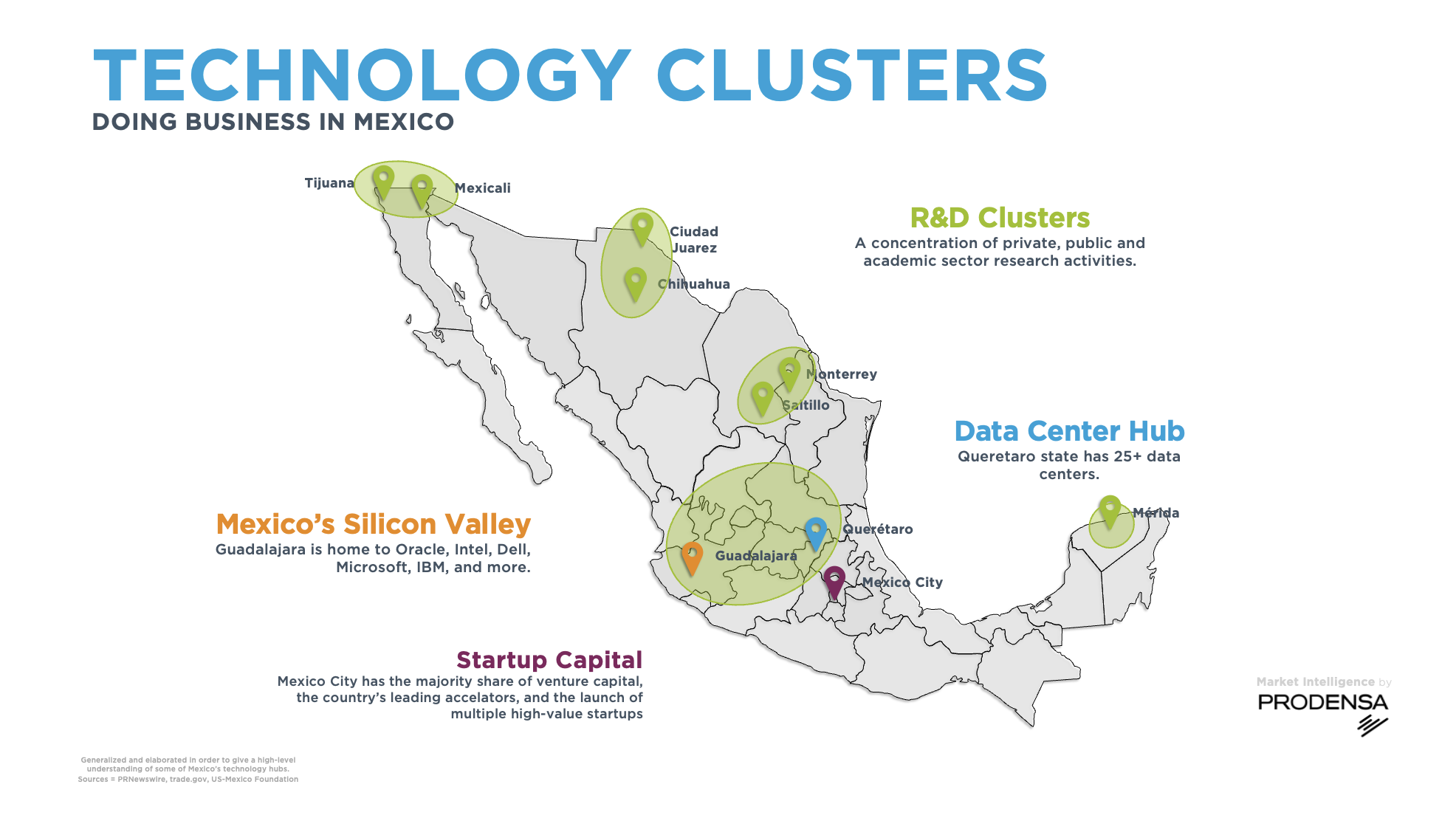
| Guadalajara | "Mexico's Silicon Valley". Magnet for IT, software development, and tech-driven service centers. |
| Querétaro | Fast-growing hub with strong manufacturing, aerospace, and finance sectors; attractive for engineering, back-office and IT. |
| Tijuana | Border city with strong U.S. connectivity; excels in BPO, customer service, logistics, and supply chain. |
| Hermosillo | Key industrial city with a growing tech and business-services sector; ideal for cost-effective business services, BPO and IT support. |
| Mérida | Emerging support and technology hub with high English proficiency and strong quality of life. |
Download the Mexican Services Export eBook to see a list of top shared service centers in Mexico.
IT & software
IT talent in Mexico has expanded at roughly a 30% annual rate since 2004 (Csoft Cluster Monterrey), fed by top universities and technical institutes, widespread English proficiency, and labor costs well below other North American markets. This workforce is also remote-native, meaning that flexible and hybrid schedules are the norm.
Mexico has one of the most complete digital ecosystems in Latin America, spanning software and cloud, hardware, e-commerce, telecom and cybersecurity. Deep integration with the U.S. economy, favorable trade policy under the USMCA, and maturing infrastructure make it a strategic bridge between North America and emerging markets. The USMCA digital trade chapter eliminates customs duties on digital transactions and limits restrictions on cross-border data flows — a real tailwind for software delivery across borders (though data-privacy and cybersecurity standards still vary by country and warrant planning).
Tech hubs are located in and around Mexico City, Guadalajara, Monterrey and Tijuana—delivering digital transformation, automation and AI.
R&D & engineering
Mexico's R&D ecosystem has expanded over the past decade, supported by foreign direct investment, university–industry collaboration, and nearshoring trends. States such as Nuevo León, Querétaro, Jalisco, and Guanajuato have become magnets for research in advanced manufacturing, aerospace, biotechnology, and energy.
The R&D landscape is diverse, spanning many areas including:
- Agricultural Research - companies like Gruma, Grupo Bimbo, Syngenta and more conduct research into crop yields, sustainable farming and new tech.
- Biotechnology & Pharmaceuticals - companies like Liomont and Silanes as well as national institutes of Mexico like IMSS conduct genetic research, drug development, and medical device testing.
- Automotive Manufacturing - with major automakers present like General Motors, Ford, Stellantis and more, the R&D centers focused on electric vehicles, automation and advanced manufacturing have grown in Mexico.
- Renewable Energy - as the world shifts to cleaner energy, Mexico invests in solar, wind and hydroelectric R&D through universities, government agencies and private industry.
R&D and Engineering centers can be found throughout Mexico, especially in large business cities like Mexico City and Monterrey as well as industrial clusters like Guanajuato, Querétaro, Tijuana and Ciudad Juarez.
Download the Mexican Services Export eBook to see a more robust list of companies investing in R&D in Mexico .
Administrative services & BPO
The cost-benefit of Artificial Intelligence has created a second wave of interest in shared service centers. Consolidating functions and leveraging labor-cost advantage, organizations can realize a 15-25% reduction in overhead, according to Deloitte.
Because these roles are often people-intensive and communication-heavy, Mexico's bilingual workforce and real-time overlap with U.S. business hours are especially valuable. Service exports from Mexico to the United States have grown steadily, driven by shared services, IT and administrative support.

US-Mexico collaboration in services
The United States and Mexico share one of the most deeply integrated manufacturing relationship in the world. For decades that partnership was defined by physical goods crossing the border. Today it is evolving into something more sophisticated: a collaboration built on engineering, software, and services that wrap around the products both countries build together.
The products coming off North American lines are no longer purely mechanical. A modern vehicle, appliance, or industrial machine is a hybrid of hardware and software, and value is migrating toward the digital layer. Manufacturing knowledge and software engineering are no longer separate disciplines — they are merging.
Mindfacturing®: a binational EOR for service exports
Prodensa's EOR solution is at the intersection of manufacturing and technology. It is an Employer of Record designed for North America's evolving industrial landscape, including the growth of shared services, R&D, and technical functions.
Under Mindfacturing®, companies can:
- Attract and recruit top talent under the strong employer brand of Prodensa
- Hire Mexican professionals compliantly under an IMMEX-registered structure
- Export R&D or service output while maintaining U.S.-Mexico tax alignment
- Protect intellectual property and maintain seamless binational collaboration
- Accelerate time-to-market through flexible, locally managed teams
Mindfacturing® embodies the evolution from manufacturing to mindfacturing — where Mexico's industrial foundation meets knowledge-based innovation. Through it, companies can perform exportable R&D and service work under IMMEX registration, unlocking VAT exemption on exported services, streamlined import/export of digital assets and technology, and simplified compliance through a registered operator.
Main takeaways
- Mexico is an established service economy, not an experiment. Services generate ~62% of GDP, one in three Latin American shared service centers operates there, and global names like IBM, Accenture, SAP, and Citi already run on Mexican talent.
- The talent is young, skilled, and next door. A median age near 29.6, ~60 million employed professionals, ~114,000 new engineering and technical graduates a year, and a bilingual workforce that shares your time zones.
- Export incentives change the economics. Qualifying services delivered abroad can invoice at 0% VAT instead of 16% under Mexico's IMMEX program — a direct margin improvement on every hour delivered (with real compliance obligations).
- An EOR removes the biggest barrier. You can hire, pay, and manage talent compliantly without forming a Mexican entity — cutting time-to-team from months to weeks and avoiding permanent-establishment risk.
- One talent pool covers many functions. Shared services and BPO, IT and software, R&D and engineering, and administrative operations — all from a single nearshoring hub.
- Mindfacturing® ties it together. Prodensa's binational EOR pairs compliant hiring with IMMEX export incentives, so your exported service and R&D work is tax-aligned from day one.
About Prodensa: binational solutions
Prodensa has more than 40 years helping international companies establish operations in Mexico. We help global companies build successful businesses in Mexico, led by experts in IMMEX, USMCA and cross-border operations. Our turnkey operations models leverage the highest expertise in compliance with changing market conditions to add value to foreign investors in Mexico.

Frequently Asked Questions:
Can I hire employees in Mexico without setting up a legal entity?
Yes. An Employer of Record (EOR) in Mexico legally hires, pays, and manages talent on your behalf, so you can build a team without forming a local subsidiary. It removes permanent-establishment risk and typically reduces time-to-team from months to a few weeks.
What is an Employer of Record (EOR) in Mexico?
An EOR is a locally registered company that becomes the legal employer of your Mexican staff — handling payroll, benefits, tax, and labor compliance — while you direct their day-to-day work. It's the fastest compliant way to start hiring in Mexico. Prodensa's Mindfacturing® adds IMMEX registration so exported work also captures tax incentives.
How do services from Mexico qualify for 0% VAT?
Services delivered from Mexico to clients or affiliates abroad — and demonstrably used abroad — can qualify as exports under Mexico's VAT Law, making them eligible for a 0% VAT rate instead of the standard 16%. Under the IMMEX program, export-oriented functions like IT, finance, and engineering can invoice at 0% VAT, subject to certification, documentation, and audits.
What services can be nearshored to Mexico?
Companies commonly nearshore shared services and BPO (finance, HR, procurement, customer support), IT and software (development, cloud, cybersecurity, AI, fintech), R&D and engineering (product design, testing, automotive, aerospace, biotech, energy), and administrative back-office functions delivered to international affiliates.
Which Mexican cities are best for IT and software teams?
Guadalajara ("Mexico's Silicon Valley"), Mexico City, Monterrey, and Tijuana are the leading tech hubs, with Puebla and Querétaro growing quickly. Each has a slightly different specialty — from fintech and e-commerce to AI, engineering, and hardware — so the right city depends on your function.
Is Mexican talent bilingual?
English proficiency is widespread, especially in universities, tech hubs, and export-oriented roles, shaped by decades of close economic ties with the United States. Bilingual, bicultural professionals make Mexico well suited to customer-facing and knowledge-work functions.
How much can nearshoring to Mexico save?
Beyond lower labor costs versus the U.S. and Europe, consolidating functions into shared service centers can reduce overhead by 15–25% (Deloitte), and qualifying exported services can eliminate the 16% VAT cost — compounding the savings.
How fast can I build a team in Mexico?
With an EOR and an experienced local partner, recruiting can begin almost immediately and teams can be operational in weeks — far faster than the months required to form and staff a new legal entity.