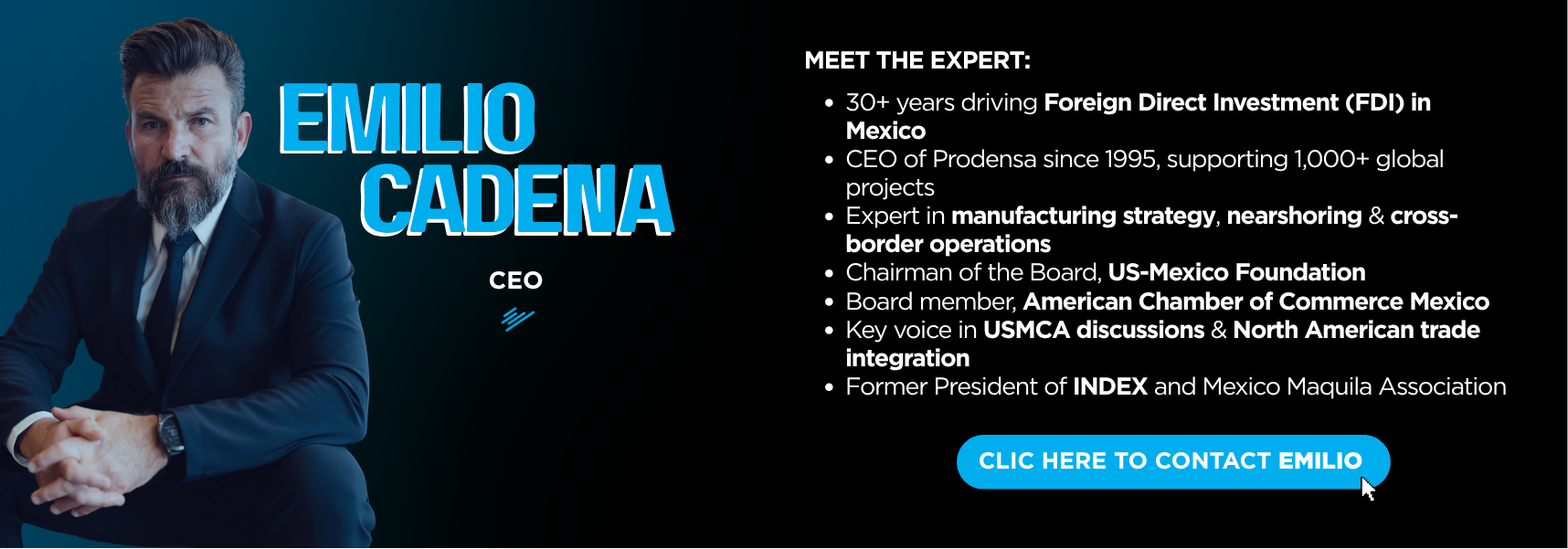


There is something that concerns me about the conversation we are having about the future of North America: we are spending too much time talking about what the United States wants and not enough time discussing what we want to build ourselves.
To some extent, that is understandable. Our trade relationship with our largest partner is going through a complicated moment. Tariffs, the USMCA review and decisions coming out of Washington are creating uncertainty for companies operating in Mexico. But I believe it would be a mistake to allow our entire industrial agenda to revolve around what the U.S. leadership says or does not say.
During the 51st Index National Convention, I had the opportunity to speak with Ildefonso Guajardo about the future of trade in North America. We discussed the USMCA, U.S. industrial policy and the changes reshaping supply chains. But one reflection stood out to me in particular: Mexico’s opportunity is not only about preserving what we already have, but about building the capabilities we still lack.
Proximity Is an Advantage, Not a Strategy
For many years, companies organized their supply chains around producing at the lowest possible cost. Efficiency was the priority. After the pandemic, we learned that an overly concentrated supply chain can become a major vulnerability when disruptions occur. Today, companies are also looking for resilience, proximity and security.
Are we prepared to take advantage of that opportunity? I believe we have the right foundations, but we cannot assume investment will come automatically simply because we are next to the United States. Geography gives us an advantage, the USMCA provides a framework for integration and our manufacturing experience gives us a strong platform. But none of those advantages can replace the need to remain competitive.
Build on What Mexico Already Does Best
I sometimes hear "Mexico needs to stop being an assembly-based manufacturing country" and I couldn't disagree more. Moving toward more advanced manufacturing does not mean abandoning what we already do well. Assembly has been essential to our integration into global supply chains, creating jobs and supporting engineering, design, supplier development and increasingly sophisticated processes. What we should do is build on that foundation, not leave it behind.
We need to ask ourselves how Mexico can participate more actively in the production of electronic components, semiconductors, data center equipment and other industries that will be critical in the years ahead. Today, a significant share of these inputs still comes from Asia. We are not going to replace all of them overnight, nor would doing so necessarily make economic sense. But we do need to identify where real opportunities exist to build capabilities in North America and determine the role Mexico can play.
Competitiveness Is Within Our Control
To achieve that, we cannot keep postponing competitiveness. We may have an excellent geographic position and favorable trade agreements, but if a company faces security concerns, high logistics costs, energy uncertainty or customs-related difficulties, our advantage begins to erode.
We need to be clear: Washington's tariffs and trade decisions are beyond our control, but Mexico's competitiveness is not. We can reduce operating costs, improve infrastructure, facilitate trade, secure competitive energy and strengthen supply chain security. We cannot dictate U.S. policy, but we can (and must) improve the conditions for manufacturing in Mexico.
Those are things we can control. And this is not a responsibility that belongs to government alone. The private sector also has a role to play. We need to move beyond meetings where we simply list the problems and toward an agenda where we propose solutions, build consensus and participate in their implementation.
I also believe Mexico needs to recover a much more ambitious approach to international investment promotion. We need to actively pursue investment, identify opportunities in global markets and engage with the companies that are redesigning their supply chains. We cannot simply wait for investors to discover on their own everything Mexico has to offer.
Mexico Must Shape Its Own Industrial Future
At Prodensa, we see firsthand that investment decisions depend on much more than tariff advantages. Companies evaluate talent, infrastructure, costs, suppliers and long-term certainty. That's why my concern is not only what happens with the USMCA, but what we do as a country to ensure Mexico remains competitive and attractive for manufacturing investment, regardless of the outcome. Let's not forget that North American integration was not built in just a few years, and we should not put it at risk through short-term decisions. But we should not settle for simply defending what already exists, either.
The United States needs a more competitive region. So does Canada. And Mexico has a great deal to contribute to that equation. We should not wait for someone in Washington to tell us where we fit in the new economy. We need to build that role ourselves.
The next stage of North American manufacturing will be defined not only at the negotiating table, but by the plants we build, the suppliers we develop and the investments we attract. The opportunity is there. Mexico must stop waiting and start executing.