
More US companies are moving accounting, payroll, HR, IT and customer support into a shared service center in Mexico. The talent is there, the time zones match, and the work flows straight back to headquarters.
Most of these companies also assume that exporting services from Mexico comes with tax benefits built in. It does not. There are two primary routes to that rate:
- the services modality of the IMMEX program
- 0% rate under Mexico's VAT law
They cover different activities, are structured differently, require different levels of ongoing compliance, and pose different risks. This blog goes into more detail.
When does a shared service center in Mexico export services?
A shared service center exports services when the work happens in Mexico but is used abroad. In other words: your team in Mexico closes the books, runs the payroll or answers support tickets, invoices your U.S. parent, and the value lands in the United States.
That binational setup is the whole point of the model. It is also exactly what Mexico's tax authority, the SAT (Servicio de Administración Tributaria) will ask you to prove.
That this means in practice: the center is usually a Mexican subsidiary that bills its U.S. parent company for services, often on a cost-plus basis. How that subsidiary is set up, staffed and documented decides which tax benefits it can actually use.
Two routes to a 0% VAT rate:
Article 29 of Mexico's VAT law (Ley del IVA, or LIVA) applies a 0% rate to services 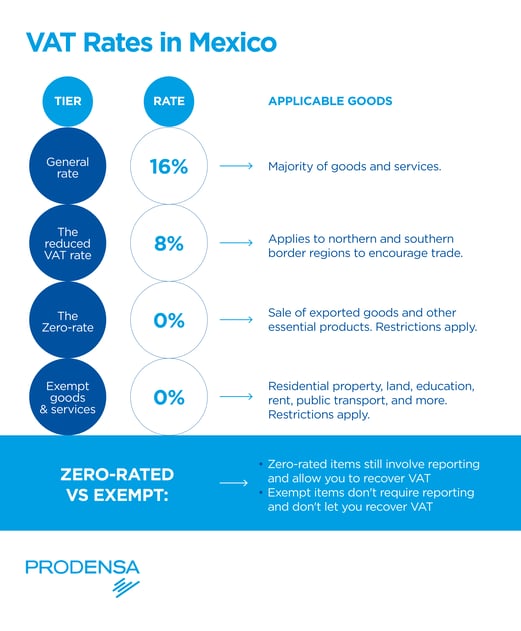 performed in Mexico and used abroad. Zero-rated is not the same as exempt. Because the rate is 0%, your center can still credit or recover the 16% VAT it pays on rent, software licenses and local suppliers.
Neither route is "set and forget". The difference is where the work sits. IMMEX front-loads compliance into a program you must maintain. Article 29 spreads it across every invoice and every refund claim. In both cases, mismanagement could lead to significant financial impacts and back tax assessment.
Read more in the Nearshoring Service Centers blog post.
1. Service IMMEX, built for export-only operations
IMMEX (Industria Manufacturera, Maquiladora y de Servicios de Exportación) is best known for manufacturing. Its services modality covers activities the Ministry of Economy (Secretaría de Economía) authorizes. For a shared service center, the relevant ones are:
- Global business process outsourcing: administration, accounting, purchasing, payroll, HR and call centers
- IT-supported services: software consulting, systems maintenance, database design and data security
- System and product design or engineering: project management, creative teams, and other technical roles
The modality also covers services on physical goods, such as repair, maintenance, inspection, testing, storage and distribution.
Service IMMEX adds a benefit on the input side.
The center can import computers, servers and telecom equipment without paying VAT upfront. It invoices a US entity, related or not, for the services it exports, and the U.S. parent company typically funds the operation.
The trade-off is compliance: it runs on a calendar.
Once the Ministry of Economy authorizes your program, keeping it is an ongoing obligation. In practice, that means:
- Annual report to the Ministry of Economy on the program's sales and exports, due by the end of May each year
- Export volume that meets the program minimum, generally more than $500,000 USD a year or at least 10% of total sales
- Annex 24 inventory control for every temporarily imported computer, server and piece of equipment, so you can show where each asset is at any time
- VAT/IEPS certification (CIVA) under Annex 30, renewed on its one-, two- or three-year cycle, if you use it to credit import VAT
- Current registered addresses, updated whenever the center moves, expands or adds a site
Miss these and the risk is not a fine on one transaction. It is cancellation of the program, which turns your temporary imports into definitive ones, with duties and VAT due.
2. 0% export VAT under Article 29 of LIVA
Article 29, section IV states that zero-rates are for services performed in Mexico and used abroad, but only for the activities it lists:
- Technical assistance, related technical services and industrial, commercial or scientific know-how
- Maquila and sub-maquila operations under customs legislation
- Advertising
- Commissions and brokerage
- Insurance, reinsurance and bonds
- Financing operations
- Filming or recording used abroad
- Call center services for calls originating abroad
- Information technology services, such as software development and data processing
The SAT (Servicio de Administración Tributaria) and Mexican courts increasingly expect four things per billing period:
- An international services agreement with the foreign recipient describing the services actually performed
- Invoices (CFDI) issued to that foreign resident
- Payment from abroad, traceable to the recipient
- Deliverable evidence showing the work was used outside Mexico
These services have to be contracted by a resident abroad without a permanent establishment in Mexico. They must also be paid for from bank accounts opened in foreign financial institutions. Including evidence of deliverable or other documentation that expressly demonstrates that the service was effectively used abroad.
This route's advantage is flexibility.
There is no program, no IMMEX audit and no registered-address rule, and the same entity can serve Mexican affiliates at 16% VAT alongside foreign clients at 0%.
Compliance runs invoice-by-invoice.
The SAT (Servicio de Administración Tributaria) and Mexican courts increasingly expect four things per billing period:
- An international services agreement with the foreign recipient describing the services actually performed
- Invoices (CFDI) issued to that foreign resident
- Payment from abroad, traceable to the recipient
- Deliverable evidence showing the work was used outside Mexico
These services have to be contracted by a resident abroad without a permanent establishment in Mexico. They must also be paid for from bank accounts opened in foreign financial institutions. Including evidence of deliverable or other documentation that expressly demonstrates that the service was effectively used abroad.
Without a program, there is no annual report to file, but the burden of proof never goes away. Each month, your center:
- Issues each invoice (CFDI) flagged as an export, with the foreign client's tax ID
- Files its monthly VAT return, where the 0% sales usually generate a VAT balance in your favor
- Requests refunds of that balance, which is exactly when the SAT asks for contracts, proof of payment and deliverables
- Documents arm's-length pricing when the client is a related party
Keep the file for at least five years, the general record-keeping period under Mexico's Federal Fiscal Code. A refund claim is effectively an audit you request yourself, so build the file before you file the claim.
Services invoiced at the 0% VAT rate that do not meet the requirements or do not demonstrate the evidence will be subject to the general 16% VAT rate, regardless of their actual utilization. This situation can have an economic impact, as VAT charged to residents abroad will not be recoverable. Compliance is judged on a case-by-case basis per invoice, so consistency and organization is crucial.
Which route fits your shared service center?
Both routes can reach the same 0% rate on exporting services from Mexico. They differ in which activities they cover, what they cost to run and what they let you do. Most centers fall into one of three situations:
- Export-only BPO center. Accounting, payroll, HR, or back-office work, all for the U.S., often with significant equipment. Service IMMEX gives those activities a clear footing and avoids the VAT outlay on imports as well as the constant gathering of evidence to accompany frequent invoices.
- IT or call center that also serves Mexico. Software, data or support work for headquarters and for Mexican plants. Article 29 covers the export work at 0% and lets the same entity bill locally at 16%.
- Lean or hybrid center. People, laptops and cloud software, with part of the team remote. A comparison between the two models must be made, considering factors like activities. A binational EOR like Mindfacturing® is worth considering for projects with lower investment.
|
Service IMMEX |
0% export VAT (Article 29) |
|
|---|---|---|
|
Activities covered |
Ministry of Economy-authorized services, including BPO (accounting, payroll, call centers, engineering, etc.) |
Listed services only, including technical assistance, IT services and call centers |
|
Clients |
Export only |
Foreign clients at 0%, Mexican clients at 16% |
|
Equipment |
Imported without paying VAT upfront |
VAT paid, then recovered |
|
Facility |
Registered address with a qualifying lease |
Any building |
|
Approval |
Ministry of Economy program |
None |
|
Proof required |
IMMEX audits and compliance documents |
Deliverable evidence for every invoice |
Mistakes we have seen at Prodensa
The tax rules are rarely the problem. The way the center is set up is.
Fundamentally the two routes support two different business plans. An IMMEX operation is a cost center where a foreign company, through their Mexican subsidiary, is effectively utilizing the Mexican workforce to deliver services to themselves. The invoice between the parties covers the cost of the operation, as they are funding it. When a company sells and delivers a service to a foreign resident abroad at 0% VAT, they are effectively charging the price or cost of the corresponding deliverable, and the Mexican operation serves as a profit center.
Robin Conklen, Managing Director USA
Robin's top 5 tips:
- Activities really matter, especially on the IMMEX. The application and approval process requires meticulous detailing of the activities conducted, with all corresponding equipment listed.
- Pay attention to the services agreement. Make sure it can support the invoice: foreign client, activities rendered, transfer pricing, etc.
- Respect labor compliance. Adhering to outsourcing regulations, visa-holding employee limits, contractor classifications, etc is crucial to keeping tax incentives.
- Don't hire without a tax structure. The time to build the strategy is before hiring employees in Mexico. A new, clean entity may be advantageous in some cases, or a certain type of entity may adapt better to the business plan.
- Don't forget about profit-sharing. Per Mexican regulation, 10% of the entity's taxable profit is shared among employees. Even in a cost-plus model such as an IMMEX cost center, the actual profit may not match market-driven rewards, and should be assessed on a case-by-case basis for retention purposes.
Ready to build your shared service center in Mexico?
Let's touch base and walk you through our experience.
Need to hire your team right away?
With Mindfacturing®, Prodensa's employer of record platform, you can hire your shared service center team in Mexico in 1 to 2 weeks while you choose your VAT route and build the contracts behind it. That is how one client moved its global service center to Mexico, hiring specialized talent while it set up its own entity.
Our team can deliver a quote while our Advisors build your tax strategy.