
A Mexico EOR (employer of record) is a Mexican company that legally employs your team on your behalf. It runs payroll, social security, taxes and labor-law compliance, while you direct the day-to-day work. It lets a foreign company hire in Mexico in weeks, without forming a Mexican entity.
Choosing an EOR in Mexico is also a compliance decision.
-
Mexico is phasing its workweek down from 48 to 40 hours starting January 1, 2027.
-
The general minimum wage rose 13% in January.
- Employer retirement contributions step up again every year through 2030.
And after the July 1st USMCA joint review, the US-Mexico trade now runs on annual reviews. If you hire in Mexico from the United States, your EOR partner is not part of your risk profile.
What is an Employer of Record (EOR)?
An employer of record in Mexico is a locally incorporated company that signs the employment contract, registers the worker with Mexican authorities, and carries the legal obligations of the employer. Your company decides who to hire, what they work on and how they perform. The EOR makes sure every peso of payroll and every legal filing is right.
In practice, a Mexico EOR handles:
- Spanish-language employment contracts under the Federal Labor Law (LFT)
- Monthly payroll and the official electronic payroll receipts (CFDI) required by the SAT (Mexico's tax authority)
- Registration and contributions to IMSS (Mexico's social security), INFONAVIT (housing fund) and SAR (retirement savings)
- Income tax withholding and state payroll tax
- Statutory benefits, vacations and year-end bonuses
- Terminations, settlements and, when you are ready, the transfer of employees to your own entity
Who uses an EOR in Mexico?
An Employer of Record service in Mexico is used by a variety of companies and industries, including:
- Multinational Companies - testing the waters of a new market before investing
- Small & Medium Enterprises - control of administrative overhead
- Startups - to focus on their core business and minimize distractions
- Nearshoring Companies - to benefit from proximity and trade agreements
- Global Service Firms - for cost-beneficial talent, many trained on U.S. systems
By leveraging a local EOR in Mexico, these organizations gain flexibility, reduce risks and streamline their operations while maintaining compliance with Mexican laws.
How does Mexico EOR work, step-by-step?
Most EOR engagement follow the same six steps:
-
Define the role and offer. You choose the candidate and set the salary in Mexican pesos (MXN) and, in some cases, also the benefits package. A good EOR helps you benchmark the offer against the local market.
- Sign a compliant contract. The Mexican EOR issues a Spanish-language contract under the LFT (Mexico's Labor Law). A trial period can last up to 180 days.
- Register the employee. The EOR registers the worker with IMSS within five business days of the start date and sets up INFONAVIT and tax records.
- Run payroll every period. The EOR calculates pay, withholds income tax (ISR), pays social security and state payroll tax, and issues CFDI payroll receipts.
- Invoice you. You receive an invoice for the payroll costs and service fee. With Prodensa's Mindfacturing®, companies hire in Mexico and pay in the United States.
- Manage the full employee lifecycle. Vacations, year-end bonuses, profit-sharing, terminations and eventually the transfer to your own entity.
Need an EOR quote?

Is an EOR legal in Mexico after the outsourcing reform?
Yes, when it is structured correctly. In 2021, Mexico reformed the labor law and its tax laws to prohibit subcontracting of personnel, meaning one company supplying workers to another. Specialized services that are not part of the client's corporate purpose or predominant economic activity are still allowed, but only when the provider is registered in the REPSE registry of the Ministry of Labor, which must be renewed every three years.
What this means in practice: the risk does not stay with the provider. If the arrangement is non-compliant, the client company can face fines and loss of benefits, or even fraud charges in serious cases.
An EOR can mitigate this risk, under the right operating structure.
Ask the Mexico EOR provider these questions:
- Is the employer a Mexican legal entity, and who exactly signs the employment contract?
- Where REPSE applies, what is the registration number, and is it currently active in the public registry?
- Does the provider file the quarterly specialized-services reports to IMSS and INFONAVIT?
- Can it show a current positive tax compliance opinion from the SAT and from IMSS?
- How is the service structured so your team is not treated as "supplied personnel"?
How does an EOR mitigate permanent establishment risk?
Additionally, an EOR reduces, but does not eliminate, permanent establishment (PE) risk: if EOR employees negotiate or sign contracts on behalf of your foreign company, you may still create a taxable presence in Mexico.
An EOR absorbs the workplace and operating compliance on your behalf.
Mexico's labor laws are among the most comprehensive in Latin America.
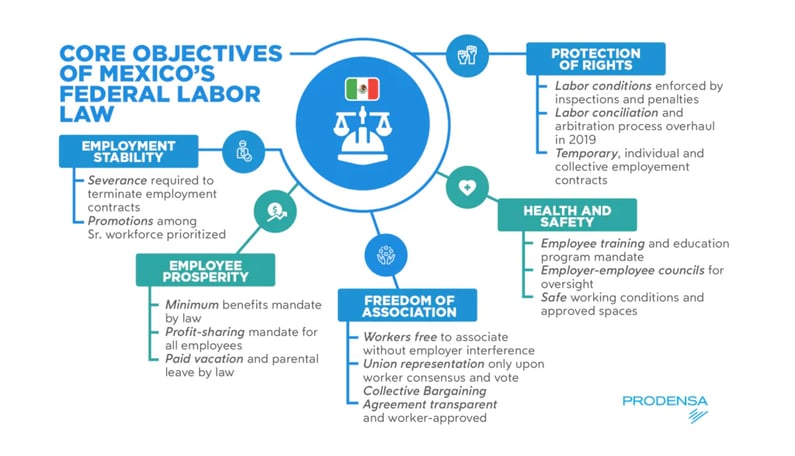
What changes in Mexican labor law in 2026 affect EOR employees?
2026 brought the most significant labor changes since the 2019-2021 reforms. Any EOR in Mexico should already have a plan for each.
The40-hour workweek: phased from 2027 to 2030
Mexico enacted a constitutional reform in March 2026, and the matching LFT reform took effect on May 1, 2026. The maximum workweek falls by two hours every January until it reaches 40 hours in 2030. Salaries and benefits cannot be reduced because of the shorter workweek.
| Year | Max. regular hours per week | Max. double-pay overtime per week |
| 2026 | 48 | 9 |
| 2027 | 46 | 9 |
| 2028 | 44 | 10 |
| 2029 | 42 | 11 |
| 2030 | 40 | 12 |
Overtime beyond those limits is paid at triple rate, capped at four additional hours per week, and regular plus overtime hours cannot exceed 12 in a single day.
→ Read the blog: 40 Hours - Cost Pressure or Competitive Evolution?
Increasing wage floors (and employer contributions)
-
Minimum wage (effective January 1, 2026): MXN $315.04 per day in general zones (+13%) and MXN $440.87 per day in the Northern Border Free Zone (+5%)
- UMA (effective February 1, 2026): MXN $117.31 per day. The UMA sets caps for IMSS contributions and the size of most fines.
- IMSS retirement contributions: 2026 is the fourth annual step-up of the employer rate under the 2020 pension reform, and increases continue through 2030 for employees earning above the minimum wage.
- State payroll tax: ranges from 2% to about 4.25% of payroll depending on the state. Mexico City now charges 4%, while Nuevo León, Jalisco, Querétaro and Guanajuato charge 3%.
The binational lens: USMCA and labor enforcement
At the 2026 joint review, the United States did not confirm the 16-year extension that Mexico and Canada supported. The agreement now moves to annual reviews through 2036. The USMCA labor chapter (Ch23) and the Facility-Specific Rapid Response Labor Mechanism (Annex 31-A) remain in force.
Translation: for any U.S. company with people in Mexico, clean labor compliance is part of how you protect your North American supply chain.
What benefits must a Mexico EOR provide by law?
Mexican employees are entitled to a defined set of statutory benefits, whether their employer is your own entity or an EOR. These are the minimums; competitive offers add more in order to attract and retain top talent skilled in international operations.
| Benefit | Legal Minimum |
| Paid vacation | 12 days after the first year +2 days per year up to 20 days in year five, then +2 days every five years |
| Vacation premium | 25% of salary during vacation days |
| Profit-sharing (PTU) | 10% of employer's taxable profit, capped per employee at three months of salary or the average of the last three years |
| Sunday premium | 25% of daily salary for work on Sunday |
| Mandatory rest days | Seven annual holidays, plus October 1 every six years and election days. Work on these days pays double on top of regular salary |
| Social Security | IMSS medical, disability, life, retirement and childcare coverage; INFONAVIT (5% employer contribution); SAR retirement account |
| Maternity and paternity leave | 12 weeks of paid maternity leave; 5 working days of paid paternity leave |
How a provider handles PTU varies across the market. Many employers also offer food coupon vouchers, a savings fund and major medical insurance to stay competitive for professional talent.
Managing Payroll and Benefits
Managing payroll and benefits in Mexico requires a deep understanding of local laws and regulations. Through an EOR in Mexico, payroll is streamlined, ensuring accurate calculations.
How much does an EOR in Mexico cost?
The EOR invoice is built from the same components as any Mexican payroll, plus a service fee.
| Payroll concept | Detail | Amount |
| Gross salary | Month, in pesos | Decided by client |
| Statutory benefits | Annual costs, provisioned monthly |
Minimum required:
|
| Employer social charges | For IMSS, INFONAVIT, SAR | About 25-35% of integrated daily wage |
| State payroll tax | Depends on state | 2% to 4.25% |
| Fringe benefits | Market-driven extras like private insurance, food coupons or savings fund | Can add an addition 30% to 50% additional cost. For highly skilled employees, this is common |
| EOR service fee | Varies by provider and scope | Usually a flat fee for basic service, or a % over payroll cost for customized offering |
| VAT (value-added-tax) | 16% over invoice | *Some providers, like Prodensa, have incentives to eliminate it |
Compare that against the cost of your own entity:
- Notary and incorporation fees
- Tax registration
- Local accountant and Treasury
- Payroll software, HR staff
- Special permits and incentives to hire visa-holders, REPSE certification, or the Service IMMEX Program
→ Read the blog: Comparing EOR to entity setup in Mexico
Looking for an EOR provider in Mexico?
*Prodensa's Mindfacturing® is a solution built for Mexican talent export.
EOR, PEO, Shelter or your own entity in Mexico: which model fits?
Many of our clients use a combination of these solutions for their footprint in North America, including shelter or PEO for their manufacturing operation, and EOR for their service or technical teams, in order to maintain strict compliance with both.
| Model | Legal employer | Best for | Watch out for |
| Employer of record (EOR) | The EOR's Mexican entity | Fast market entry, professional and service teams | REPSE structuring, PE risk, level of on-the-ground support |
| PEO / co-employment | Shared (US model) | International companies that require strict compliance | PEO service provider should be REPSE-certified |
| Shelter | The Mexican shelter company | International manufacturers that want help ramping up | Scope limited to the shelter's IMMEX operation |
| Your own entity | Your Mexican subsidiary | Long-term, large headcount, full control | Setup time, admin load, full compliance ownership |
Which EOR mistakes do we see most often at Prodensa?
- Keeping long-term contractors as contractors. If someone works fixed hours, under one direction, for one client, Mexican labor authorities may see them as an employee.
- Choosing on software price alone. A platform can run payroll; it cannot attend a labor inspection in Querétaro or negotiate a settlement in Monterrey.
- Assuming the contract transfers all liability. There is always risk: from paying contractors incorrectly, to establishing PE as a foreign company, to assuming liability for the actions of your employees in Mexico. A good EOR will share it with you.
- Budgeting in USD without MXN logic. Xmas bonus, vacation premium and PTU catch first-year budgets off guard. The peso-dollar exchange rate is crucial.
- Disregarding the "extras". Overlooking the importance of REPSE certification, constancia de empleador to hire visa-holders, tax-deductible employee expense reimbursements, or CFDI payroll receipts. These are things many EOR software cannot directly provide in Mexico.
How does Prodensa's Mindfacturing® work as your EOR in Mexico?
Mindfacturing® is Prodensa's employer of record solution in Mexico: a local payroll and employee administration solution with hands-on leadership. Companies hire in Mexico and pay in the United States, and onboarding usually takes 1-2 weeks instead of months to set up an entity.
It is built on four decades of operating in Mexico: more than 1,000 expansion projects, over 500,000 people hired on behalf of clients, and teams on the ground in 15 Mexican cities.

Hi, I am Lucia Ibarra, Mindfacturing® Coordinator at Prodensa. I am located in Hermosillo, Mexico and have teammates in 11 different offices across the country.
I speak frequently with all the employees on our EOR and I also ensure that all my clients' questions are answered. I know they are not accustomed to the laws and regulations of hiring employees in Mexico, and I enjoy being the local partner they can rely on for transparency and a cost-effective payroll solution.
My Client Results:
- A software development client from the U.S. who formalized a Mexican team in 2022 and has maintained a hybrid environment in Monterrey. They have been using Mindfacturing® EOR ever-since. I provide the labor advisory that allows them to implement employer flexibility while maintaining strict compliance, as they are in a regulated industry. Read the case study.
- A +500-person nearshore global service center for a leading retail brand opened in 2023 in Querétaro. They used Prodensa's Mindfacturing® solution during the ramp-up to provide an immediate hiring solution while simultaneously using our PEO solution to incorporate their Human Resources department of their subsidiary. Read the case study.
- A customized solution to transition a small company away from manufacturing operations when they were affected by tariffs. Our Mindfacturing® team has supported them to create a service IMMEX from scratch after supporting their employee transition from a manufacturing to a service environment. Read the case study.
Comparing EOR providers in Mexico?
Browse our resources:
→ Read the blog: EOR vs your own subsidiary in Mexico
→ Read the blog: Compare Prodensa's Mindfacturing® to software-first like Deel
→ Read the blog: How to hire a salesperson in Mexico
Most common questions we receive:
Your EOR is part of your compliance footprint, not just your payroll.
At Prodensa, we have been the operating partner for foreign companies in Mexico since 1985. Reach out to our Mindfacturing® team to map the right structure for your employees in Mexico.

Advantages of Mindfacturing®: the binational EOR platform for foreign companies
A local partner with boots-on-the-ground ensures compliance in Mexico and alleviates the burden of navigating foreign regulations. They provide risk mitigation and experience-driven advice that can help you understand different opportunities and pitfalls with your business plan.
Mindfacturing® provides a local payroll and employee administration solution with hands-on leadership. Leveraging multiple trade programs and incentives, Mindfacturing® is a binational solution, hired in the United States with a service agreement. All cross-border and compliance risks are left to our professionals, and without a Permanent Establishment abroad, no need to worry about fiscal compliance like audits. For export or domestic services, Mindfacturing® solutions work with multiple business plans and stages of growth.
Benefits of Mindfacturing®
An EOR structure is best for companies seeking risk mitigation or rapid market entry in Mexico. Some of the ways in which Mindfacturing® is supporting foreign clients in Mexico:
- An alternative to incorporating a Mexican entity and managing the fiscal relationship with the corporation
- Alongside a maquiladora (IMMEX) operation to separate the manufacturing workforce from non-related functions (ex: global purchasing)
- To formalize a group of independent contractors into one cost center
- To provide professional services in Mexico under full compliance
- To build a global service center with on-site compliance management from a local partner
- A reputable and trustworthy hiring entity in Mexico to attract and retain top talent
Keep reading:
→ Download the eBook: Mexico's Employment Law
→ Download the eBook: the Mexican Payroll Guide
→ Download the eBook: Mexico's Tax Guide